
Fruit trees
Japanese loquat
Eriobotrya japonica
Synonyms: Eriobotrya japonica, loquat, shesik, Crataegus bibas Lour., Mespilus japonica Thunb., Photinia japonica (Thunb.) Benth. & Hook.f. ex Asch. & Schweinf.
Japanese loquat – a species of evergreen shrubs or trees of the genus Eriobotrya (Eriobotrya) of the Rose family (Rosaceae). In the wild it grows in India and China, where it forms dense thickets on mountain slopes. It was introduced into cultivation more than 1000 years ago. Widely cultivated in the USA, Japan, Australia, Russia (Black Sea coast), and in Ukraine (Crimea). Most extensively cultivated in Japan, where more than 30 thousand fruits are harvested annually, as well as in southern Europe (France, Italy and others), the southern USA, Latin America, Africa, and Australia.
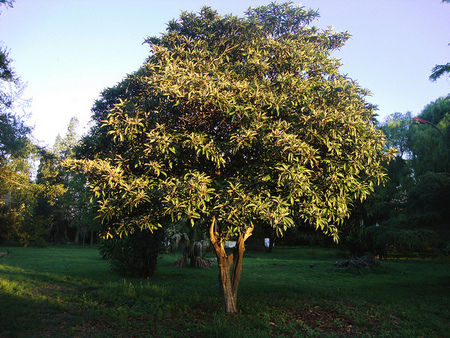
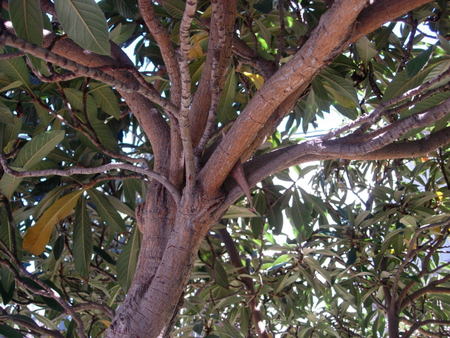
It is a large evergreen shrub or a small tree. It reaches 6–8 m in height. Crown dense, rounded, later pyramidal. Trunk twisted, covered with brown bark that becomes dark and rough at maturity. Shoots reddish-gray, covered with felt-like pubescence.
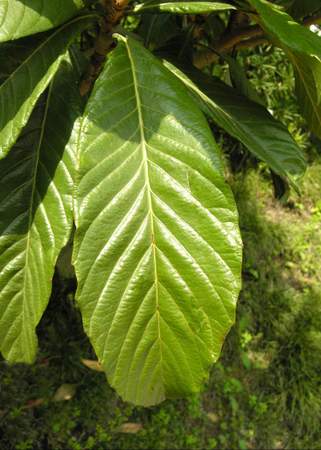
Leaves large, up to 40 cm long and 7–10 cm wide, elliptic-lanceolate, leathery, with a serrated-saw toothed margin, with impressed veins, dark green above, lighter below, covered with brownish down. Petiole short.
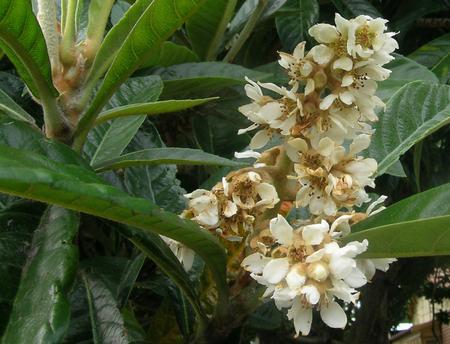
Flowers hermaphroditic, small, fragrant, about 2.5 cm in diameter, creamy-greenish in color, gathered in panicle inflorescences 3–12 cm long, which contain 60–80 flowers. Petals slightly undulate, upper surface weakly pubescent. Stamens numerous, yellowish-green. Blooms at the tips of the current year shoots. The flower scent resembles bitter almond. Flowers from November to December. In northern India it blooms from July to December–January.
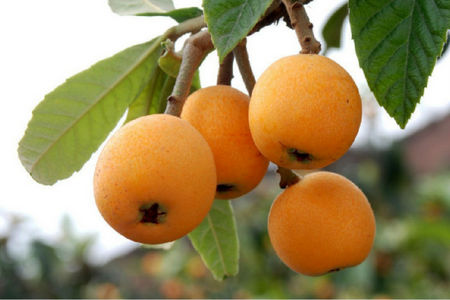
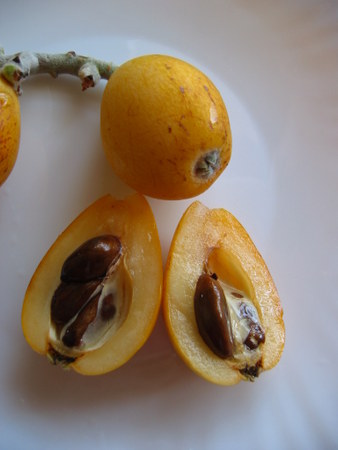
Fruits pyriform, round or flattened pomes, edible, borne in clusters of 1–8, orange or yellow, juicy, 3–10 cm in diameter. Flesh fragrant, aromatic, sweet-sour. Skin dense; when consuming fresh fruits the skin should be removed. Inside the flesh are 1–5 large seeds. Seeds large, hard, brown. Yield about 16 kg per tree. Fruits form by both cross- and self-pollination. Fruits ripen in April (May–June). Begins fruiting in 2–3 years, when grown from cuttings; from seed in 4–5 years. Main harvest obtained at ages 6–40 years.
Cultivars: Early Red, Monreale, Tanaka, Uze-fanchzhun, Large Agra, Golden Yellow, Tams Pride, Advons, Premier, Fales
Hardiness zone: 5a (−15°C). Flowers are sensitive to frost. Buds and young fruit can tolerate down to −5…−7°C.
Location: In most of Ukraine it can be grown in winter gardens or as a houseplant. Moisture-loving. Optimal annual precipitation 1200–1500 mm. Undemanding to soil, but grows well on deep, fertile soils.
Planting: Substrate: turf, leaf mold, river sand in ratio 2:4:1.
Care: Fertilize every 2 weeks is recommended. An optimal fertilizer is cow manure infusion at a ratio of 1:8.
Watering: use warm water for irrigation. Moisture-loving.
Spraying: spraying is not recommended. To remove dust, bathe the plant under a shower once a month.
Light: light-loving. With insufficient light the plant flowers later and blooms less abundantly. To improve flowering it is recommended to supplement light before and during flowering with a fluorescent lamp to extend the day length to 12 hours.
Pruning: crown shaping is not mandatory. Sanitary pruning is sufficient.
Repotting: needs annual repotting for the first 5 years. After that it is sufficient to replace the top layer of soil every 3–4 years.
Soil: quite undemanding, but prefers a substrate of turf, leaf mold, compost soil and sand in a ratio of 4:2:2:1.
Propagation: propagated by seed. For cultivars they are usually grafted onto hawthorn, common quince or the German medlar. For propagation by cuttings take last year’s shoots, cut into pieces 13–15 cm long so that each piece has 2–3 developed nodes. Leaves are cut in half to reduce transpiration. Drainage must be arranged at the bottom of the pot. Before planting the lower part of the cutting is treated with charcoal to prevent rotting. Then the cutting is planted 3 cm deep and watered with warm water. The cutting should be covered with a jar or plastic bag to retain moisture. If the room temperature is +20–+25°C, roots appear in about a month. Last year’s shoots can also root in water. For this, cuttings 25 cm long are taken, leaves are not trimmed, and placed in a wide-neck bottle. It is recommended to use a dark bottle or wrap it in black paper, since reduced light promotes root formation. After 2 months the cuttings are planted in a substrate consisting of leaf mold, brown peat and river sand in the ratio 2:2:1. The plant must be covered with a plastic bag and watered abundantly. After 2 weeks the bag can be removed.
For seed propagation use fresh seeds pretreated in potassium permanganate solution for 24 hours. Sowing substrate: leaf mold, river sand and sphagnum peat in ratio 2:1:1. Sowing depth 2–4 cm. Room temperature should be no less than +20°C; with an increase of 5–6 degrees, germination is significantly faster. After two leaves appear, seedlings can be planted into pots.
Diseases and pests: practically not affected. In India it can be damaged by Rhizoctonia and tip blight. In indoor conditions the main pests are earthworms, which, burrowing, create voids in the soil. To get rid of such pests, immerse the pot in water for a few minutes.
Uses: In warm climates it can be used in solitary and group plantings. In most of Ukraine it is grown as a houseplant or in winter gardens. Fruits can be eaten fresh or processed.