
Deciduous shrubs
Heather
Erica
A small evergreen shrub of the heath family (Ericaceae), reaching 1 m in height. It has a stem with red bark and is very branched. It has small, almost three-sided, evergreen leaves that are closely arranged in four rows. The flowers form a many-flowered, one-sided raceme-like inflorescence. The fruit of heather is a four-loculed fluffy capsule with small seeds. It blooms in July or August, and the fruits begin to ripen in September. The lifespan of heather is up to 40 years. This plant is widespread in Western and Eastern Siberia, in the European part of the CIS, and grows on poor sandy-loam and sandy soils, on sphagnum peat bogs in forests.
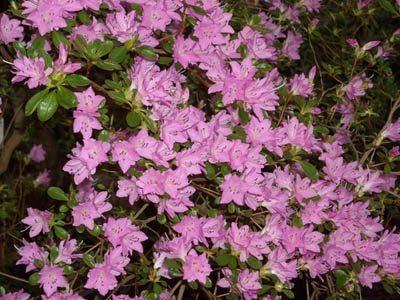
Throughout the area influenced by the Atlantic climate, heather is a characteristic plant on weak, lime-poor and low-fertility soils together with birches, pines and junipers. Its appearance indicates podzolic soil. It is insensitive to drought and heat. Heather is an ornament for any wasteland garden, indispensable for planting in front of rhododendrons and evergreen plants, and can be used as a lawn substitute. After flowering, a light pruning is recommended. All heathers are resistant to industrial atmospheric pollution.
Heather herb is considered medicinal raw material. It is harvested during flowering by cutting branches with a sickle. When collecting heather herb, it is important to leave almost half of the plants for seeding and ripening. The apical parts should be cut without disturbing the root system. The herb should be dried in the shade outdoors or in a well-ventilated room, laid out in a thin layer. Such raw material has a shelf life of about two years. It has a honey scent and a slightly bitter taste. Heather herb is generally used in medicine. It has antiseptic, anti-inflammatory, sedative and calming effects.
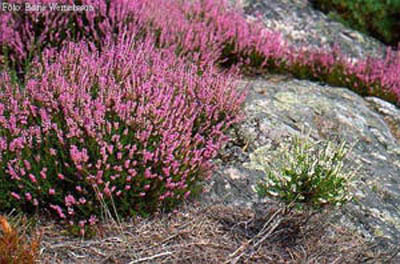
Heather herb is used externally and internally for renal colic, neurasthenia, pulmonary tuberculosis, edema, burns, allergies, colds, cough and bronchitis, chronic cystitis, dysentery, eczema, as well as urolithiasis (kidney stone disease). However, heather is not recommended for use in stomach diseases. Consultation with a physician is required. Besides its medicinal properties, this plant is used for making and flavoring liqueurs, tinctures, wine and as a tea substitute. It is worth noting that the surface of heather surpasses straw.
At the same time, heather is an excellent ornamental plant. Gardeners have selected more than 20 forms with a rich palette of leaves and flowers. In winter, heather looks superb, like a bouquet in dried form. Gardeners recommend this plant for decorating rock gardens in gardens and parks.
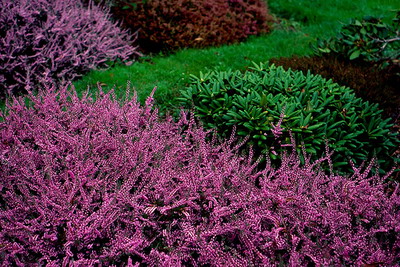
Type: herb.
Size: height up to 50 cm.
Description: broad dwarf, upright-growing shrub, slow growth rate.
Flowers / fruits: numerous small flowers, fruits inconspicuous.
Leaves: small, evergreen, scale-like or needle-like, light green in color.
Root system: superficial.
Soil requirement: does not require special soil.
Light requirements: partial shade, sun.
Winter hardiness: zone 6.
Growing conditions: well-drained, moist or fresh, light soils. Responds well to pruning. For winter, covering with spruce boughs and mulching is recommended.
Care requirements: does not require special care.