
Flowers for the garden
Eremurus or Shiryash
Eremurus
Eremurus, or Shiryash (lat. Erémurus) — a genus of perennial herbaceous plants of the Asphodel family (Asphodelaceae).
The genus includes about 60 species. Almost all of them grow in Central Asia, but individual species occur in southeastern Europe and extend eastward to the Altai and the Himalayas. Their favorite habitats — sandy plains, steppes and clayey foothill deserts. Some species rise into the mountains up to 3600 m, settling in stands of juniper. They grow on stony screes and subalpine meadows located in moist mountain river valleys.
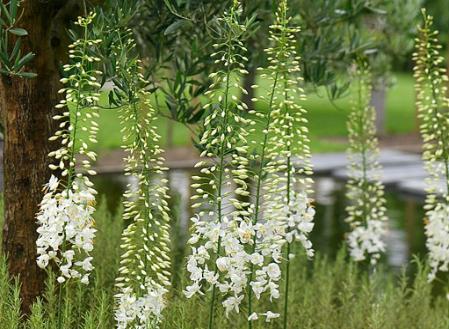
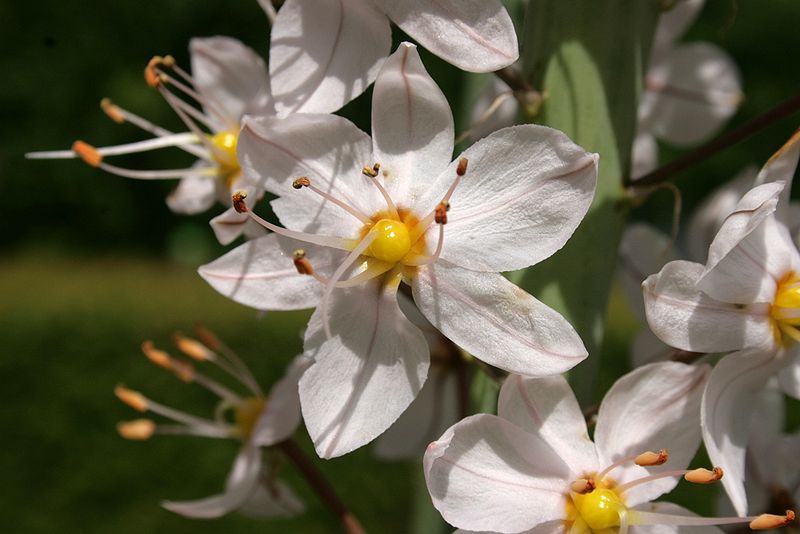
The appearance of eremuruses is very characteristic: above a rosette of dense linear keeled or triangular leaves there rises a sturdy flowering stem, sometimes over 2 m high, bearing an elongated cylindrical inflorescence — an erect raceme. The raceme length can sometimes exceed 1 m. Flowers on the raceme are arranged in a spiral, each on its own pedicel. The flower is widely open or bell-shaped and consists of six white or variously colored perianth segments (resembling petals, they are called the perianth) and six stamens with a pendulous anther at the end of a thin long filament. The pedicels change their position relative to the axis of the inflorescence as they open: they are maximally spread at full bloom. The protruding stamens, which at this time reach their greatest length, expand the display even more.
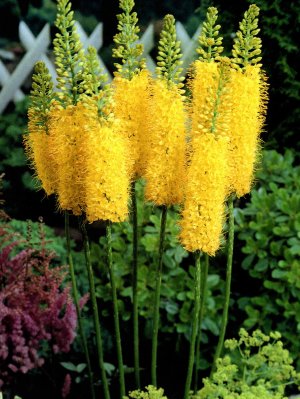
At the beginning of flowering the lower flowers of the inflorescence open first. Each flower remains open for no more than a day. The wave of flowering, the widest and most brightly colored section of the raceme, quickly moves upward. Depending on the weather, in species with sparse and few-flowered racemes 5—10 flowers open simultaneously, in species with dense inflorescences — 20—30. The number of flowers per raceme also varies by species: from 50 to 1000. Therefore the flowering period in different species can last from 10 to 30—40 days. The fruits of eremuruses, rounded dry capsules, open with three valves. The seeds are three-sided, with a wrinkled surface and a translucent wing.
The underground part of the plant is represented by a short rhizome in the form of a disc — a basal plate (donets), reaching 10—15 cm in diameter. From the basal plate radially and almost in a horizontal plane spread about 30 thick cord-like or spindle-shaped roots up to 15 cm long. They store nutrients and pull the basal plate deeper into the soil. This whole part of the plant is called the root-disk. In some species at the end of summer, in others in spring, a network of thin feeding roots forms on the storage roots, which can reach a meter in length. Each year the upper part of the basal plate grows, producing new storage roots, while the lower part with the old roots dies off by autumn.
Location: eremuruses are plants of open places. Only a few of them can tolerate slight shading. They do not require constant moisture. Waterlogging and nearby groundwater can quickly kill the plants, even those that in nature occur in relatively moist places, on subalpine tall-grass meadows. Therefore, for planting a well-lit and warmed site is chosen. Reports that eremuruses suffer from wind, break and need staking have not been confirmed in practice. Their flowering stem is sturdy enough to withstand any normal wind.
Soil: soils of their natural habitats are quite varied: dense clays of the Kazakh deserts, which during summer drought turn to rock; barchan sands of Turkmenistan; solonchaks and exposures of gypsum-bearing rocks. But they are especially attracted to stony-gravel plateaus covered with sparse shrubs. On these soils there is in any case no waterlogging; the reaction is neutral or alkaline, but never acidic. Thanks to their thick roots the plants can accumulate nutrients for many years, which allows them to live and rapidly develop a powerful above-ground part at the right moment even in sandy deserts. If they had a choice, they would still prefer nutrient-rich soils. In such conditions they grow and develop faster.
Planting: eremurus is usually purchased as a dried root-disk. When buying, check for the presence of a bud: sometimes there are several on the upper surface of the basal plate. Make sure the roots are not completely broken off. The more roots, the better. The condition of the basal plate itself is also important. A basal plate deprived of roots or with poor roots will perish. Individual roots alone are also unable to produce shoots. Breaking off the thin tips of the roots is permissible, as imported material always has shortened tips.
Prepare high and thoroughly drained beds for the plants, which is very important. It is best to place small gravel or pebbles at the base of the bed as drainage so that excess water can drain away. The depth of the soil layer should be no less than 20 cm, preferably around 40 cm. Soil reaction should be slightly alkaline or neutral. Ideally prepare a mix of fresh turf soil with one-third greenhouse soil and humus or compost, to which add coarse sand or small gravel. But most species can also grow well on any clay soils loosened with the addition of sand, lime rubble and compost.
Propagation: by seed and vegetatively (division).