
Flowers for the garden
Eranthis or Winter Aconite
Eranthis
The name comes from the Greek words 'er' — spring and 'anthos' — flower, and indicates the early flowering of most species.
The genus includes 7 species distributed in Europe and Asia. In the former USSR three species of Eranthis occur: long-stipitate (Eranthis longistipitata) — in Central Asia, Siberian (Eranthis sibirica) — in Western and Eastern Siberia, and stellata (Eranthis stellata)—in the Far East.
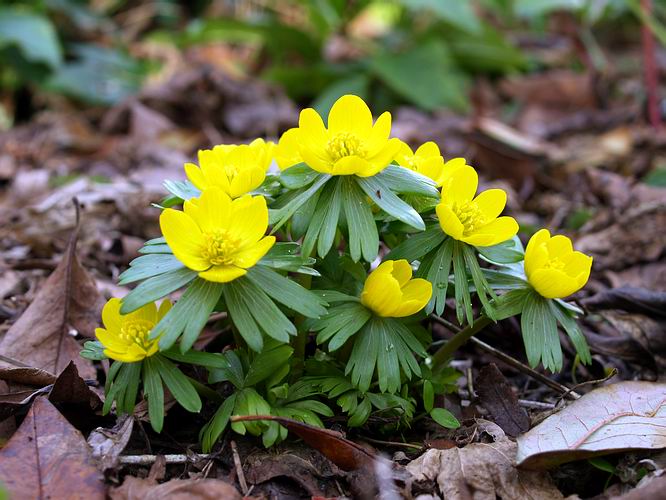
Perennial herbaceous plant with a tuberous-thickened root. Leaves basal, palmately divided, 1–2 in number. Flowers solitary, widely open. A cup-like calyx resembling a corolla consists of 5–8 dark yellow sepals up to 3 cm in diameter, while the petals of the corolla have been reduced to tiny nectaries. Immediately beneath the flower is a whorl of deeply divided large stem leaves, especially decorative when fruiting. Flower stalks up to 25 cm long. Basal leaves appear during flowering or later. Flowering occurs early in spring for 2–3 weeks. Fruits on short or long pedicels, linear or ovoid, arranged radially. Seeds small, globular, brownish-yellow.
Eranthis winter — Eranthis hyemalis (L.) Salisb.
The native range of winter aconite is Southern Europe: southern regions of France, Spain, Italy, Greece, Bulgaria. It is found in forests under deciduous trees, on mountain slopes, on well-drained alkaline soils.
The plant has an underground stem with tuber-like swellings the size of a hazelnut. Leaves basal, 1–2 in number, palmately divided. Cup-shaped six-petaled yellow flowers are grouped in 3–6 on the tips of leafless scapes 15–20 cm high. Beneath the flowers are green, leaf-like, divided, very showy bracts. Flowering is very early, at the end of winter, directly from beneath the snow. The flowers appear first, and the leaves later. Flowers open only during the day in sunny weather; in cloudy conditions the petals of the corolla fold into a house-like shape and protect the pistil and stamens from possible rain. The above-ground part of the plant dies back soon after flowering, in late May to early June. Bare ground remains, in which the underground stem with tubers and buds is preserved. In cultivation since 1570.
Eranthis long-stipitate — Eranthis longistipitata Regel
Native to Central Asia.
A species resembling E. hyemalis, but considerably smaller in size. Plant up to 25 cm tall. Flowers yellow. Flowers in May.
Eranthis stellate — Eranthis stellata Maxim. = Schibateranthis stellata (Maxim.)
Native to the Far East. It is being destroyed as a result of collection for bouquets.
Plant up to 20 cm tall. A herbaceous perennial with a leafless stem, two or three basal leaves, topped by a single flower with white petals, slightly bluish-violet beneath. Grows in deep shade of cedar-broadleaf or mixed forests, as well as at forest edges, on humus-rich and well-moistened soil. Blooms in April.
Eranthis cilicica — Eranthis cilicica schott et kotschy = E. hyemalis group Cilicica.
stellata Maxim. = Schibateranthis stellata (Maxim.)
Grows in Greece and Asia Minor. The species was introduced to Europe in 1892.
Reaches 10 cm in height, flowers larger than those of E. hyemalis. Young leaves reddish-violet, very finely and deeply divided. Stem leaves beneath the flower are also divided into narrow lobes. Blooms about 14 days later than E. hyemalis; flowering is less abundant, and the species is less hardy.
Location: light-loving, but also develop well in shaded areas. In low-lying sites winter aconites may perish under an ice crust. E. cilicica is less winter-hardy than E. hyemalis.
Soil: require light, fertile soils with sufficient moisture and alkaline reaction.
Propagation: mainly by seed, since the formation of new tubers is insignificant. Seeds are sown immediately after harvesting or in autumn in shaded places. With spring sowings seeds germinate only after stratification. Stratify for 2 weeks at 1–20 °C and 2–3 months at 2–3 °C. It is possible to grow without stratification, but the seedlings will be uneven. The most preferable is a late-autumn sowing. Seedlings appear in spring; in the first year only cotyledonous leaves are formed, which quickly die back. Therefore it may seem that the plants have died, but they manage to form small tubers that sprout the following spring and produce one true leaf each. Tubers formed the next season are dug up and planted out in the usual time. In the spring of the third year they usually flower. Winter aconites can spread by self-seeding, forming large colonies. Seedlings sometimes appear quite far from plantings, as seeds are scattered by ants.
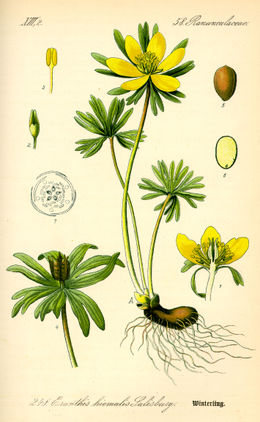
Depth of planting tubers about 5 cm, distance between them 6–8 cm. Groups of plants are especially decorative; for this 3–6 tubers are placed in one hole filled with compost mixed with a small amount of lime. Every two to three years propagation is possible by separating daughter bulbs. They are very small and resemble lumps of clay. Therefore when digging up, it is recommended to sieve the soil. To obtain more plants, during summer transplant the tuber is cut into parts, the cuts are dusted with powdered charcoal and the divisions are planted. It is better to plant tubers immediately after digging. If planting is delayed, they are stored in moist peat or sand, otherwise they dry out and will not sprout the following spring. The latest planting time is the end of August. In suitable conditions Eranthis can flower well in one place for 4–5 years. It is important after the above-ground parts have died back not to allow weeds to overgrow the area, and also not to trample this spot.