
Indoor plants
Epipremnum, Scindapsus
Epipremnum
One of the most common houseplants, which demonstrates how confusion sometimes arises with names. In Britain it is popularly called «devil's ivy», in the USA it is known as «golden pothos», and for the botanist it is Epipremnum aureum! It is sometimes thought to be difficult to grow, but if you follow the rules you should have no problems. In some varieties most of the leaf is white or yellow - such plants are better grown in a greenhouse or hothouse, in a room they do not fare well.
The genus name, translated from Greek, means "on trunks": referring to its growth habit. 15 species, distributed from SE Asia to Malaysia, Japan, the Philippines and Australia. Evergreen climbing plants. Leaves entire or pinnately divided, on a long petiole. Inflorescence - a spadix. Flowers bisexual. Found in the tropical regions of the Indo-Malayan area. The genus contains 25 species.
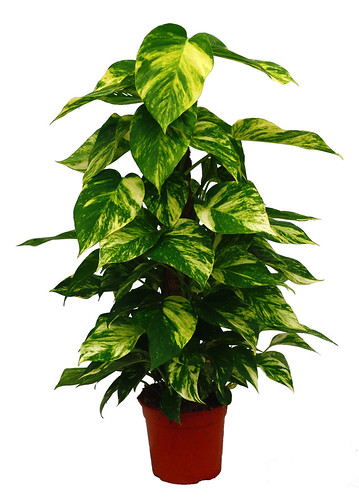
Location: grows at room temperature year-round, which in winter should not be below 16 degrees.
Light: Bright light
Watering: Epipremnum is undemanding and will grow even in a shaded spot, however a location that is too dark causes the leaves to become entirely green and their growth to cease. Keep the soil moderately moist; the plant tolerates dry air, but this does not benefit it.
Humidity: Moderate. For spraying use only soft cool water, otherwise spots will form on the leaves.
Care: Epipremnum grows excellently on "moss poles", as the ability to root in moss most corresponds to its natural way of life. In addition, this vine prefers a temperature of 15-20°С, regular moderate watering and, from April to September, fertilizing every two weeks.
Propagation: Plants are propagated mainly by tip cuttings with 2-3 leaves, as well as by dividing a shoot into parts (provided it has at least one leaf, from whose axil a shoot subsequently develops). Cuttings root very easily in a propagation box, directly on the bench and even when conventionally planted in pots (1-3 per 7-9-centimeter pots), at a substrate temperature not less than 22° (preferably 24°). Rooted plants are planted in 7-centimeter pots. Soil mixture composition: humus - 1 part, leaf mould - 1 part, peat - 1 part, turf soil and sand - 1/2 part each. Watering abundant; in spring and summer regular spraying with water is necessary. Cuttings root within 15-18 days. After rooting, during growth the tip cuttings are pinched once to stimulate branching. The smaller the size of the cutting, the more time is required to grow developed trailing plants. In winter the greenhouse temperature should be not less than 18° for young plants and 14° for adults. On sunny days the plants need shading. As the rootball becomes entwined with roots young plants are shifted into 9-10-centimeter pots. The soil mixture composition is the same. They are often planted several together in bowls for decoration and used as hanging plants, for arranging shop windows and room windows. The plants are light-loving, and leaf coloration and growth depend on light intensity.
Repotting: as needed in spring.
Pests - scale insects. With overwatering the roots rot; from excess light leaves bleach.