
Indoor plants
Epidendrum
Epidendrum
Orchid family. Florida, Central America, the Caribbean islands, Bolivia and Paraguay
Genus Epidendrum - genus Epidendrum L. One of the large genera which includes up to 1000 species. Like the previous one, it is not very clearly defined taxonomically; some authors assign certain Epidendrum species to other genera. Despite their number, not all species are of interest to growers. Epidendrums inhabit various regions of the American tropics and subtropics - from Florida to Argentina. These are sympodial orchids of varied appearance. Some have well-developed bulbs, while others have reed-like stems. Various inflorescences bear from 1-2 to numerous, usually small, flowers of different colors. A common feature of all epidendrums is the fusion of the lip with the column over a large portion. Many species are suitable for indoor cultivation but require good lighting and supplementary light in winter. Species: E.cochleatum, E.ilense, E. mariae, E. parkinsonianum, E.prismatocarpum, E.pseudepidendrum, E. radicans.
Undemanding plants. They are grown on the usual substrate for epiphytic orchids and kept in a cool, well-ventilated room. They are propagated by aerial offshoots.
Epidendrum ciliare L. (fringed Epidendrum) An epiphytic or epilithic plant with strongly elongated spindle-shaped bulbs sitting on a creeping rhizome. Leaves fleshy or leathery, lanceolate, glossy. Flowers over 10 cm in diameter, 5-7 in a racemose inflorescence emerging from the leaf axil, fragrant, pale yellow-green with a white lip. Sepals and petals very narrow, long, linear, widely spread. The lip is shorter than them, deeply three-lobed: the lateral lobes are broadly falcate, the margins deeply and unevenly cut or fringed, the middle lobe is very narrow, almost thread-like, entire. Blooms in November-January.


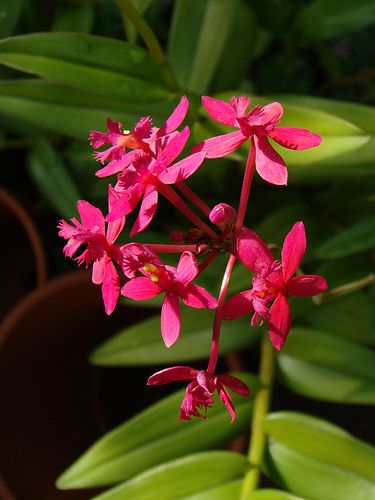
Epidendrum radicans Pav. (rooting Epidendrum) An epiphyte with long, up to 2.5-3 m, thin, densely leaved branched stems, often forming huge tangles together with numerous aerial roots. Leaves sessile, oblong, stiff. Flowers small, red, orange, more rarely yellow, in short, sometimes umbel-like racemes at the stem tips. Sepals and petals narrow and spreading. The lip, fused to the column, appears as its continuation. Its middle lobe is deeply split into two, so the lip appears four-lobed. All four lobes are fringed at the ends. The number of flowers in an inflorescence can reach 50. No more than 10-12 bloom at once, so flowering is prolonged.
Features: ensure good ventilation and that nighttime temperatures drop slightly. When buying an orchid, find out the conditions it requires.
Location: bright diffused light without direct sunlight. Species growing in mountainous areas prefer cool conditions, however most orchids are grown in heated rooms at temperatures: summer - about 20°C, winter - about 16°C.
Lighting: Bright light
Watering: during the growth period the medium should be kept slightly moist at all times, and the plant should be regularly misted. During rest periods watering is reduced, but ensure the medium does not dry out.
Air humidity: Moderate
Feeding: during the growth period apply flowering fertilizer every three weeks at half the concentration recommended in the instructions.
Propagation: species with pseudobulbs are propagated by division of the plant.
Repotting: required once every four years. Repot at the beginning of the growth period. Use orchid substrate.
Possible problems: susceptible to scale insects and spider mites. Avoid overwatering.