
Deciduous shrubs
Crowberry
Empetrum
Crowberry (lat. Émpetrum) — a genus of evergreen, low-growing, creeping dwarf shrubs of the Heath family with needle-like leaves and inconspicuous flowers; widely distributed in the Northern Hemisphere, and also found in South America. Used as ornamental plants.
The genus name comes from the Greek words en "on" and petros "rock" — referring to the plant's typical habitat.
Russian folk names for the plant include bagnovka, voronika (after the berry color), bearberry, p’yanka, ssykha (due to the diuretic action of the berries; the name vodyanika was likely given because of the small amount of flesh and large amount of insipid juice), black grass, shiksha, siksa.
Names in other languages: English Crowberry, German Krähenbeeren, Finnish Variksenmarja, French Camarine. The literal translation from English, German and Finnish is crow berry.
Crowberry is widespread across the Northern Hemisphere — from temperate zones to the subarctic (Russia, continental Western Europe from Finland to Spain, the United Kingdom, Iceland, Greenland, USA, Canada, Japan). Typical habitats are sphagnum bogs, moss-lichen and rocky tundras, coniferous (usually pine) forests, where it often forms a continuous cover. Crowberry also occurs on open sands (spits, dunes), on granite outcrops; in mountains it grows in the subalpine and alpine belts.
Crowberry is a prostrate shrub whose height rarely exceeds 20 cm, while shoot length can reach 100 cm.
It grows in patches — tussocks, each of which represents a single individual. The stem is dark brown, densely covered with leaves, hairy-brown when young; it is highly branched and the branches form adventitious roots. A tussock gradually occupies more and more space while branches in its center die off. Occasionally extensive stands of crowberry occur — so-called voronichniki or shikshyovniki.

Like some other members of the Heath family, crowberry depends on symbiosis with fungi: it obtains certain mineral nutrients from them in exchange for photosynthates.
Twigs up to 1 m long, mostly concealed in the moss cushion, are covered with punctate glands of white or amber color.

Leaves alternate, small, with very short petioles, narrowly elliptic, 3—10 mm long. Leaf margins are bent downward and almost closed, making the leaves resemble needles and the plant itself resemble a dwarf fir. Each leaf remains on a branch for up to five years.
Plants are monoecious or dioecious. Flowers axillary, inconspicuous; with a double actinomorphic perianth, with three pink, red or purple petals and three sepals; solitary or in groups of two to three. Staminate flowers have three stamens. The stigma is radiate, the ovary superior, with 6 to 12 locules. In Europe crowberry flowers in April-May. Pollination is by insects: its flowers are visited by butterflies, flies and bees.
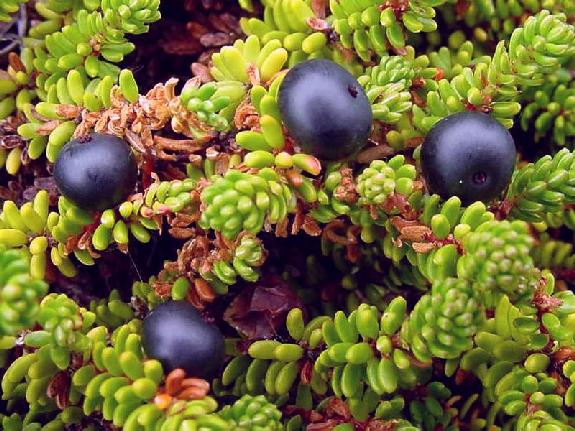
Fruit is a black (with a glaucous bloom) or red berry up to 5 mm in diameter with a tough skin and hard seeds, externally similar to a blueberry. Ripens in August. The juice is purple. Berries remain on the shoots until spring. The soft part of the berries is edible, but their low sugar and acid content makes them rather insipid in taste.

Location: grows slowly, sun-loving.
Soil: prefers sandy and peaty soils, does not tolerate compaction or waterlogging.
Planting: plants are set at a distance of 30 - 50 cm from each other. Planting depth 40 cm. The root collar is buried 2 cm into the soil. Prepare a soil mixture of turf soil, peat and sand in equal volumes. Make drainage of crushed stone and sand 10 cm thick.
Care: fertilize the plants once per season, applying 50 g of nitroammophoska per 1 m2. Mulch young plantings with peat in a 5-6 cm layer. Fully winter-hardy, additional covering is not required as it overwinters under the snow. Pruning should be cautious and minimal, mainly removing dead shoots.
Propagation: by seeds and layering.
Uses: as a groundcover plant in various garden compositions.