
Encyclopedia - Plants for ponds
Elodea canadensis (Canadian waterweed)
Elodea canadensis
Elodea canadensis, anacharis, waterweed (lat. Elódea canadénsis) — an aquatic plant; a species of the genus Elodea (Elodea).
The plant's native range is North America, where it grows abundantly in standing and slow-flowing waters: ponds, deep ditches, river backwaters, oxbows, and canals. It is an invasive species in Europe, Asia, Africa and Australia.
It sends out long, heavily branched stems that grow extremely rapidly and often reach lengths of more than two metres. The stem, initially floating, easily takes root, producing long, up to 40 cm, white roots. The stems are very long, thin, brittle and covered with oblong-linear leaflets, which are arranged in fairly dense whorls of three leaves each.
>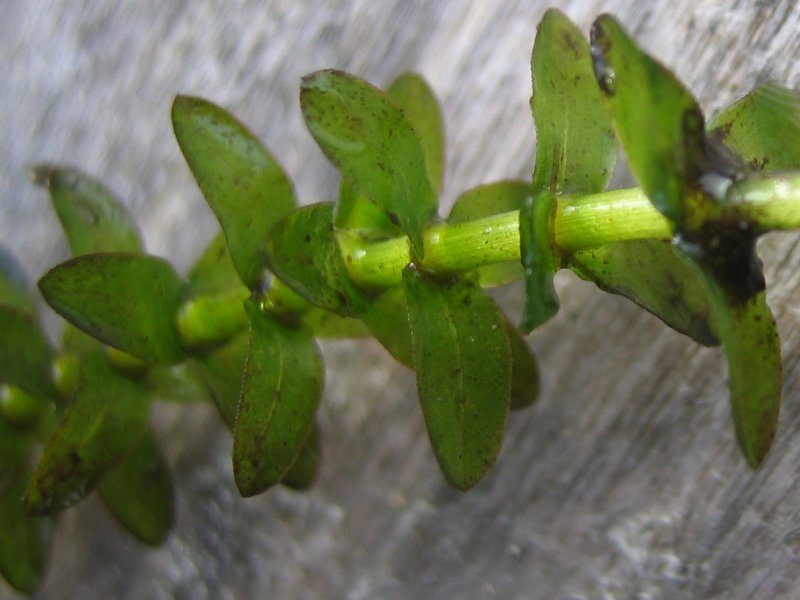
The leaflets are bright green, translucent, from oblong-ovate to linear-lanceolate, slightly curled, acute, finely serrated along the keel. In the apical parts of the stem the leaflets are always lighter in colour than those lower down.
The flowers are of two kinds: female and male, and are borne on separate plants. Female flowers are solitary and small, consist of six petals, three inner and three outer, and sit on long filiform pedicels; their three stigmas are bright raspberry-coloured and fringed. There are three sepals, which are reddish or greenish. These flowers open only after the pedicel reaches the water surface. Male flowers are almost sessile, with nine sessile anthers that detach from the parent plant during flowering, or are borne on an elongating pedicel reaching the water surface. In Western Europe and in the CIS countries, plants with male flowers are not encountered; only female specimens are present.
The bright green, metallic-tinged shoots of elodea cover the bottom and, rising to the very surface of a shallow body of water or an aquarium, form a dense emerald network in the water, making elodea one of the decorations of the underwater landscape.
Habitat: Elodea grows everywhere, especially abundant in standing waters and in bodies of water with slow current. It grows well at temperatures of 16—24 °C, in both hard and soft water, at depths from 20 to 300 cm. It prefers bright lighting, but can tolerate moderate shading.
Care: If it becomes too overgrown, some plants can be removed from the pond using rakes (including fan rakes) or other tools. In small ponds and aquariums that contain fish, elodea should be removed carefully, as its sap is poisonous and can cause the death of fry. In addition, the sap can inhibit the growth of other aquatic plants. Removed plants can be used for compost or as feed for birds, especially ducks.
Propagation: vegetatively, using parts of the plant at least 20 cm long. It is best to plant young specimens at the end of May in the pond substrate in clumps of 5—10 stems, at a depth of 60—70 cm.