
Flowers for the garden
Echinacea
Echinacea
Echinacea (lat. Echinacea) — a perennial plant, a genus from the family Asteraceae, or Compositae (Asteraceae).
The Latin name of the genus is derived from the Greek word 'echinos' — spiny. Native to the eastern part of the USA. Cultivated as an ornamental and medicinal plant.
The most studied and well-known species — Echinacea purpurea (Echinacea purpurea), is used in folk medicine, pharmacology and ornamental gardening.
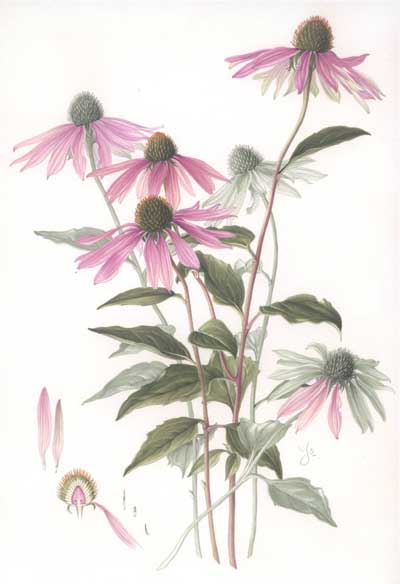
A perennial rhizomatous herbaceous plant. Stems erect, rough, up to 150 cm tall. Basal leaves on long, winged petioles, broadly ovate, serrated, forming a rosette; stem leaves — sessile, lanceolate, rough, arranged alternately.
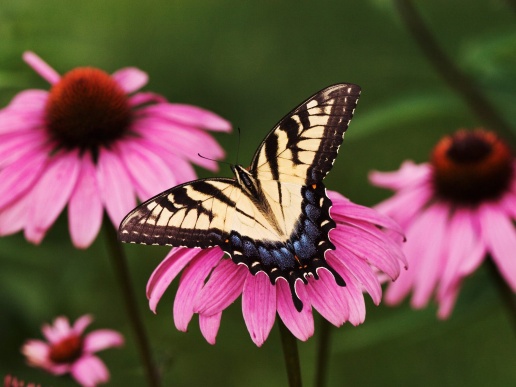
Inflorescences – heads (capitula), large, up to 15 cm in diameter. Ray florets purple-pink, pointed at the tip, up to 4 cm long; disc florets — reddish-brown. Blooms from July to September for about 60 days. Produces fruit. Attracts butterflies.
In cultivation since 1692. The most commonly distributed cultivars are:
'Гранатштерн' ('Granatstem') — Plant up to 130 cm tall. Heads large, up to 13 cm in diameter. Ray florets purple, with two teeth at the tip, somewhat drooping; disc florets — brown, located on a convex receptacle forming a hemispherical "cone" 4 cm in diameter. Produces fruit.
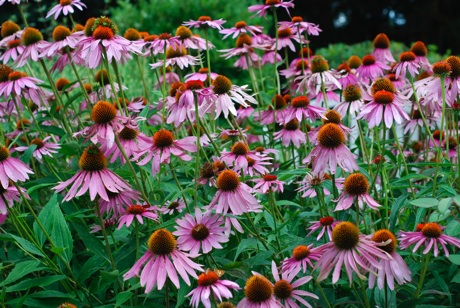
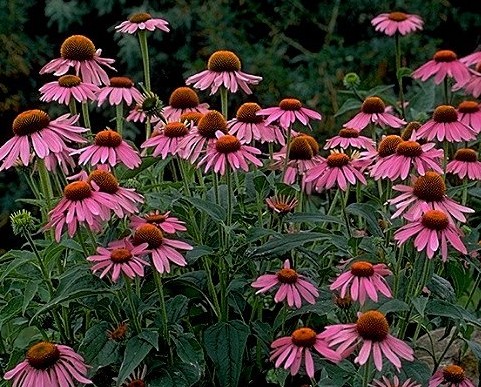
'Зонненлах' ('Zonnenlach') — Plant up to 140 cm tall. Heads up to 10 cm in diameter. Ray florets dark purple, up to 3.5 cm long, lanceolate, ending in 2-3 small teeth; disc florets — brown, sit on a convex receptacle and form a "cone" 3.5 cm in diameter.
'Кинг ('King') — Stems 100-120 cm tall. Heads 12-13 cm in diameter. Ray florets purplish-red; disc florets — brown. Produces fruit.
Location: grows well in open sites, in slightly shaded places it can become leggy. Prefers fertile, calcareous soils.
Care: warmth-loving; in snowless or severe winters it may be killed by frost. After flowering it should be cut back severely. It can grow in one place for 3-4 years, after which it requires transplanting as it loses its decorative appearance.
Propagation: mainly by dividing the clump, which should be done every 2-3 years, and also by seed.