
Flowers for the garden
Indian Duchesnea, Indian cinquefoil
Duchesnea indica (Andr.) Focke
Indian cinquefoil (lat. Potentilla indica, traditional obsolete names — duchesnea, or Indian strawberry, or false strawberry, Duchesnea indica) — a species of herbaceous plants that externally resemble strawberries in their leaves and false fruits. Although in many reference works the plant is placed in the genus Duchesnea (separated from Potentilla) (for example, on the Germplasm Resources Information Network website), genetic studies indicate that it is more correct to assign the plant to Potentilla.
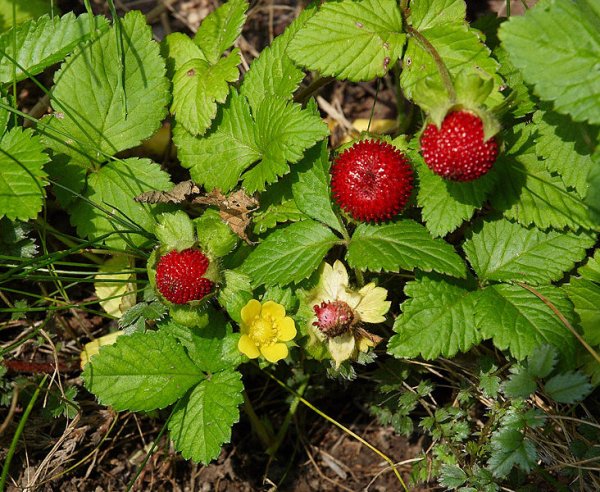
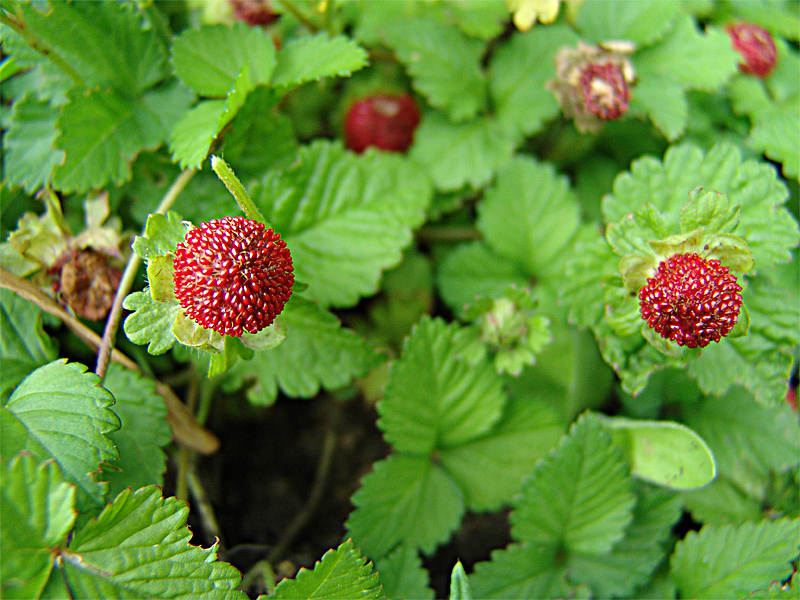
Six species are known, originating from Asia. Perennial, herbaceous plants with a short rhizome. Stems thin, creeping, rooting at the nodes, 30-90 cm long. Leaves dark green, trifoliate, on long petioles, gathered in a basal rosette. Flowers solitary, on long peduncles, cream or yellow. Flowers from May throughout the summer. Fruits red, fleshy up to 1.5 cm in diameter, but entirely inedible. Hardy. In cultivation since 1804.
Location: prefers partial shade, but with sufficient watering also grows well in sunny sites.
Soil: undemanding, grows on practically any soil. Moisture-loving, yet drought-tolerant.
Care: frost-hardy, but may suffer in snowless winters, therefore covering with coniferous boughs is recommended.
Propagation: by division of the clump, by pieces of rooted stems and by seeds. When grown from seed it flowers in the first year. For more uniform germination post-sowing freezing is recommended.
Uses: for decorating rock gardens and slopes. Decorative for its fruits. Suitable for container cultivation.
Zone: 5