
Indoor plants
Dionaea or Venus flytrap
Dionaea
Native — North America, areas of marshy meadows and sphagnum bogs.
A perennial herbaceous carnivorous plant. Because of the difficult conditions of its natural habitat, this plant supplements the missing nutrients required for normal growth by capturing insects.
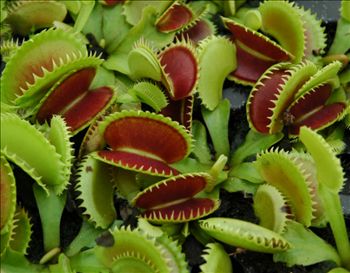
The leaves of Dionaea, arranged in a rosette, fold along their heart-shaped veins. Along their edges are marginal teeth, and on the upper surface of the leaves there are bristles. When insects touch these bristles, the leaves snap shut, trapping the insects. Inside the leaves are small glands that secrete enzymes and formic acid, which ensure the digestion of the insects. The leaves of Dionaea are short-lived.
The flowers are small and white, borne in a paniculate inflorescence. The process of catching insects is very interesting and fascinating.

The Venus flytrap's trap consists of two halves or lobes, somewhat reminiscent in structure of the opening shells of mollusks. Along the edges of the lobes there are two rows of teeth. Along the rim of the lobes, along the inner row of the trap's teeth, glands are located. They produce and secrete pleasantly scented nectar that attracts insects into the trap. Each of the two inner flat surfaces of the Dionaea trap is equipped with three trigger hairs. If insects repeatedly touch these hairs while feeding on the nectar, the trap begins to close.
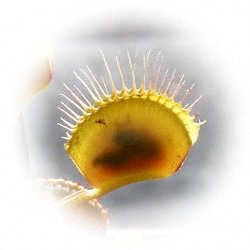
At first the Venus flytrap's trap only partly closes, and insects can still move back and forth within the trap. If the insect is small, it has a chance to escape being eaten by slipping through the gap between the teeth. When this happens, stimulation of the trigger hairs ceases — and the trap reopens fully (after about a day). This response mechanism is essential for Dionaea: it helps prevent wasting time on a "false triggering" of the trap by external disturbances (for example, a raindrop, sticks blown in by the wind, small twigs, or insect exoskeleton fragments).

But if a beetle trapped in the Dionaea trap cannot escape, stimulation of the trigger hairs continues and the trap closes more tightly. The process of digestion begins. From the glands located on the inner surfaces of the trap lobes, digestive juice is abundantly secreted — the insect becomes fully immersed in this fluid. The trap remains closed for several days. When it finally reopens, only the undigested chitinous shell of the former insect remains. Each Venus flytrap trap is capable of about three digestive processes, after which it dies.
Light: bright light and several hours of sun.
Watering: the soil should always be moist; do not allow it to dry out. Water with rainwater or distilled water.
Temperature: summer 22-27 °C, but not above 35 °C. Winter 3-7 °C.
Air humidity: humidity 40-70%.
Propagation: by division, by seeds.
Pests, diseases: aphids, spider mites, gray mold, sooty mold and bacterial infection — this occurs when the trap cannot digest a caught insect and begins to rot.