
Flowers for the garden
Dimorphotheca
Dimorphotheca
Dimorphotheca (lat.Dimorphotheca) - a genus of annual and perennial herbaceous plants of the family Asteraceae native to South Africa. The genus comprises up to 20 species.
The name derives from the Greek words 'di morphos' — two-formed and 'theke' — container, which is explained by the presence of two types of fruits in representatives of this genus.
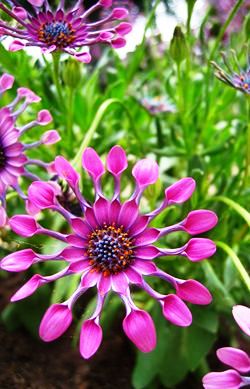
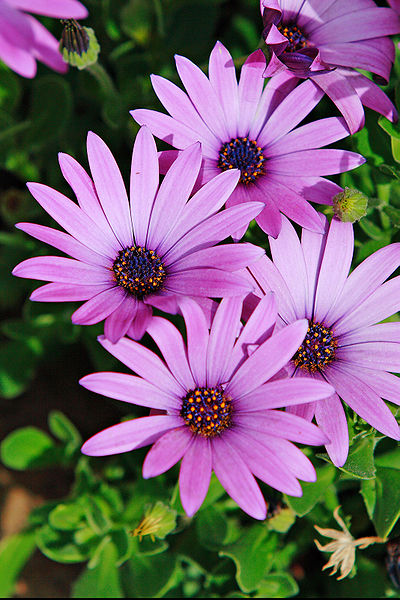
Plants annual and perennial, herbaceous or semi-shrubby, with ascending stems.
Leaves — entire, narrow, toothed or pinnately divided, gathered in a basal rosette or arranged alternately.
The ray florets are white, yellow, orange or purple above, and purple or crimson beneath; the tubular (disk) florets are small, yellow or dark brown, gathered in solitary inflorescences — terminal heads up to 5–7 cm in diameter. Flower stalks are long. In cloudy weather and at night the inflorescences are closed. In dry weather the inflorescences open early in the morning and close at 4–5 p.m. The fruit is a discoid, flattened, grayish-yellow achene.
In cultivation:
Dimorphotheca hybrid - Dimorphotheca hybridum
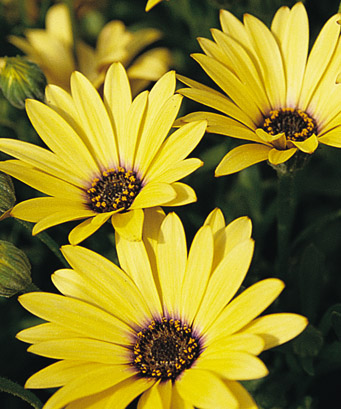
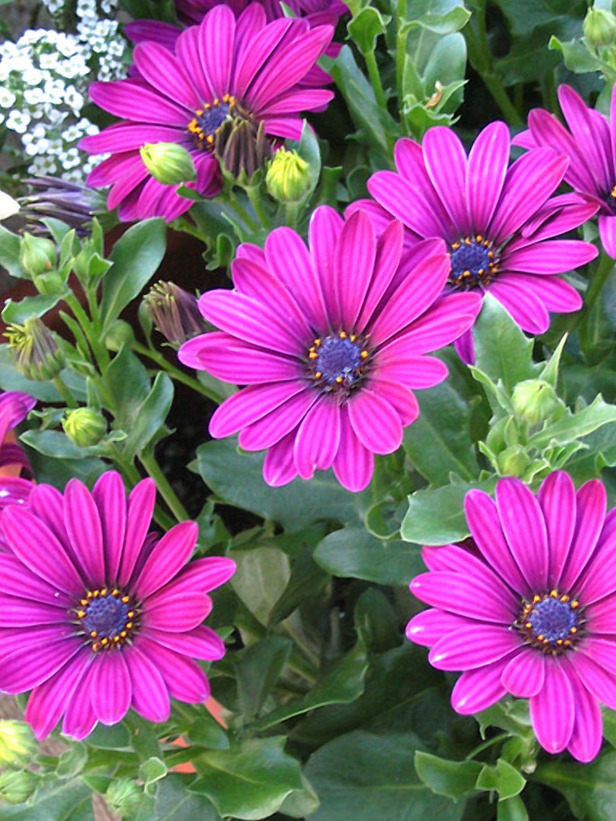
Obtained by crossing two species: Dimorphotheca pluvialis and Dimorphotheca sinuate. An annual plant. The bush is erect, densely branched, about 30–40 cm tall. Leaves alternate, dark green, narrow, toothed or entire. Inflorescences up to 7 cm in diameter. Ray florets glossy, in various colors: white, yellow, bright orange, pink, lilac; disk florets — yellow. Fruit — a disc-shaped, flattened achene.
Dimorphotheca sinuata — Dimorphotheca sinuata
An annual, erect plant branching from the base, forming a densely leafy bush up to 40 cm tall. Leaves elongated, sinuate at the margin, intensely green, brittle, glabrous.
Inflorescences very graceful, large heads 5–7 cm in diameter with bright orange, glossy ray florets with a dark-brown spot at the base; a small disk of black-brown tubular florets. Flower stalks sturdy, slender, pubescent. Blooms abundantly from mid-June to September. Self-seeding.
Dimorphotheca pluvialis — Dimorphotheca pluvialis = Dimorphotheca annua
An annual herbaceous plant with erect or prostrate stems up to 20 cm tall. Leaves elongated, pubescent. Inflorescences on long peduncles with graceful ray florets, white or creamy above, purple beneath; tubular florets golden-brown, forming a small disk. Flowers and leaves aromatic.
Location: require a well-lit warm position, preferably a south-facing exposure.
Soil: undemanding, however they achieve greatest ornamental effect on very loose, well-drained but nutrient-poor soil. On fertilized sites plants develop vigorous bushes at the expense of flowering.
Care: is limited to removing spent inflorescences to stimulate additional flowering.
Propagation: by seed; sowing is carried out in early April in cold frames. Flowering begins 6–7 weeks after seedling emergence and lasts 35–65 days.