
Flowers for the garden
Dicentra or Broken Heart
Dicentra
The name comes from the Greek words 'dis' — twice and 'kentron' — spur, which can be translated as 'two-spurred', referring to the presence of two spurs on the petals of the corolla. The French call this plant "Coeur-de-Jeannette", the Germans "flower of the heart", and we call it "broken heart". Other names encountered: dilictra, bull's head.
The plant was introduced to Europe in 1816 from Japan. The legends and beliefs associated with it are related to the heart-shaped form of the flowers and their drooping habit. According to a French legend, Jeannette fell in love with a young hunter who helped her when she was lost in the forest; a few days later she met her rescuer again, but in a different... The girl's heart broke, turning into a dark red flower. All the beliefs involving dicentra relate to love and marriage: if you pick a flower on the way home and tuck it into your bosom — you will meet a bridegroom (Germany), etc.
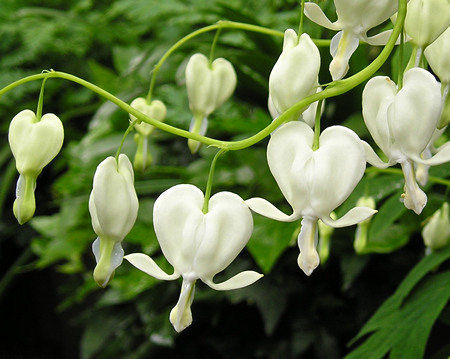
The genus includes up to 20 species growing in the Far East, in eastern China and North America. Beautiful perennial plants from 30 to 100 cm tall with a fleshy rhizome extending deep into the ground. The leaves are very decorative, delicate, pinnately divided, green with a glaucous tint, on petioles. The flowers are pink or reddish, nodding, heart-shaped, up to 2 cm in diameter, slightly compressed in one plane, gathered in terminal, arching, nodding racemes that rise above the clump; the corolla has two spurs. The fruit is a capsule. Seeds are slightly elongated, black, shiny, and remain viable for 1-2 years.
Dicentra was once very popular with gardeners, who gave this plant the name “broken heart”. Over time it yielded to other garden plants that became fashionable. Now its time has come again, and alongside the long-known pink-flowered clumps, a form with white “hearts” has appeared in gardens. Not every person will call a plant “magnificent”, but dicentra fully justifies that name.
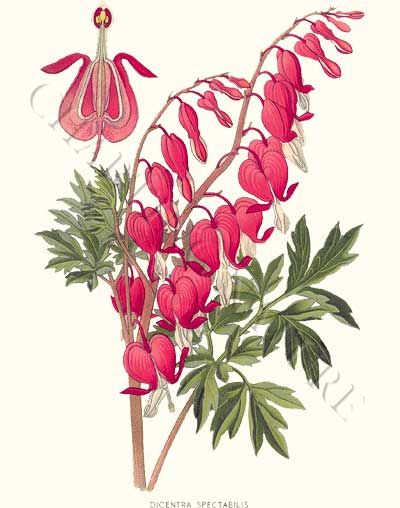
Dicentra spectabilis, or Broken Heart — Dicentra spectabilis (L.) Lem.
In the wild it is found in eastern China and on the Korean peninsula. A rhizomatous perennial. Stems are erect, branched, fleshy, up to 100 cm tall. Leaves large, petiolate, pinnately divided, mostly basal, green above, glaucous beneath, glabrous. Flowers pink, flat, heart-shaped with curved petals, quite large, up to 3 cm in diameter, gathered in one-sided, arching, racemose inflorescences up to 20 cm long. Blooms in May — early June for 30-35 days. After flowering the above-ground part dies back. Hardy, but may be damaged by late spring frosts. Does not tolerate shallow groundwater or summer drought. In the latter case it may go dormant prematurely.
In cultivation since 1810. There is a white-flowered form (f. alba), shorter than the typical species. A novelty of 2004 was a form with pink flowers and golden-yellow leaves 'GoldHat' ('GoldHeart').
Location: both sunny sites and shaded corners of the garden are suitable for planting, although flowering will start slightly later in shade.
Soil: undemanding regarding soil. Good results can be obtained on light, fertile soil worked to a depth of 20—25 cm, moderately moist. In wet places the thick fleshy roots rot. The planting site should be prepared in autumn by digging the soil to a depth of 30—40 cm and enriching it with humus (3—4 kg/m2) and a complete mineral fertilizer (20 g per 10 l of water).
Care: not burdensome. During the season it is fed 2-3 times with mineral fertilizers, weeds are removed and the soil around the clumps is occasionally loosened. During dry periods it needs watering. Timely removal of spent racemes prolongs the flowering period. The delicate flowers and leaves of dicentra may be damaged by spring frosts, which are not uncommon in temperate regions at that time. To preserve it when an unfavorable forecast is expected, cover the clump at night with a light nonwoven material (such as lutrasil), which will protect it from low temperatures and will not break the shoots with its weight. The cover is removed in the morning. In autumn the yellowed above-ground part is removed, leaving stumps 3-5 cm high, and the soil under the clump is mulched with dry peat to a layer of 5-8 cm. Hardy, but preventive mulching is desirable.
Propagation: by division of the clump, by green and root cuttings.
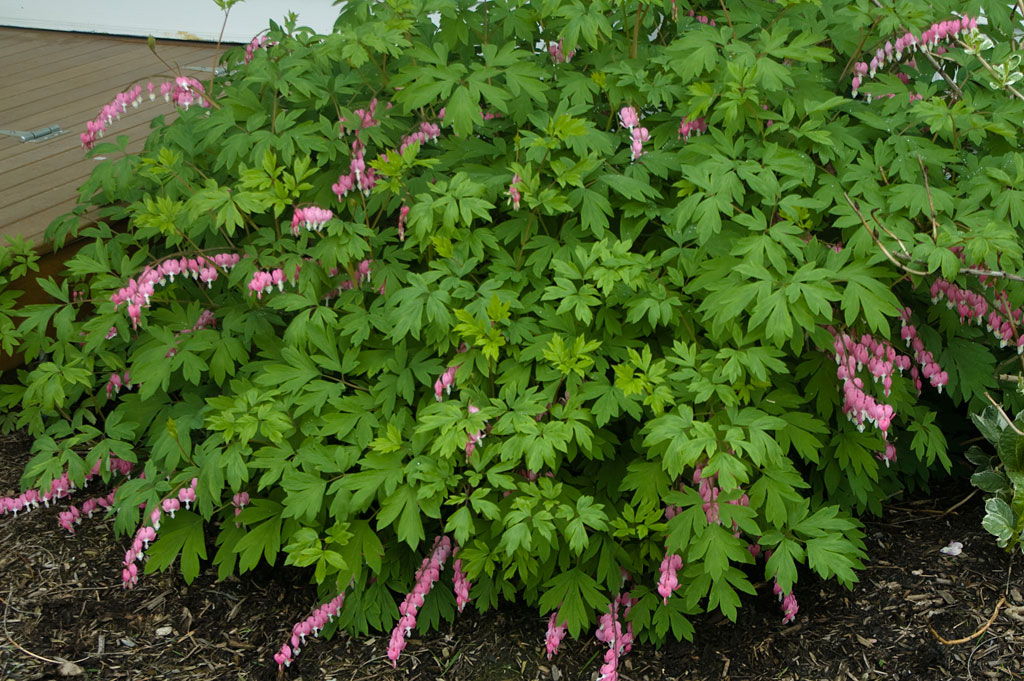
Clumps are divided and transplanted in spring (late April — early May) and in autumn (September). Without transplanting they can remain in one place for 5-8 years. The rhizomes are very fragile and require careful handling when digging up and dividing. Sections 8-10 cm long with 3-4 shoots are prepared and immediately planted in their final position. For a single planting 2-3 divisions are placed in one hole at a distance of 30-40 cm. This allows a lush clump with several flower stalks to be obtained in the first year.
For cuttings use young shoots, which for Dicentra spectabilis are taken in early spring, while for other dicentras they may be taken throughout the summer. Pieces of roots of various sizes (10-20 cm) can also be used as cuttings. They are planted in light, moist soil, preferably in a cold frame, to a depth of 10 cm and pressed in. The soil is kept moist. Shoots appear in 3—4 weeks. Rooted cuttings are moved to their permanent place in the spring of the following year.
Seed propagation is not recommended. If necessary, sowings are done in autumn or in February-March. The optimum temperature for germination is 18°C. Seedlings appear 20-30 days after sowing. Seedlings are pricked out and covered with leaves for the winter; they flower in the third year.