
Flowers for the garden
Carnation
Dianthus
Synonyms: Dianthus
Carnation (Dianthus L.) – a genus of perennial plants of the carnation family (Caryophyllaceae). It was first described by Carl Linnaeus in 1753 in Sp. Pl. 409. It was mentioned earlier in the works of the philosopher Theophrastus, who gave the name meaning in Greek “divine flower”, the flower of Zeus, Jupiter. Long cultivated.
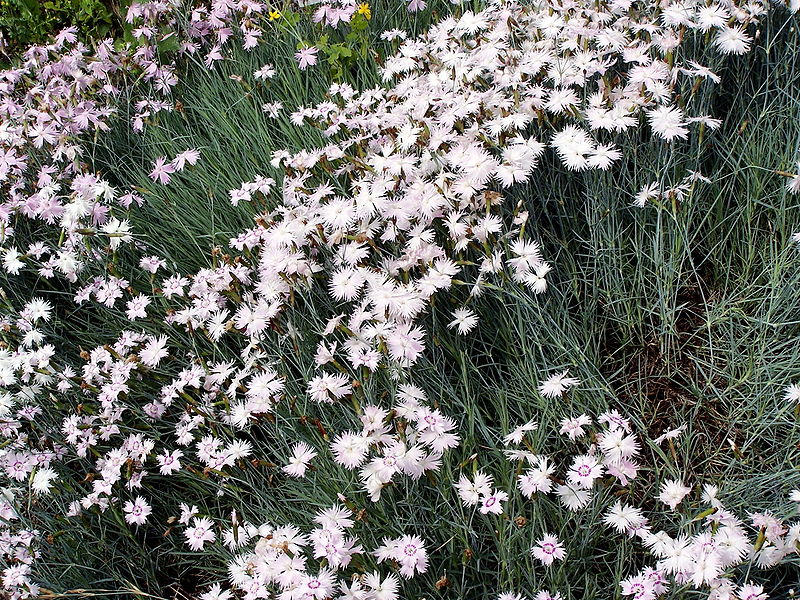
Garden carnation
Occurs in North America, Eurasia (from the Balkans to Asia), and Africa. Introduced to South America, the Hawaiian Islands, and Australia.
They are perennial and annual herbs and subshrubs with herbaceous stems, slightly woody at the base, reaching up to 70 cm in height. Stems erect or ascending, branched or simple, smooth, often with a glaucous bloom, thickened at the nodes.
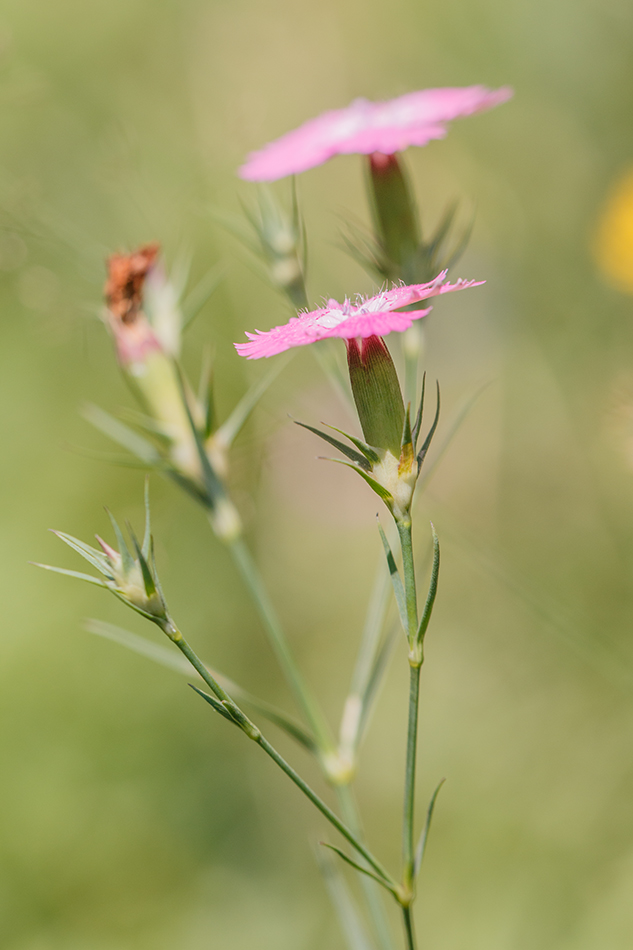
Caucasian carnation (piebald Dianthus). Author I. Mikheev
Leaves opposite, narrow, linear or linear-lanceolate, rough-edged, gray-green or glaucous.
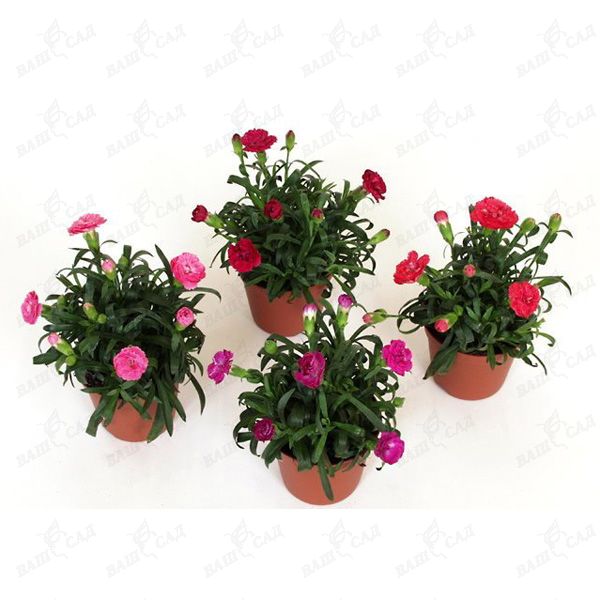
Dianthus Annet
Flowers are borne in terminal or apical inflorescences, solitary or in groups of 2-3; in some species dense, head-like, in others loose, semi-umbellate or almost corymbose. Rarely the inflorescences are surrounded by a involucre of closely set bracts. Flowers are usually purplish-red, white or pink, less often yellow, and fragrant. The calyx is gamosepalous, cylindrical, 5-toothed, with 1-3 pairs of partially imbricate, narrow, awn-tipped bract scales at the base. Petals 5, free, with a widely spreading blade narrowed into a long claw. The upper edge of the petals is usually toothed or nicked, often fringed. Stamens 10, carpels 2. Blooms in summer, less often in May or September.
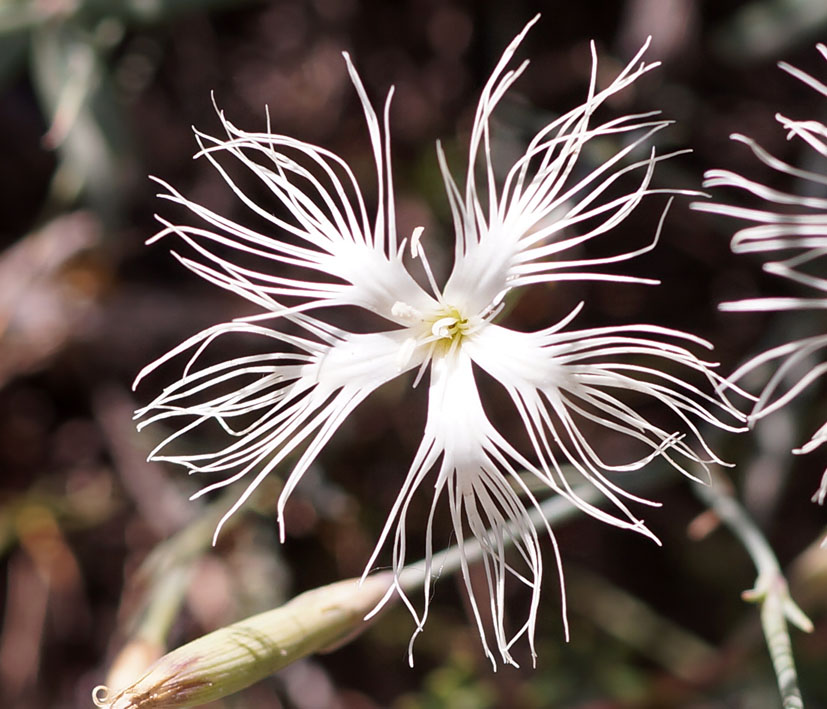
Kushakevich's carnation. Author G. Chulanova
Fruits are one-chambered many-seeded capsules that open with 4 teeth. Seeds flattened, oval, black, finely obtusely tuberculate.
Species: there are 300–350 species, about 50 of which are used in ornamental horticulture.
- Dianthus alpinus L. — Alpine carnation
- Dianthus armeria L. — Armeria-like carnation
- Dianthus barbatus L. — Turkish carnation. Garden plant.
- Dianthus bicolor Adams — Bicolored carnation
- Dianthus campestris M.Bieb. — Field carnation
- Dianthus carthusianorum L. — Carthusian carnation, or Narrow-leaved carnation
- Dianthus caryophyllus L. typus[2] — Garden carnation, or Dutch carnation
- Dianthus caryophyllus var. schabaud — Schabaud carnation.
- Dianthus chinensis L. — Chinese carnation )
- Dianthus deltoides L. — Maiden pink
- Dianthus gratianopolitanus Vill. — Grey-blue carnation
- Dianthus hoeltzeri C.Winkl. — Hoeltzer's carnation
- Dianthus japonicus Thunb.
- Dianthus nardiformis Janka — Nardiform carnation
- Dianthus superbus L. — Showy carnation
Hardiness zone: 3-9.
Location: Light-loving, prefers warm sites with bright sunlight. Drought-tolerant. Prefers light, sandy or rocky soil, well-drained, dry or moderately moist, not demanding in fertility and grows even on poor soils.
Planting: Soil mix: garden topsoil, peat and sand in a ratio of 2:2:1.
Care: requires organic and mineral fertilization. Potassium fertilizers (chloride-free) are applied at planting.
Pruning: not required.
Diseases: Alternaria, Fusarium, rust, carnation spotting.
Pests: mole crickets, earwigs, spider mite
Propagation: By seed, division, cuttings or layering. Seeds are sown in boxes in May–June, kept in partial shade outdoors or in a cold frame. Seeds germinate in 10–14 days. Seedlings are pricked out at the stage of 2–4 pairs of true leaves; planted in their permanent place in early May or in August–September. Seedlings bloom in the second year. Sowing seeds of perennial species used as annuals is done in a greenhouse in January–February in boxes with a loose substrate and kept at 15–20 °C. Seedlings are pricked out after 3–4 weeks and grown at about 12 °C, in March–April moved to cold frames, and planted out in May. Seeds of annual species are sown for seedlings in February–March or in May directly in the ground. Clumps are divided in spring or autumn. Cuttings are taken in February or March, less often in June. Cuttings root in a bright place in a loose substrate with added sand or in pure sand at 10–13 °C; stock plants are kept in greenhouses until February, or cuttings are taken in September–November, and rooted plants are transplanted into separate pots, grown on at 6–10 °C, pinched, and then kept until spring in a bright room at 5–6 °C. Some species hybridize easily. Propagation of double-flowered cultivars by seed may produce plants with single flowers.
Uses: highly ornamental, showy flowering plants forming dense bushes. Used as groundcover or to form dense carpet-like turfs. Used for small groups or masses on lawns or glades, for creating the front row of mixed borders, flower borders, for summer flowerbeds, beds, for containers, vases and balcony greening. Dwarf species are used in rock and heather gardens. Some species are used for cutting.