
Indoor plants
Dendrobium
Dendrobium
Synonyms: Den.
\r\nDendrobium (Dendrobium Sw.) – a genus of perennial herbaceous plants of the family Orchidaceae. The genus was first described by the Swedish botanist Peter Olof Swartz in 1799 in his » Nova Acta Regiae Societatis Scientiarum Upsaliensis 6: 82.». The name of the genus comes from the ancient Greek words ένδρον (tree) and βίος (life), which can be translated as «living on a tree».
\r\nThe range extends to tropical Asia, the islands of Oceania, Australia, New Zealand, New Guinea, China, Japan and the Philippines. Found in lowland and mountain forests. A monsoon climate, with the regular alternation of rainy and dry seasons, is the natural condition in which the Dendrobium orchid develops and blooms.
\r\n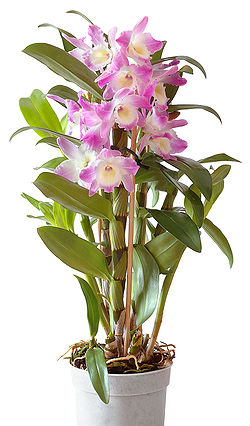
\r\nDendrobium nobile
They are epiphytic or lithophytic sympodial perennial herbaceous plants with diverse forms and sizes of shoots, 40-90 cm in height. Shoots are cylindrical, with ribbed or smooth surfaces, thickened in many species and covered with membranous leaf sheaths, erect or pendulous, from 1-2 cm to 5 m in length. Roots are well developed, the surface covered with velamen.
\r\n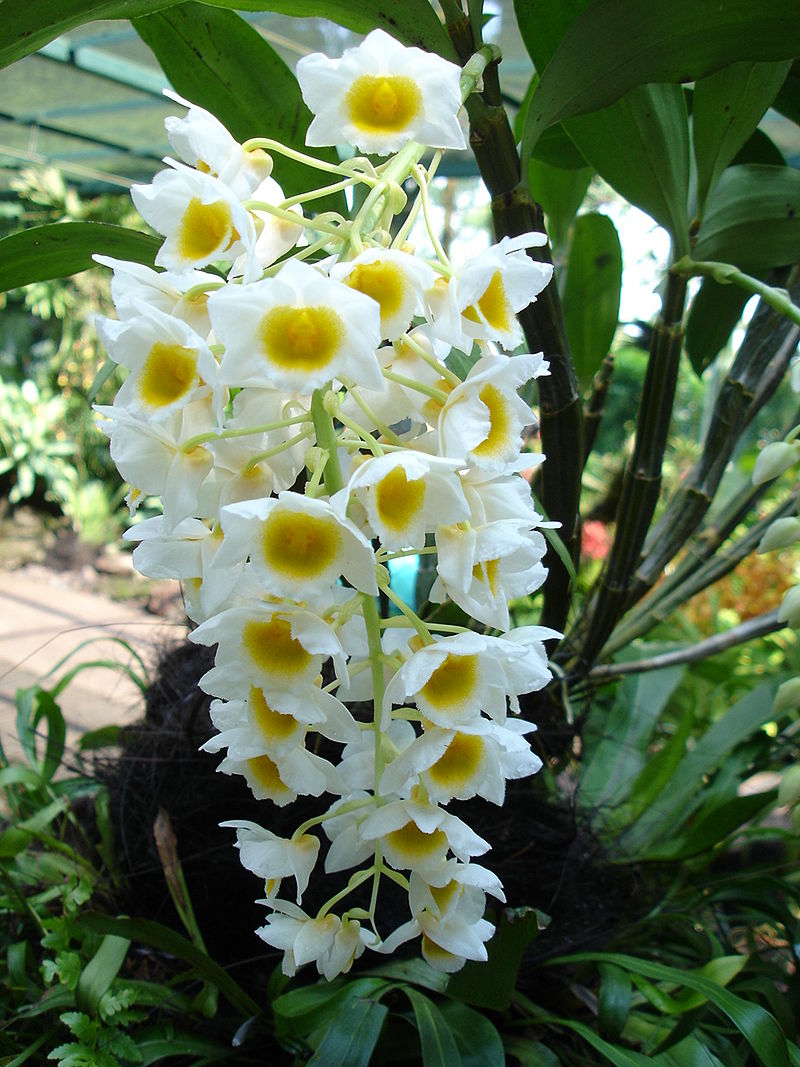
\r\nDendrobium farmeri
Leaves are narrow-lanceolate, elliptic, oblong or ovate in shape, grow along the whole stem or only at the top, fusiform or cylindrical, swollen or cane-like. In some species they are succulent and thick. Species that grow in temperate zones are deciduous.
\r\n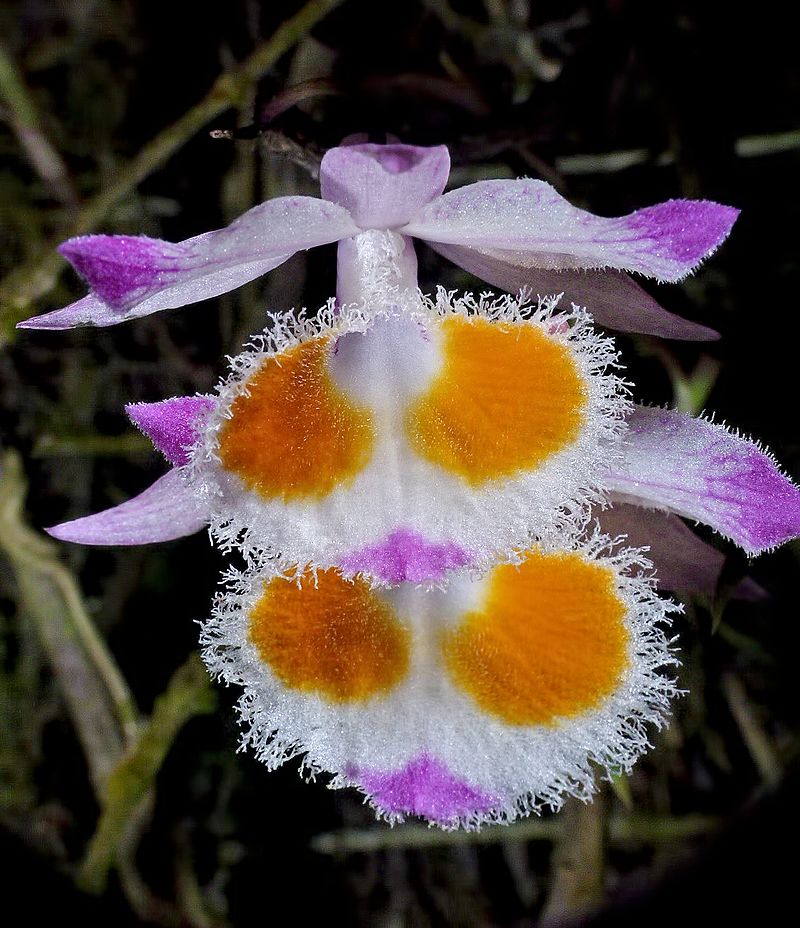
\r\nDendrobium devonianum
Inflorescences are racemose, erect or pendulous, single- or many-flowered, lateral or terminal. Flowers vary in size, shape and color, some with a pleasant fragrance. The only common characteristic is the tube-like base of the lip rolled around the column. The column is short, with an elongated "foot" base, with lateral sepals on it that form a sac-like outgrowth in the form of a short blunt spur. Pollinia 4.
\r\nSpecies: 1000-1200 species described. The most popular in indoor cultivation:
\r\n- \r\n
- Dendrobium phalaenopsis — Dendrobium phalaenopsis \r\n
- Dendrobium nobile — noble Dendrobium \r\n
- Dendrobium densiflorum — densely-flowered Dendrobium \r\n
- Dendrobium bellatulum – beautiful Dendrobium \r\n
- Dendrobium kingianum - Dendrobium King \r\n
Hardiness zone: 10b (12°C).
\r\n\r\nTemperature: very warmth-loving plants. Optimal temperature – 22-25°C, at night – 15°C. During the dormant period (winter), depending on the species, the plant is kept in cool conditions – 12°C.
\r\nLight: prefers a west or east window; on a south window it should be shaded during the hottest hours of the day.
\r\nWatering: abundant watering is necessary during the growth period. The standard watering method – immerse the pot to 2/3 of its height in a container with water for about 20-30 minutes. Before the next watering the substrate should dry well. In winter observe a dry regime and water rarely (once every 2 weeks).
\r\nFertilization: fertilize with a standard orchid fertilizer. Usually fed during the growth period and until flowering.
\r\nHumidity: should be no less than 60%, preferably higher, so it is better to place the plant on a tray with wet pebbles or water.
\r\nRepotting: repot once every 2-3 years. Main reasons for repotting are substrate compaction and insufficient pot size. Potting mix for repotting is the usual substrate for orchids and epiphytes of medium and small fractions. If the indoor air is too dry, a very small amount of perlite or vermiculite can be added to the substrate to retain moisture. After repotting it is recommended not to water, fertilize or move the orchid to another place for a week.
\r\nPropagation: by division (no more often than every 3-4 years) and by cuttings. Top shoots can be removed every year. Most Dendrobiums form aerial plantlets (keikis), by which they also propagate.
\r\nDiseases: may be affected by fungal and bacterial diseases.
\r\nPests: orchid aphids, red spider mite, thrips. Control method - use of specific treatments.
\r\n