
Flowers for the garden
Delphinium, larkspur, spur
Delphinium
Дельфиниум, живокость, шпорник (лат. Delphinium) — род однолетних и многолетних травянистых растений семейства Лютиковые (Ranunculaceae), близкий к роду известных ядовитых растений Аконит (Aconitum). Включает около 370 видов, произрастающих в Северном полушарии и в горах тропической Африки. Многие виды происходят из Юго-Восточной Азии и особенно из Китая, где произрастает более 150 видов. Однолетние виды рода Дельфиниум иногда выделяются в смежный род Сокирки (Consolida), включающий около 40 травянистых однолетних растений.
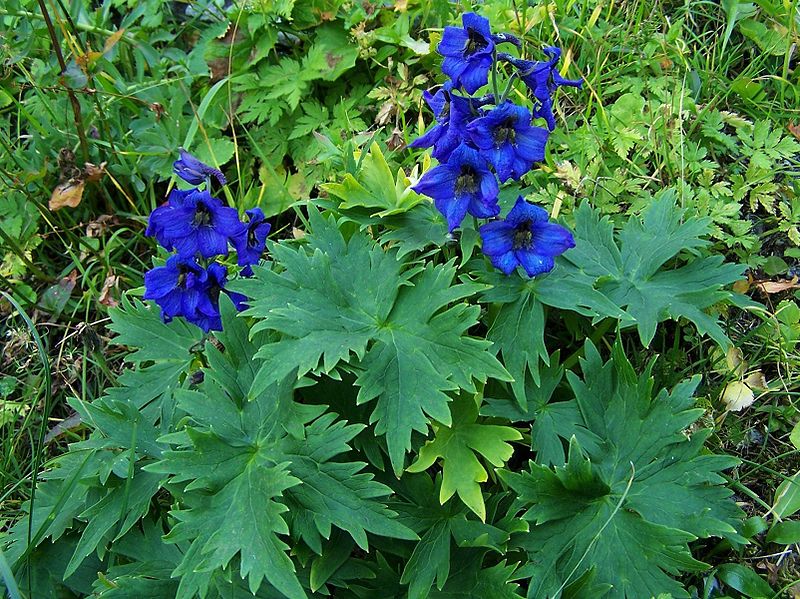
The plant received its scientific Latin name possibly because the unopened flower resembles the shape of a dolphin's head and body. According to another version, the plant's name comes from the name of the Greek city of Delphi, in the vicinity of which many of these flowers grew. The city was located on the slope of Mount Parnassus and contained the famous temple of Apollo and the Delphic oracle. It is possible that the name of the plant mentioned by Dioscorides can be literally translated as the flower of Apollo of Delphi.
In Russian, the name "Delphinium" is more often found in fiction and popular literature; in scientific literature the name "zhivokost" is used predominantly. In gardening books the name Delphinium is usually applied, which is reflected in the names of hybrids.
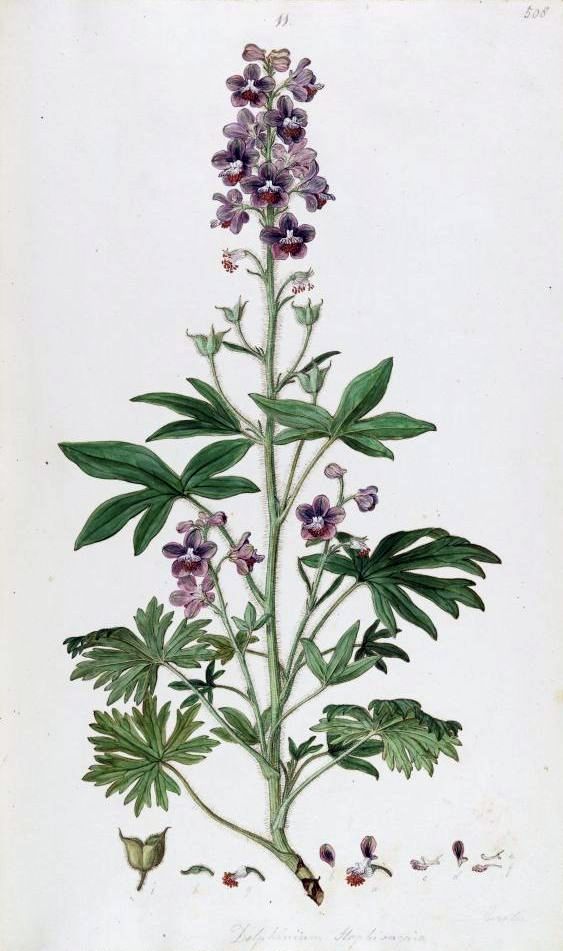
Annual and perennial herbaceous plants. Stem height, depending on the species, ranges from 10 cm in some alpine species to 3 or more meters in forest species. Leaves are palmately divided, often deeply and repeatedly dissected into pointed or toothed lobes.
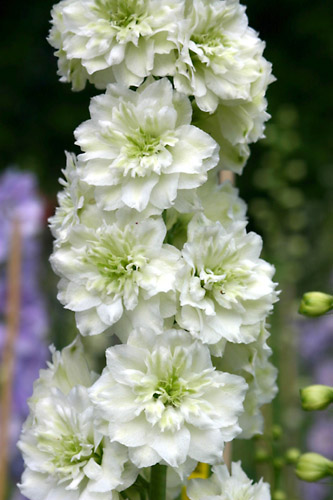
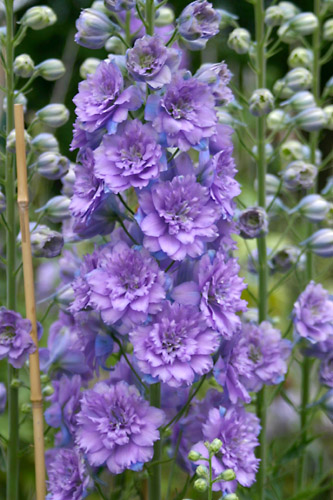
The flowers are irregular (zygomorphic), consisting of five colored sepals. A distinctive feature of the flower's structure is the presence of a spur, a cone-shaped appendage of the upper sepal. Spurs range from 5–6 mm in primitive species to 45 mm in length in the African species Delphinium leroyi. The hollow spur contains two nectaries, beneath which are two small petals. In the center of the flower the nectaries and petals form an eye, which often differs in color. Most flowers are blue or violet, but there are species with other colorations as well.
Depending on the species, inflorescences consist of 3–15 flowers in primitive panicle-type inflorescences, or of 50–80 in advanced pyramidal inflorescences, forming a simple or branched raceme. Many species are good nectar sources, pollinated by butterflies and bumblebees, and two American species are pollinated by hummingbirds.
Larkspur is a poisonous plant that causes depression of the central nervous system with simultaneous effects on the gastrointestinal tract and the cardiovascular system. Cases of poisoning of cattle and sheep are known.
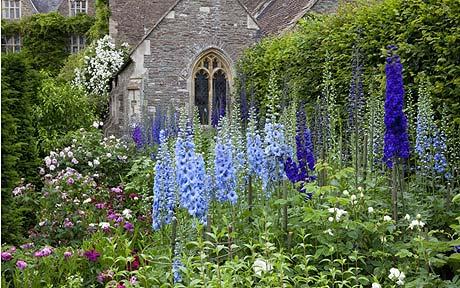
Delphinium is one of the favorite garden plants. Many varieties and hybrids have been bred and are used in gardening as ornamental plants. Cultivated since the 17th century. Annual species, brought to Europe by traveling botanists, were the first to be cultivated in gardens. The crossing of the annual species Delphinium "eastern" and Delphinium "doubtful" led to the appearance of the first hybrid, named Delphinium Ajax.
Later, widely distributed perennial species began to be widely cultivated in ornamental gardening. Gardeners were attracted by their impressive appearance and undemanding nature in cultivation.
In the mid-19th century the French breeder Victor Lemoine developed ornamental hybrids that became well known. The gardener James Kelway from England successfully worked on improving the early hybrid forms of these plants.
Frank Reinelt is perhaps the most famous delphinium breeder. In the 1930s he developed 12 varieties that, thanks to their decorative qualities, quickly gained popularity worldwide.
Location: sunny sites with light shading during midday hours and well protected from the wind.
Soil: prefer sandy-loam or loamy soil rich in humus, moderately moist. The plant is relatively drought-tolerant; in overly wet conditions it easily becomes diseased and rots.
Care: during the growing season delphinium produces a large vegetative mass from vigorous shoots with large leaves. To build this mass the plant requires a large amount of nutrients, especially during regrowth. Therefore, in addition to the nutrients applied at planting, several top-dressings are carried out annually. After flowering, flower stalks are usually cut off, as they detract from the plants' ornamental appearance. A short dormancy period follows, and new shoots appear at the base of the old shoots, which bloom in August.
Propagation: annual species are propagated by seed sown in open ground in spring or autumn. Perennial delphiniums are propagated by dividing the clump, by cuttings, and by seeds.