
Flowers for the garden
Datura
Datura
Datura (lat. Datura) — a genus of herbaceous, rarely tree-like plants of the nightshade family (Solanaceae). The genus includes about 15 species, distributed in temperate and steppe zones worldwide. Plants that are now placed in the separate genus Brugmansia (Brugmansia Pers.) were formerly also assigned to this genus.
The scientific name of the genus comes from Sanskrit dhattura or Arabic tatura from tat — to prick.
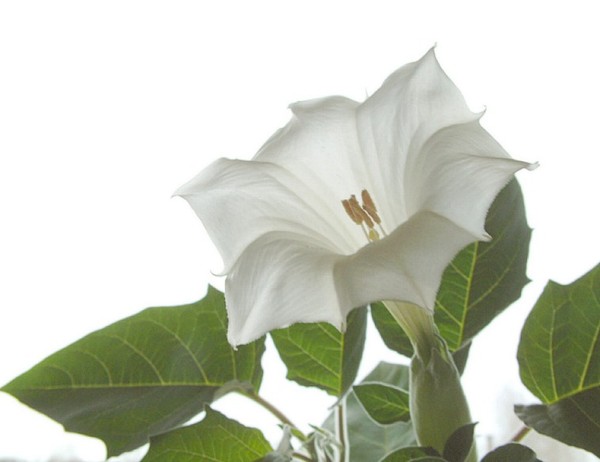
Annual herbaceous plants 0.5—1 m high. Stem glabrous, erect, ternately and fork-branching.
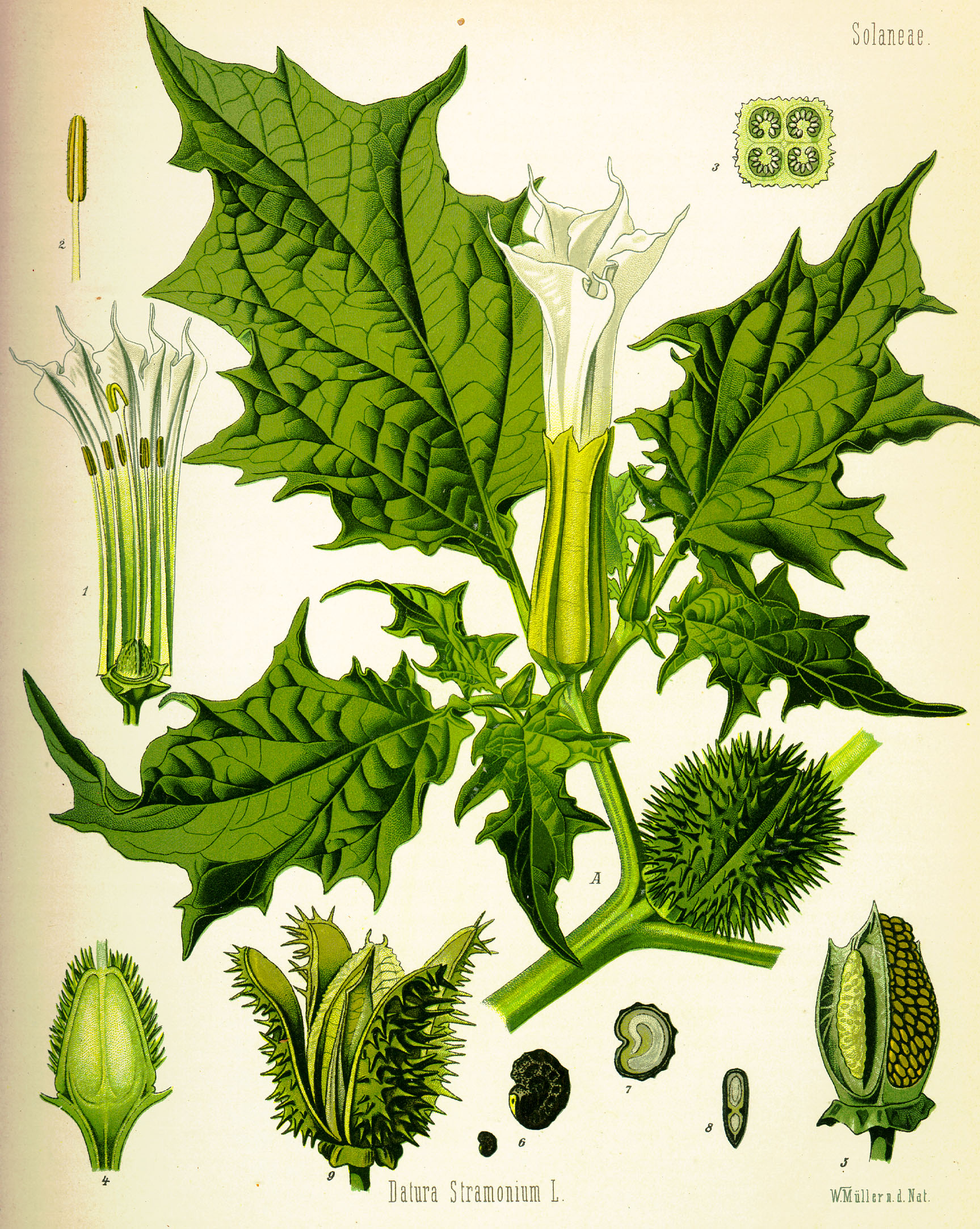
Leaves alternate, long-petioled, ovate-acuminate, up to 15 cm long, glabrous, dark green above, slightly lighter below. The main and lateral veins are whitish, strongly raised on the underside.
Flowers solitary, large, funnel-shaped, in the forks of the stem. Fruit — a large ovoid, mostly four-chambered capsule, covered with numerous spines, completely drying at maturity or fleshy, splitting into 4 valves, or sometimes not opening at all. The plant is poisonous.
In cultivation:
Common datura - Datura stramonium
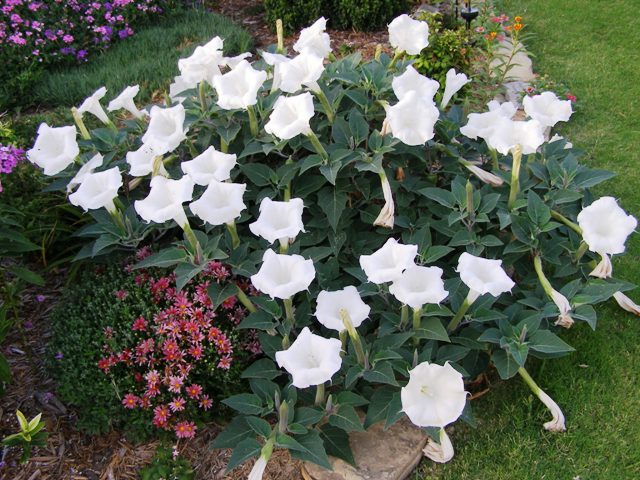
An annual herb up to 1.5 meters tall. Root a taproot, branched, robust.
Stems erect, fork-branching, glabrous. Leaves alternate, petiolate, simple, ovate, toothed with an acuminate tip, dark green above, lighter below.
Flowers solitary, terminal or axillary, large, white, fragrant, emitting a strong intoxicating scent. Blooms in June—August.
Fruit — a four-chambered capsule opening with four valves, covered with spines. Seeds numerous, kidney-shaped, matte-black. The entire plant is poisonous!
Indian datura - Datura metel
An annual herb. Stem branched, 60–120 cm tall.
Leaves large, alternate, long-petioled, asymmetrical, margin entire or slightly wavy.
Flowers white or pale lilac, solitary, large, up to 20 cm long. In cultivated forms they can be not only white but also purple, violet and yellow. Fruit — a brownish or grayish-green globular capsule 3–6 cm long, with thin needle-like spines. Seeds bright yellow. The whole plant is poisonous!
Site: Require well-lit warm locations, tolerate direct sunlight.
Soil: Undemanding; grow on any well-drained soil, but flower more abundantly on fertile, loose substrates or on compost heaps.
Care: Do not require additional care. Respond well to the application of fertilizer.
Propagation: By seeds.