
Flowers for the garden
Dahlia
Dahlia
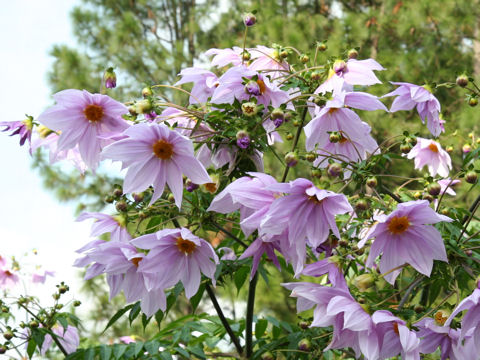
Family Asteraceae. Luxuriant dahlia bushes, covered with bright large flowers, attract everyone's attention. They bloom continuously throughout the summer and autumn, and only the harsh breath of the approaching frosts destroys their charm.
Dahlias are a perennial tuberous plant with an above-ground part that dies back annually and strong perennial tubers that store nutrients for the initial growth of buds. They belong to the Aster family. Their native range is North America.
Currently there are more than 10 thousand dahlia cultivars.
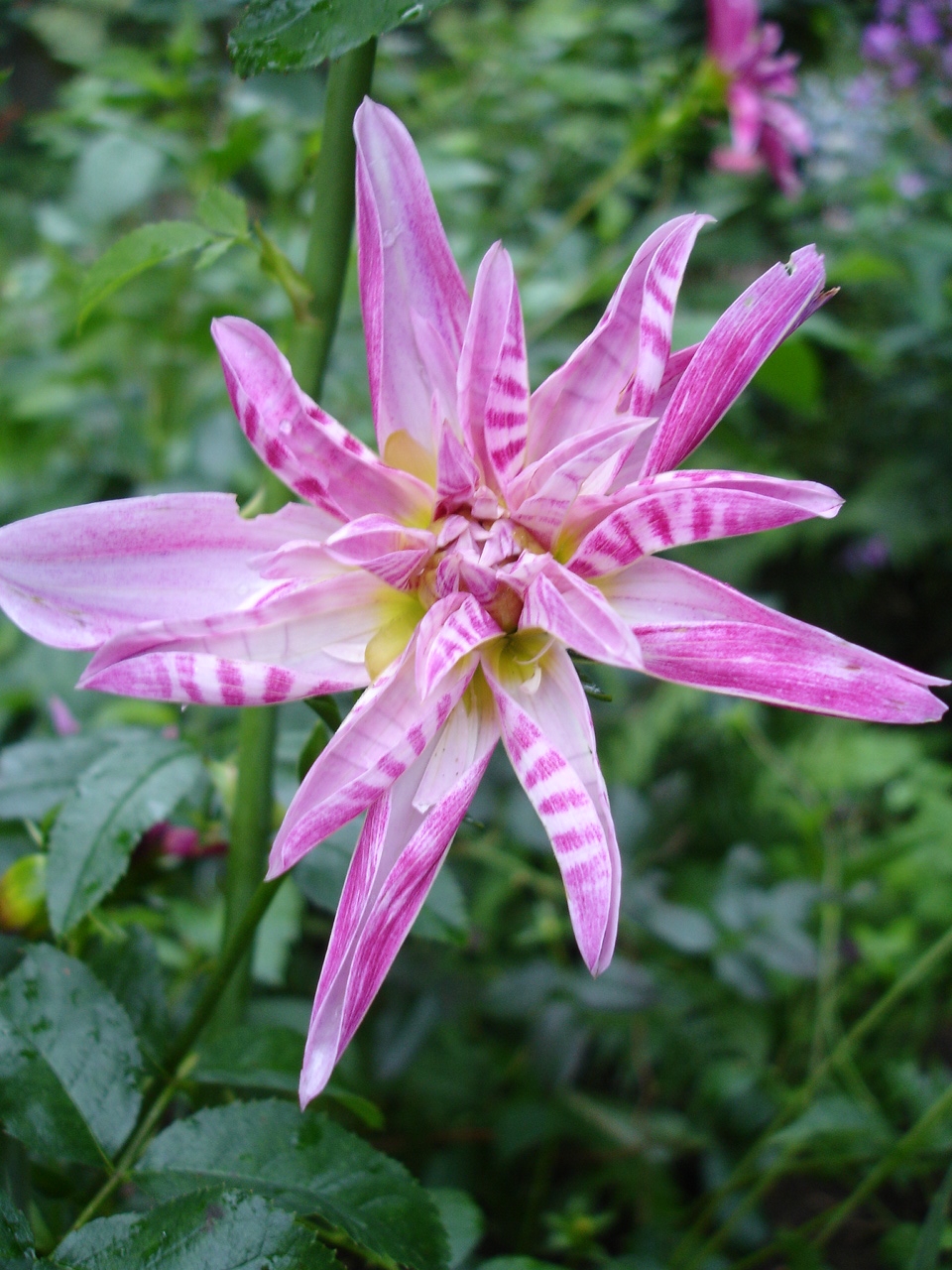
Their inflorescences come in a variety of colors, with the exceptions of blue, black and light blue. In addition to solid-colored forms, there are many cultivars with variegated inflorescences.

Location: For growing dahlias choose sunny sites sheltered from cold and strong winds with good air circulation. They should not be planted in low-lying or waterlogged areas. Planting distance depends on the height and form of the bush of a given cultivar. The site chosen for dahlias should receive at least six hours of sunlight per day.
In the second half of February or early March the tubers of dahlias are divided for propagation; it is essential to include part of the crown containing 1-2 eyes. Tubers that fall off during division without part of the crown are not used for propagation because they lack buds. Tubers are divided with a sharp knife and planted in pots 15 cm in diameter or in boxes to obtain cuttings in March. Tubers are forced at a temperature of 15...18°C.
Care: includes removal of side shoots, periodic tying to stakes, regular watering and timely feeding. Initially leave no more than two buds on each tuber; other shoots are broken off later so as not to weaken the main growth. Stakes for tying are driven in before planting. Their height should be about 40 cm lower than the expected final height of the plant. Stems are first tied when they reach 30 cm and tying is continued as they grow to protect them from breaking. Hilling of the plants serves the same purpose. For earlier flowering it is necessary to regularly remove emerging suckers — lateral shoots that grow in the leaf axils; remove them as early as possible to minimize injury to the plant. Starting from the fourth pair of leaves, lateral shoots are left to form the bush. Low varieties are not pruned. To obtain a larger number of inflorescences suitable for cutting, the main shoots are pinched above the fourth pair of leaves, and the resulting upper lateral shoots above the second. The central bud is removed, which leads to lengthening and strengthening of the flower stalk, and an increase in the size of the inflorescences. This is especially important when growing exhibition specimens. If inflorescences have not been cut, they should be removed as soon as they begin to fade; otherwise the appearance of the planting deteriorates and the development of new buds is delayed.


Feedings are carried out after the plants have settled after planting (not earlier than 5-7 days), at intervals of 10 days, with thorough watering of the plants beforehand. Make a hole 10-12 cm deep around the "bush", apply fertilizer, and immediately backfill the hole. For feeding (3-4 times) use an infusion of cow manure (1:10), adding superphosphate and nitrogen fertilizers (20 g per 10 l of water). It is also good to perform 3-4 feedings with superphosphate (50 g per 10 l of water) with the addition of 3-4 handfuls of wood ash. With such care abundant flowering is achieved and the inflorescences become much larger. Feedings are carried out in June and the first half of July, and in August only one feeding with potassium sulfate is given for better tuber ripening (30 g per "bush"). Do not overuse nitrogen fertilizers, as this reduces the intensity of flowering, the "bush" only accumulates greater vegetative mass, flowers poorly and forms tubers that store poorly. From September watering and feedings are stopped.
Pests found on dahlias include spittlebugs, aphids, flower beetles, and slugs. For aphids, garlic infusion, onion-skin infusion, spraying with chlorophos (10 g per 10 l of water) and dusting wet leaves with ash help. For powdery mildew, spittlebugs, and also for aphids and flower beetles, spraying with urea (50 g per 10 l of water) or with cow-manure infusion (1:10) can be used. Spraying should be done in the evening hours or in cloudy weather. Against slugs it is recommended to sprinkle paths adjacent to plantings with iron or copper sulfate (10 g per m2) or with superphosphate (30 g per m2), or to treat the leaves with a 10% decoction of hot pepper pods.

In mid-August it is recommended to hill dahlias by 8-12 cm to protect the crown from frost damage. From September watering and feedings are stopped.
In autumn the tubers of dahlias are dug up with a garden fork or spade, and the stems are cut 15-20 cm above the tubers. Wounded tubers are dusted with charcoal powder and the damp ones are air-dried. Tubers for the winter are placed in cellars, storage pits or other dry and cool rooms. They are stored in nests without dividing until spring. The storage room should be fairly dry, with a temperature not higher than 3-5°C. Tubers placed in boxes should be covered with sand or sawdust. During storage they should be checked at least once a month, removing diseased and trimming damaged parts.
Digging and harvesting of dahlias is carried out in late September - early October depending on the weather: if frosts were light and warm days return, do not rush with digging; let the tubers ripen. If temperatures continue to fall and further cooling is expected, the tubers are dug up. Before digging, the stems of the plants are cut to a height of 8-12 cm from the crown. Carefully dug tubers are dried in a well-ventilated room, damaged and dead parts are removed, then they are transferred to permanent storage at an optimal temperature from 3-5 to 7°C and with a relative humidity of about 80-85%. At lower humidity the tubers are recommended to be placed in boxes and covered with dry sand or peat, or stored in tightly tied polyethylene bags.

Diseases and pests: Among diseases of dahlias are viral mosaic, powdery mildew, and bacterial crown gall. When affected by viral mosaic, light-green spots of various shapes and sizes appear on the leaf blades, along with yellowing along the veins. Infected plants show reduced decorative value of the flower, shortened internodes, stunting of the plant, and short flower stalks. The disease may also manifest in the brightness of petal coloration. The only means of control is thorough culling and burning of diseased plants. Bacterial crown gall is detected on the tubers, as a rule, in autumn at digging. At the crown of affected plants deformed buds appear first, and later growths 10-12 cm in size form. Affected tubers must be culled and burned in the autumn.
Propagation: by cuttings, division of the tuberous root and very rarely by grafting.
Seed propagation is used mainly for the group of single-flowered varieties and in breeding work. To prepare seedlings, sowing of seeds is carried out in March - April in boxes with a mixture of peat and sand (3:1). To avoid diseases, seeds are treated for 5-10 minutes in a formalin solution (10 ml of 40% preparation per 1 l of water), then dried on filter paper. Seedlings are usually pricked out into peat-compost cubes or small flowerpots. They are planted into open ground after the last spring frosts.
For cutting, at the end of February - early March, tuberous roots are placed, after treatment with a 0.1% solution of potassium permanganate for 15 minutes, on shelves or in boxes, covered up to 1/3 of their height with a light fertile soil and watered moderately. The temperature in the room is maintained at about 20-25°C. When the buds begin to grow, watering is increased and the temperature is reduced to 15-18°C. Cuttings are taken after 3-4 weeks, from late March to mid-May.


To improve root formation, stimulants are used, namely the potassium salt of heteroauxin, dissolved in water. It decomposes quickly in light, therefore all operations are carried out with minimal illumination and in opaque vessels. First, prepare 200 g of charcoal powder and sift it through a fine sieve (0.5 mm). Then mix it with a solution of heteroauxin (1 g of the potassium salt per 200 ml of snow water). Add 100 g of potassium or sodium humate, a solution of ammonium molybdate (5 g per 100 ml of water) and 50 g of talc. Mix everything thoroughly. The resulting mixture is dried without heating in the dark and crushed into a powder. This amount of stimulant is enough to treat 15 thousand cuttings. Pour the powder into a jar to a layer of up to 5 mm, so that the cutting touches it only at the cut.
Since cuttings in dahlias develop not only on the crown but also on the tuber, prepare a sharp cutting tool with straight and curved blades (it can be made from halves of curved scissors and tweezers). A blunt tool will crush plant tissues, which will lead to rotting. The cutting is cut with a heel. The larger the heel, the more successfully the plant roots. However, increasing the heel reduces the number of cuttings obtained, since dormant buds on the tuber are cut off, from which later new shoots will develop. With careful work up to 50 cuttings can be obtained from one tuber. The tool must be disinfected in alcohol after each operation.
It should be borne in mind that the use of hormones and the correct technique of taking cuttings will not give the expected result if the given cultivar has a low ability to form roots.
For rooting take cuttings with stems at least 3 mm in diameter and 8-10 cm long. From thinner ones you get plants that flower very late or do not have time to bloom at all. In a greenhouse it is preferable to take cuttings early in the morning or in the evening. Cuttings taken in sunny weather during the day often die during rooting. This can be explained by the fact that at that time the greenhouse heats up strongly, humidity decreases, leaf transpiration increases, and the shoots are in a depressed state. (The same applies to cutting flowers.) 15-20 minutes before cutting, the tuberous roots should be sprayed with water, preferably snow or rain water, to increase turgor in the plant cells.
Planted in boxes, the cuttings are abundantly watered with warm water from a small watering can. A label with the date of cutting is placed in the box. For two days the cuttings should be kept in a shaded place, then 5 days under diffused light. Only after that can they be exposed to sunlight, but no more than 8 hours a day. During rooting the substrate must be heated.
Water the cuttings with a sprayer early in the morning and in the evening. If the temperature in the greenhouse rises above 30°C, spray the plants more often. Wilted cuttings for any reason should be removed immediately.
Rooting occurs on average in 10-15 days. Cuttings from boxes are planted into pots, from cold frames into open ground. Before planting, the plants must be hardened. Rooted cuttings are planted in early June in groups or rows at a distance of 60-80 cm.
Tubers are divided shortly before planting, cutting them with a sharp knife into two to three parts so that each "division" consists of a tuber and a piece of crown with two to three eyes. All cuts are dusted with crushed charcoal mixed with sulfur (1:1). Planting in place is carried out in late May - early June, burying the crown 3-5 cm deep (rooted cuttings up to the first pair of leaves).

Uses: Low-growing varieties are suitable for creating flower beds, borders and masses. Most varieties are used in informal compositions and group plantings; as solitary specimens, prolific or large-flowered types are effective. Varieties with long and strong flower stalks are used for cutting.