
Flowering shrubs
Blackening Broom
Cytisus nigricans L.
Synonyms: Lembotropis nigricans (L.) Griseb., острокильница чернеющая, Cytisus nigricans var. nigricans., Cytisus nigricans var. elongatus Willd.
Blackening Broom (Cytisus nigricans L.) – a species of deciduous plants of the genus Cytisus (Cytisus) in the family Fabaceae (Fabaceae). The species Cytisus nigricans L. was first described in 1753 by Carl Linnaeus in Species Plantarum (Sp. Pl.). In 1843 it was placed in the genus Lembotropis under the name Lembotropis nigricans (L.) Griseb. in «Spicilegium florae rumelicae et bithynicae exhibens synopsin plantarum» («Spic. Fl. Rumel.») by the German botanist August Heinrich Rudolf Grisebach. In cultivation since 1730. The species name refers to the shoots and leaves that blacken when dried.
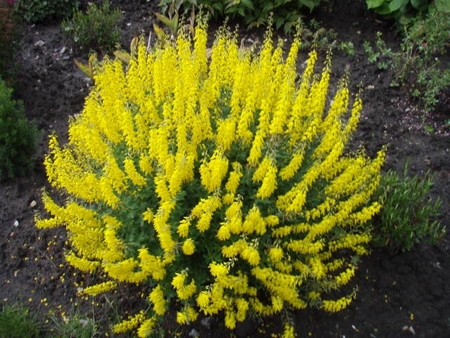
In nature it occurs in China, Belarus, Albania, Austria, Bulgaria, the Czech Republic, Slovakia, Estonia, Yugoslavia, Germany, the United Kingdom, Greece, Poland, Italy, Lithuania, Moldova, Poland, Romania, Switzerland, the European part of Russia, Sardinia, Ukraine (Cherkasy, Chernivtsi, Dnipropetrovsk, Ivano-Frankivsk, Khmelnytskyi, Lviv, Rivne, Ternopil, Vinnytsia, Volyn, Zakarpattia, Zhytomyr). It is found in the basins of the Dnieper, Dniester, Sura, and Volga rivers, as well as along their tributaries. It grows in the understorey of oak, pine, and pine-birch forests, often on sandy soils.
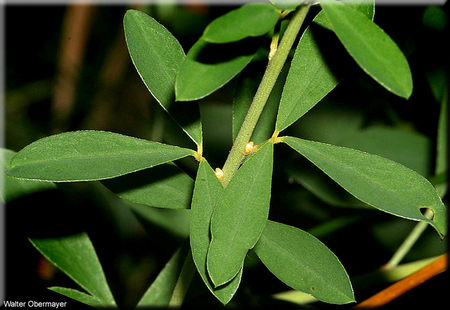
It is a deciduous shrub 30-100 (150) cm tall. The crown is densely branched and compact. Branches are erect and spreading, numerous, whip-like, angular. Young shoots are densely and appressedly pubescent with long grey hairs, later becoming glabrous and rounded.
Leaves are trifoliate, less often with 5 leaflets, on long, almost glabrous petioles. Leaflets 1.2-2.5 cm long and 0.6-1 cm wide, elliptic or obovate in shape, with an ovate base and an obtuse, rounded or mucronate apex. The blade is glabrous above, sparsely appressed- and short-pubescent beneath.
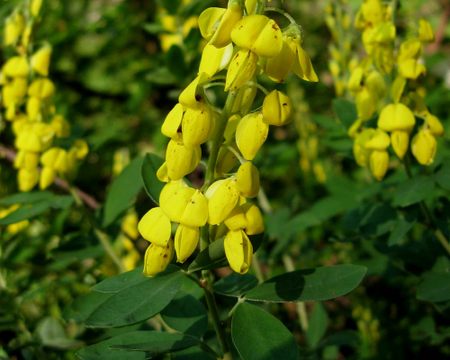
Flowers are fragrant, golden-yellow, borne at the ends of shoots in raceme-like spike inflorescences of 15-30 flowers. Pedicels 5-7 mm long, appressed-pubescent. Calyx up to 3 mm long, irregularly bell-shaped, appressed, shortly and silvery-pubescent; the upper lip sharply two-toothed and considerably longer than the lower. Standard (banner) glabrous, 0.9-1 cm long, with a weakly expressed claw, obovate, rounded at the top. Wings entire-margined, equal in size. Keel beak-like, curved with a claw, glabrous, the same length as the standard. Flowers from June to August.
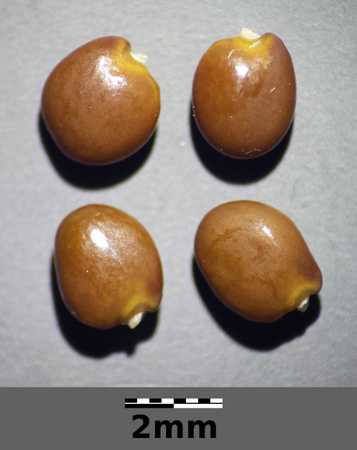
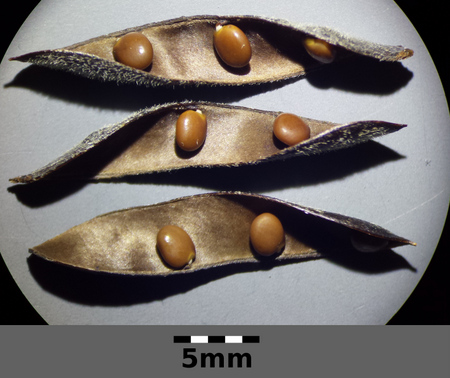
Pods linear-lanceolate, 2-2.5 cm long and 5 mm wide, densely and shortly appressed-hairy. Seeds black. Flowers and fruits from the second year.
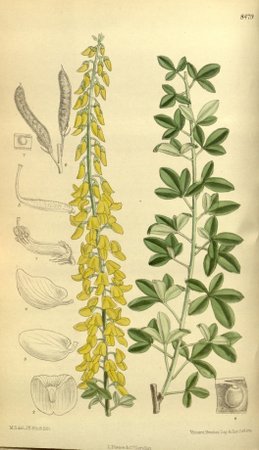
«Curtis's Botanical Magazine», London. M.S. del, J.N.Fitch, lith.
Varieties:
- Lembotropis nigricans subsp. australis (Wohlf.) Holub
- Lembotropis nigricans subsp. nigricans (L.)Griseb.
- Cytisus nigricans L. subsp. atratus (Schur) Nyman (syn. Lembotropis nigricans (L.) Griseb. subsp. mediterraneus (Pant.) Holub)
Hardiness zone: zones 4-8 (-29°C). In severe winters it may suffer slight frost damage.
Location: A light-loving mesophyte. The best planting site is an open area with a south-facing exposure, preferably sheltered from cold winds. Not recommended to plant near ponds with fish.
Pruning: after flowering it is recommended to cut back the spent shoots by half, avoiding old wood.
Propagation: seed viability 92%. Part of the seeds swell and germinate at +20 °C (within 1 month 55%). Cuttings root up to 100% without treatment.
Soil: drought-tolerant, does not tolerate prolonged waterlogging or overmoisture. Does not like clay soil. Prefers fertile, slightly acidic soil. Optimal soil pH 6.5 - 7.5.
Planting: soil mix – one part sand and one part turf soil, peat compost or humus; complete mineral fertilizer or Kemira-Universal can be added (120 g per 1 m2). Does not like transplanting. Recommended spacing between plants – 30-50 cm. Crown collar at ground level. Drainage is required (on heavy soils – layer 15-20 cm, on light soils – 10 cm). After planting mulch the planting circle with soil or peat to a depth of 3-5 cm.
Care: does not require irrigation. For better flowering it is recommended to feed the plant twice a year – first in spring, second before flowering. In spring apply urea (20 - 30 g per 10 l of water), in summer - 60 g granular superphosphate and 30 g potassium sulfate. To stimulate growth wood ash can be applied - 200 g per bush. Loosen to a depth no greater than 8-12 cm.
Diseases: Powdery mildew (treat dormant buds with copper sulfate (5%), in summer regular treatments with Fundazol, copper-soap solution, colloidal sulfur (0.8%) alternately), Black spot (treat dormant buds with iron or copper sulfate; in summer spray with Fundazol, Policarbacin (0.2 - 0.4%), copper oxychloride (1%), Captan (0.5%), Bordeaux mixture (1%)).
Pests: broom moth (spray with chlorophos (0.2%)), broom geometer (treat with organophosphorus or bacterial insecticides).
Conservation status: in Ukraine (Zhytomyr region) and in Russia (Bryansk, Ivanovo, Nizhny Novgorod regions).
Uses: a good honey plant. Widely used in rock, heather, and grass gardens, as a groundcover, and for creating borders. Looks effective in flower beds with perennials.