
Flowering shrubs
Prominently-flowered broom
Cytisus emeriflorus Rchb
Synonyms: Edge-flowered broom, Floating-flowered broom, Cytisus glabrescens Sart., Genista glabrescens Briq., Projecting broom.
Prominently-flowered broom (Cytisus emeriflorus Rchb) – a species of deciduous plants of the genus Cytisus (Cytisus) in the family Fabaceae (Fabaceae). The species was first described by the German botanist-systematist Heinrich Gottlieb Ludwig Reichenbach in 1832 in «Flora Germanica Excursoria» («Fl. Germ. Excurs.»). Introduced into cultivation by the Royal Botanic Gardens, Kew in 1836.
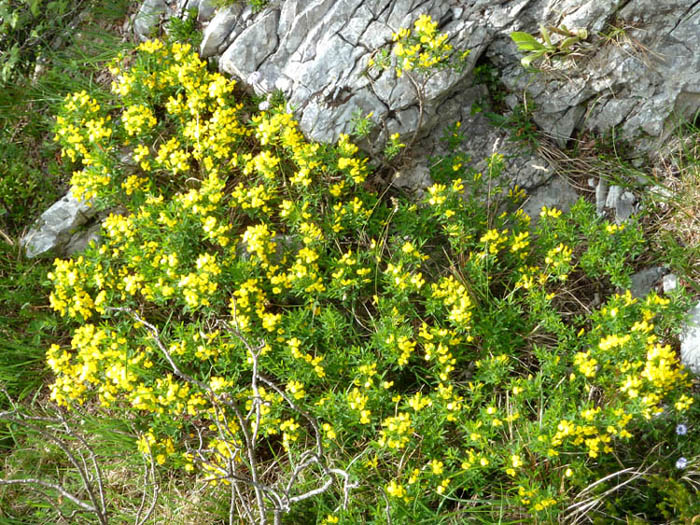
In the wild it grows in the Southern Alps, near lakes Como and Garda. It is found on mountain slopes, meadows, shrub thickets, rocky slopes, and rocky ridges. It ascends into the mountains up to 980-1800 m above sea level.
It is a deciduous shrub up to 60 cm in height. Crown dense. Stems prostrate or ascending, branched. Bark gray, smooth. Young shoots green, silky-pubescent.
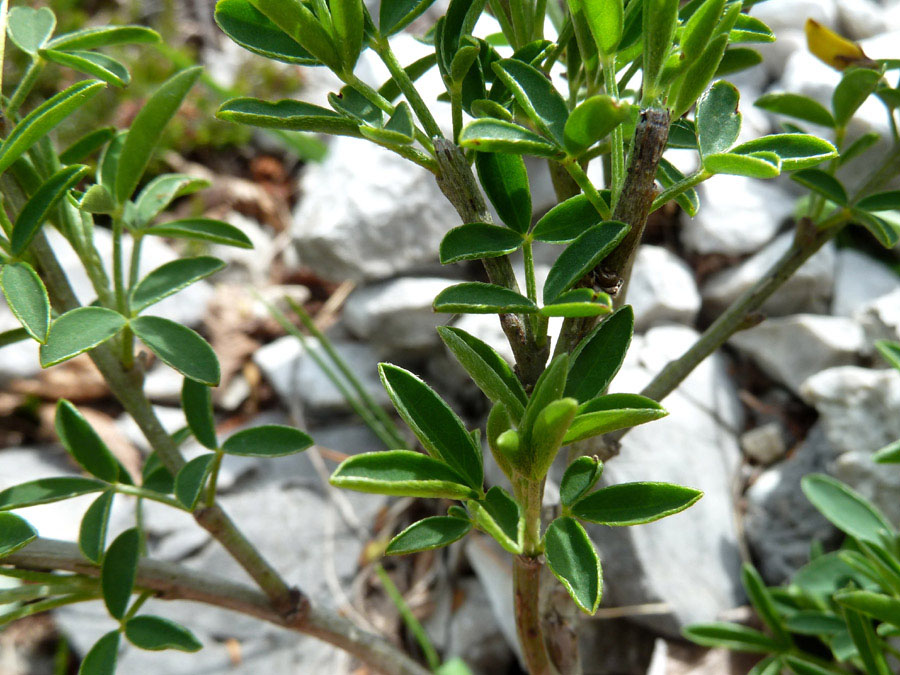
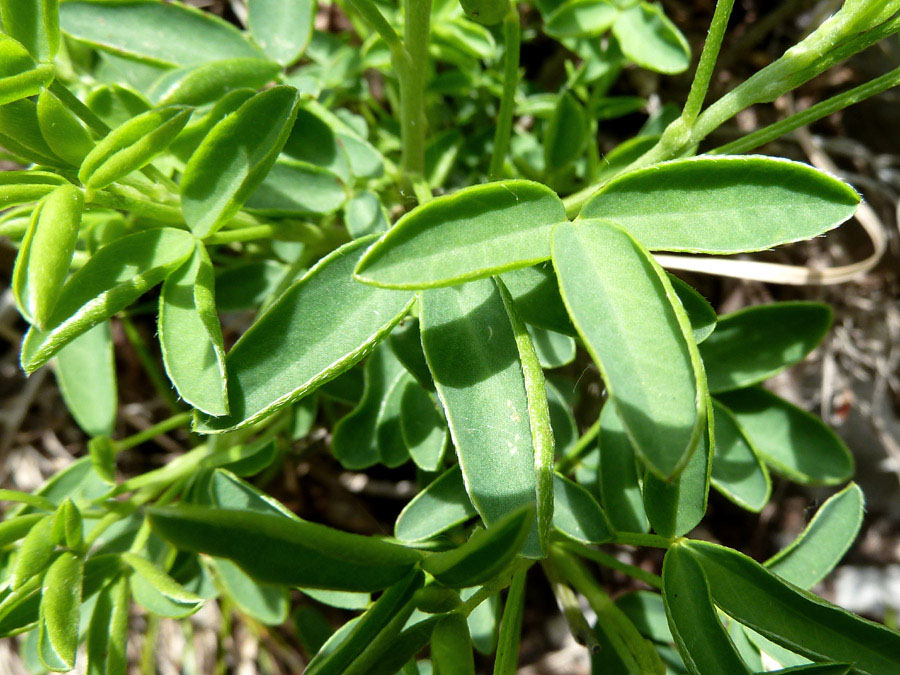
Leaves trifoliate, on long petioles. Leaflets sessile, obovate or oblong, 5-25 mm long, glabrous and dark green above, silky-pubescent and pale green beneath, margins entire, often rolled inward, apex acute, base rounded.
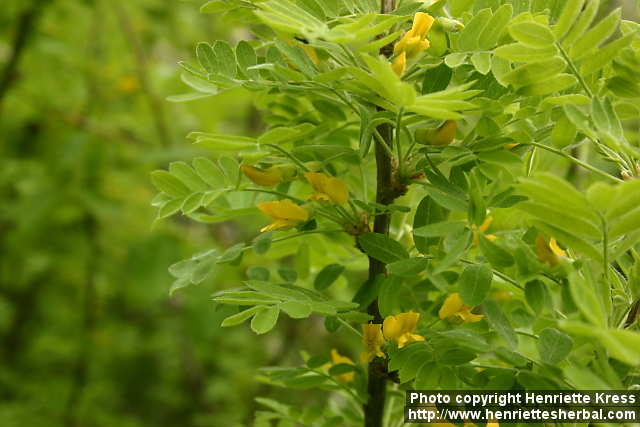
Flowers appear in the leaf axils on last year's shoots, grouped 1-4 together, papilionaceous, yellow. Calyx 10-15 mm long, bilabiate, bell-shaped. The upper lip of the calyx two-toothed, the lower with 3 short lobes. The standard (banner) is longer than the wings and the keel. The wings are folded-wrinkled along the upper margin. There are 10 stamens, fused into a tube. The style is curved, with a capitate stigma. Ovary sessile. Pedicels long, densely silky-pubescent. Flowers in May-June.
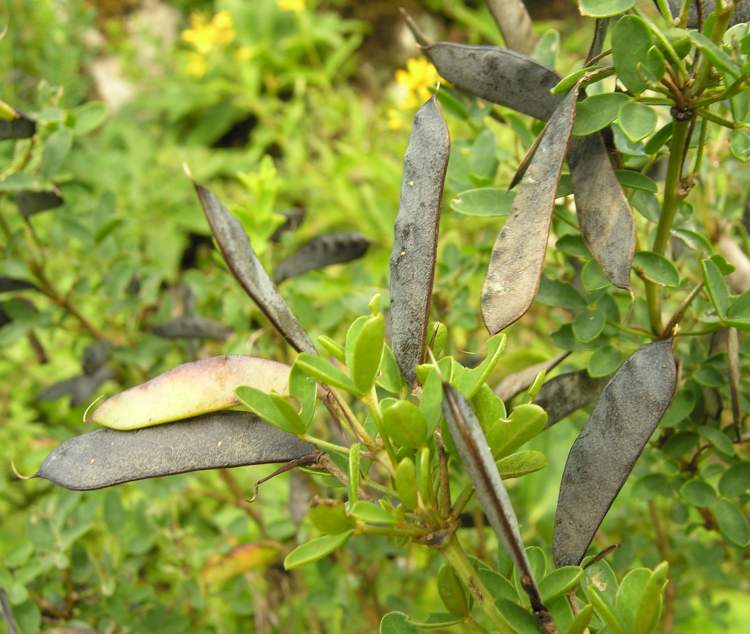
Fruits flat, broad-linear and glabrous many-seeded pods, 2.5-4 cm long, dehiscing at maturity. Seeds kidney-shaped, glossy, flat, with an aril.
Chromosome number: 2n = 50
Hardiness zone: zone 6-8 (-23°C).
Site: very light-loving. The best planting site is an open area with a southern exposure, preferably sheltered from cold winds. Not recommended to plant near ponds with fish.
Pruning: after flowering it is recommended to cut back spent shoots by half, avoiding old wood.
Propagation: by seed, sown in spring after a 2-month stratification, and also by green cuttings in summer. Cultivars can be propagated by grafting onto broom rootstock.
Soil: drought-tolerant, does not tolerate prolonged waterlogging or over-wetting. Does not like clay soil. Not demanding as to soil fertility, can grow on any garden soil, including very poor soils. Prefers slightly acidic soil. Optimal soil pH 6.5 - 7.5.
Planting: soil mix – one part sand and one part turf soil, peat-compost or humus; a complete mineral fertilizer or Kemira-Universal can be added (120 g per 1 m2). Does not like transplantation. Recommended spacing between plants – 30-50 cm. Root collar at ground level. Drainage is mandatory (on heavy soils – layer 15-20 cm, on light soils – 10 cm). After planting mulch the root circle with soil or peat to a layer of 3-5 cm.
Care: does not require watering. For better flowering it is recommended to fertilize twice a year – first in spring, second before flowering. In spring apply urea (20 - 30 g per 10 l of water), in summer – 60 g granular superphosphate and 30 g potassium sulfate. To stimulate growth wood ash may be applied – 200 g under each shrub. Loosen to a depth no deeper than 8-12 cm.
Diseases: Powdery mildew (treat dormant buds with copper sulfate (5%), in summer regularly treat alternately with Fundazol, copper-soap solution, colloidal sulfur (0.8%)), Black spot (treat dormant buds with iron or copper sulfate; in summer spray with Fundazol, Polikarbatsin (0.2 - 0.4%), copper oxychloride (1%), Captan (0.5%), Bordeaux mixture (1%)).
Pests: broom moth (spray with chlorophos (0.2%)), broom geometer (treat with organophosphate or bacterial insecticides).
Uses: a good nectar-producing plant. Used in rock gardens, alpine gardens, and rockeries.