
Flowering shrubs
Elongate broom
Cytisus elongatus
Synonyms: Chamaecytisus elongatus (Waldst. & Kit.) Link, Chamaecytisus glaber (L.f.) Rothm., Cytisus glaber L.f., Cytisus hirsutus subsp. elongatus (Waldst. & Kit.) Briq., elongate broom, glabrous elongate broom
Elongate broom (Cytisus elongatus Waldst. & Kit.) – a species of deciduous plants of the genus Cytisus (Cytisus) in the legume family (Fabaceae). The species was first described by botanists Franz de Paula Adam von Waldstein and Pál Kitaibel in 1805 in «Pl. Hung.».
In nature it occurs in the southeastern part of Europe – Bulgaria, Former Yugoslavia, Romania, Belarus, France, Lithuania, Moldova, Ukraine (Chernivtsi, Ivano-Frankivsk, Zakarpattia), Kaliningrad (Russia).
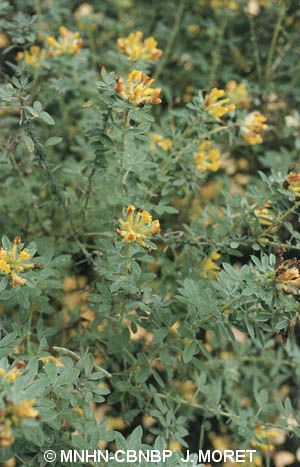
It is a small shrub up to 1.5 m in height. Crown airy, spreading. Shoots erect, gray-green in color. Young shoots green, pubescent.
Leaves compound, alternate, trifoliate, arranged along the stem on short petioles. Leaflets ovate or triangular in shape, apex rounded, margins entire, base rounded, gray-green, pubescent on both upper and lower surfaces.
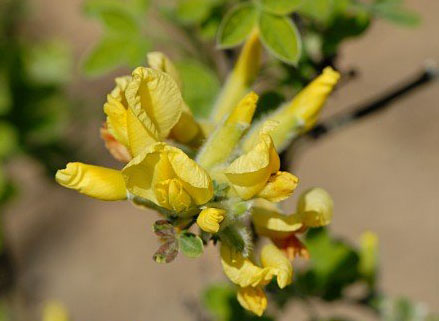
Flowers golden-yellow, up to 1.5 cm long, papilionaceous. They appear in the leaf axils. Flowers from late May until the end of July.
Fruits – dry, flat, broad-linear many-seeded pods that split open at maturity.
Varieties:
- Chamaecytisus ciliatus subsp. elongatus (Waldst. & Kit.) Soó
- Chamaecytisus glaber var. elongatus (Waldst. & Kit.) Kuzmanov
Hardiness zone: zones 6-8 (-23°C).
Site: very sun-loving. The best planting site is an open area with southern exposure, preferably sheltered from cold winds. Not recommended to plant near ponds with fish.
Pruning: after flowering it is recommended to cut back the spent shoots by half, avoiding old wood.
Propagation: by seeds, which are sown in spring after a two-month stratification, and by green cuttings in summer. Cultivars can be propagated by grafting onto broom.
Soil: drought-tolerant, does not tolerate prolonged water stagnation or overmoistening. Does not like clay soil. Prefers fertile, slightly acidic soil. Optimal soil pH 6.5 - 7.5.
Planting: soil mix – one part sand and the other part turf soil, peat-compost or humus; you can add a complete mineral fertilizer or Kemira-Universal (120 g per 1 m2). Does not like transplanting. Recommended spacing between plants – 30-50 cm. Root collar at ground level. Drainage is mandatory (on heavy soils – layer 15-20 cm, on light soils – 10 cm). After planting mulch the trunk circle with soil or peat to a depth of 3-5 cm.
Care: does not require irrigation. For better flowering it is recommended to feed the plant twice a year – first in spring, second before flowering. In spring apply urea (20 - 30 g per 10 l of water), in summer - 60 g granular superphosphate and 30 g potassium sulfate. To stimulate growth wood ash can be applied - 200 g per bush. Loosening no deeper than 8-12 cm.
Diseases: Powdery mildew (treat dormant buds with copper sulfate (5%), in summer treat regularly with Fundazol, copper-soap solution, colloidal sulfur (0.8%) alternately), Black spot (treat dormant buds with iron or copper sulfate; in summer spray with Fundazol, policarbacin (0.2 - 0.4%), copper oxychloride (1%), captan (0.5%), Bordeaux mixture (1%)).
Pests: broom moth (spray with chlorophos (0.2%)), broom geometer (treat with organophosphorus or bacterial insecticides).
Uses: a good melliferous plant. Used in rock gardens, alpine gardens, rockeries.