
Flowering shrubs
Prostrate broom
Cytisus decumbens
Synonyms: Spartium decumbens, Corothamnus decumbens (Durande) K.Koch, Genista decumbens (Durande) Willd., Genista prostrata Lam., Genista pedunculata L'Hér., Genista pedunculata L'Hér. subsp. decumbens (Durande) Gams., Cytisus multiflorus Fen., Genista decumbens Willd., Genista elata Ten., Genista procumbens Waldst. & Kit.
Prostrate broom (Cytisus decumbens (Dur.) Spach.) – a species of deciduous plants of the genus Cytisus (broom) in the family Fabaceae. The species was first described in 1782 by Jean François Durande as Spartium decumbens. In 1845 Eduard Spach placed this species in the genus Cytisus in his work «Annales des Sciences Naturelles; Botanique, sér. 3». In cultivation since 1775.
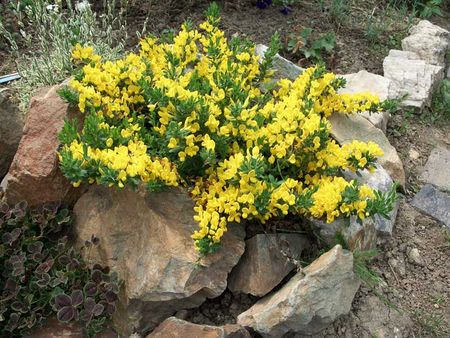
Photo by L. Khivov
Occurs in the Pyrenees and up to Stara Planina (formerly the Balkans). Also found in southern Yugoslavia, the southern Alps and the Apennines. Grows in the montane zone and rises to altitudes up to 1500 m above sea level. Occurs on rocky slopes and on forest edges on calcareous soil.
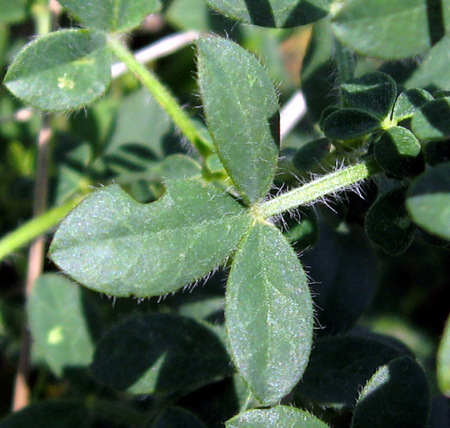
A deciduous shrub with a prostrate crown. It reaches 10-20 (30) cm in height and up to 60-80 cm in diameter. Grows very slowly. Branches numerous, sprawling, lying on the ground and rooting. Shoots ascending, pubescent, thin, ribbed (5 ribs), green in color.
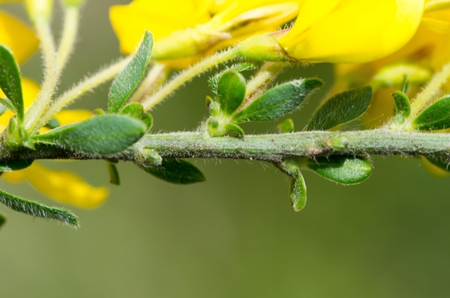
Leaves often simple, less often trifoliate, sessile, oblong or obovate in shape, 0.6-1.5 (2) cm long, acute at the apex and narrowed toward the base, densely green, covered with spreading hairs, especially strongly beneath and along the margins, appearing whitish due to pubescence. Stipules absent.
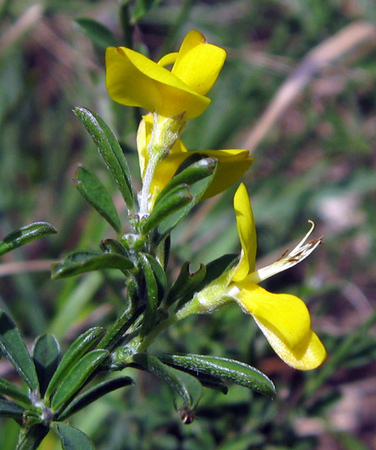
Flowers borne singly, in pairs, less often in threes, in the leaf axils along the length of the shoots. The corolla is papilionaceous, bright yellow. Standard 1-1.4 cm long, ovate in shape. The standard and the keel are glabrous; the keel is the same length as the standard and the wings together. Calyx bell-shaped, openly hairy. Flowers abundantly from June to July.
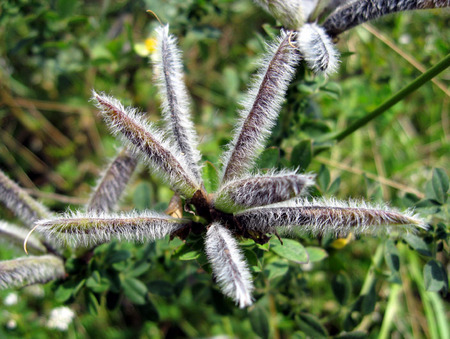
Pods erect, hairy, 20-25 (40) mm long, appear in October.
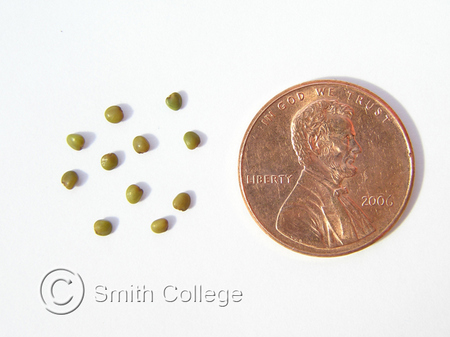
Chromosome number: 2n = 48
Varieties:
- Cytisus decumbens subsp. pindicola (Bald.) K.I. Chr. (syn. Cytisus decumbens var. pindicola (Bald.) Hayek, Corothamnus medius (Halácsy) Skalická, Cytisus medius Halácsy)
- Cytisus decumbens subsp. elatus
Hardiness zone: zone 5-8 (-28°C). In severe winters may suffer slight frost damage.
Position: very light-demanding. The best place to plant is an open area with a southern exposure, preferably sheltered from cold winds. Not recommended to plant near ponds with fish.
Pruning: after flowering it is recommended to cut back the faded shoots by half, without cutting into old wood.
Propagation: by seed (seed germination 90%). Summer cuttings root immediately after flowering (cutting rooting rate 87%).
Soil: drought-tolerant, does not tolerate prolonged waterlogging or over-moisture. Does not like clay soil. Prefers fertile, slightly acidic soil. Optimal soil pH 6.5 - 7.5.
Planting: soil mixture – one part sand and one part turf soil, peat compost or humus; a complete mineral fertilizer or Kemira-Universal (120 g per 1 m2) can be added. Does not like transplanting. Recommended spacing between plants – 30-50 cm. Root collar at ground level. Drainage is mandatory (on heavy soils – layer 15-20 cm, on light soils – 10 cm). After planting, mulch the root circle with soil or peat to a depth of 3-5 cm.
Care: does not require watering. For better flowering it is recommended to fertilize the plant twice a year – first in spring, second before flowering. In spring apply urea (20 - 30 g per 10 l of water), in summer - 60 g of granular superphosphate and 30 g of potassium sulfate. To stimulate growth, wood ash can be applied - 200 g under each bush. Cultivate no deeper than 8-12 cm.
Diseases: Powdery mildew (treatment of dormant buds with copper sulfate (5%), in summer regular treatment with Fundazol, copper-soap solution, colloidal sulfur (0.8%) alternately), Black spot (treatment of dormant buds with iron or copper sulfate; in summer spray with Fundazol, polikarbacin (0.2 - 0.4%), copper oxychloride (1%), captan (0.5%), Bordeaux mixture (1%)).
Pests: broom moth-pestrjanka (spraying with chlorophos (0.2%)), broom geometer (treatment with organophosphate or bacterial insecticides).
Conservation status: listed in the Red Book in Switzerland
Uses: a good nectar plant. Used in group plantings, on rocky slopes. Ornamental with bright yellow flowers densely covering the shoots along their entire length.