
Flowering shrubs
Clustered broom
Cytisus aggregatus
Synonyms: Cytisus hirsutus L., rakitnik gustovolosistyy (densely haired broom), Rakitnichek lezachiy (prostrate little broom), Melkorakitnik lezachiy (small prostrate broom), Melkorakitnik skuchennyy (small clustered broom), Rakitnichek skuchennyy (clustered little broom), Rakitnik lezachiy (prostrate broom), Cytisus hirsutissimus K.Koch, Chamaecytisus ciliatus (Wahlenb.) Rothm., Chamaecytisus hirsutissimus (K.Koch) Czerep., Chamaecytisus hirsutus (L.) Link, Chamaecytisus leucotrichus (Schur) Czerep., Chamaecytisus polytrichus (M.Bieb.) Rothm., Chamaecytisus proteus (Zum.) Holub, Chamaecytisus supinus (L.) Link, Cytisus aggregatus Schur, Cytisus alpestris Schur, Cytisus capitatus Scop., Cytisus ciliatus Wahlenb., Cytisus colchicus Albov, Cytisus falcatus Waldst. & Kit., Cytisus gallicus A.Kern., Cytisus hirsutissimus K.Koch, Cytisus leucotrichus (Schur) Schur, Cytisus polytrichus M.Bieb., Cytisus prostratus Scop., Cytisus proteus Zum., Cytisus pumilus De Not., Cytisus supinus L., Genista capitata (Scop.) Scheele, Genista supina (L.) Scheele.
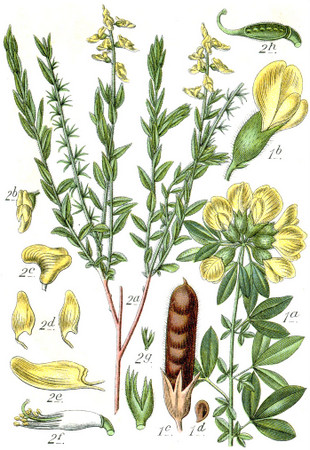
Artist - Jacob Sturm «Deutschlands Flora in Abbildungen» Johann Georg Sturm, 1796.
Clustered broom (Cytisus aggregatus Schur.) – a species of deciduous plants of the genus Cytisus (broom) in the legume family (Fabaceae). The species was first described under the name Cytisus hirsutus L. in 1753 by Carl Linnaeus in his work "Species Plantarum" ("Sp. Pl."). The name Cytisus aggregatus was published by the German-Austrian botanist Philipp Johann Ferdinand Schur in his book "Enumeratio Plantarum Transsilvaniae" ("Enum. Pl. Transsilv.") in 1866.
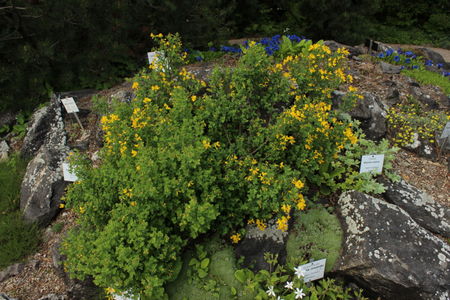
Botanical Garden of the University of Vienna
Native to Turkey, Georgia, the Russian Federation (Krasnodar Krai), Austria, the Czech Republic, Germany, Poland, Slovakia, Switzerland, Ukraine (Ivano-Frankivsk, Lviv, Ternopil, Zakarpattia), Albania, Bulgaria, the former Yugoslavia, Greece, Italy, Romania, France, Spain. Naturalized in India (Tamil Nadu) and Estonia. Grows in dry scrub and forests. Often occurs alongside downy oak.
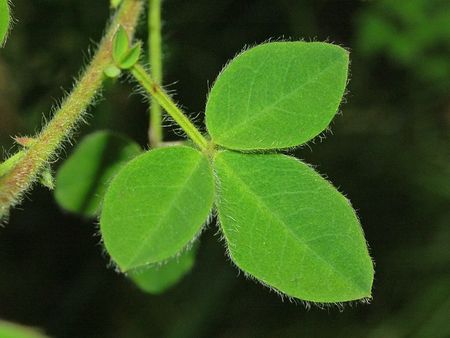
Photo author – Hectonichus, Genoa (Italy), 2008.
It is a dwarf shrub 30-40 cm in height and up to 100 cm in diameter. Branches erect and creeping, woody at the base, densely branched, bark gray-brown. Shoots green, covered with hairs up to 3 mm long.
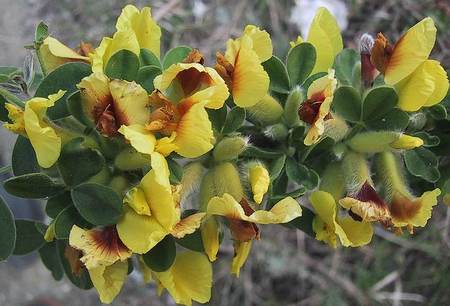
Photo author – polypo, 2009.
Leaves trifoliate, distributed along the length of the shoot. Leaflets ovate or elliptical, hairy on both sides, 18-25 mm long, tips and bases rounded, margins smooth. Petioles of medium length, covered with long hairs.
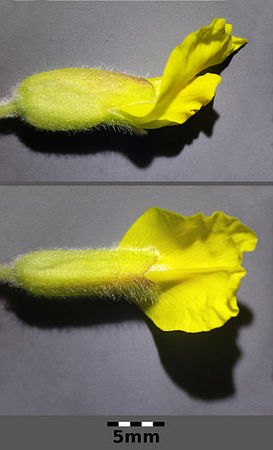
Photo author - Stefan.lefnaer, Korneuburg, Lower Austria, 2015
Flowers papilionaceous, initially orange-yellow, later the center becomes reddish-brown. Flowers from April to June.
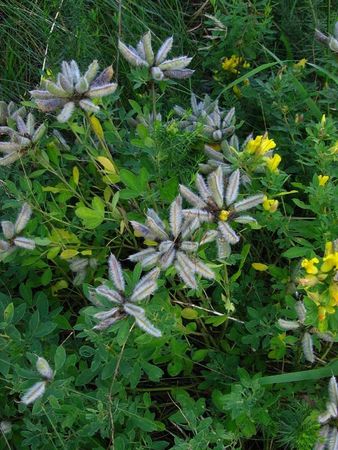
Photo author - Michael Kesl, Banat (Romanian part)
Fruits – pod-like legumes 25-40 mm long, densely covered with hairs, ripen in late summer. Plants flower and fruit from the age of 3 years.
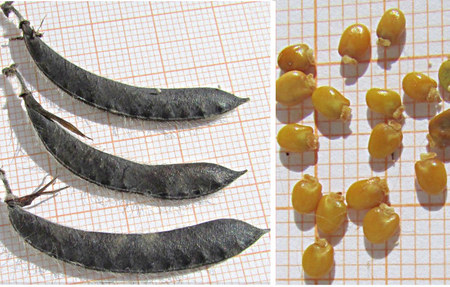
Subspecies:
- Cytisus hirsutus L. subsp. hirsutus
- Cytisus hirsutus L. subsp. ciliatus (Wahlenb.) Asch. & Graebn.
- Cytisus hirsutus L. subsp. elongatus (Waldst. & Kit.) Briq.
- Cytisus hirsutus L. subsp. leiocarpus (A.Kern.) Briq
- Cytisus hirsutus L. subsp. leucotrichus (Schur) Asch. & Graebn.
- Cytisus hirsutus L. subsp. polytrichus (M.Bieb.) Hayek
- Cytisus hirsutus L. subsp. ponticus Nyman
- Cytisus hirsutus L. subsp. ratisbonensis (Schaeff.) Briq.
Hybrids: Cytisus × ceticus Dostál
Hardiness zone: zone 6-8 (-23°C). The tips of annual, less often perennial shoots may be damaged by frost.
Exposure: very light-demanding. The best planting site is an open area with a southern exposure, preferably sheltered from cold winds. Not recommended to plant near ponds with fish.
Pruning: after flowering it is recommended to cut back the spent shoots by half, avoiding old wood.
Propagation: by seeds (seed germination 90%). Summer cuttings root immediately after flowering (cutting rooting success 87%).
Soil: drought-tolerant, does not tolerate prolonged waterlogging or over-wetting. Does not like clay soil. Prefers fertile, slightly acidic soil. Optimal soil pH 6.5 - 7.5.
Planting: soil mix – one part sand and the other part turf soil, peat compost or humus; a complete mineral fertilizer or Kemira-Universal can be added (120 g per 1 m2). Does not like transplantation. Recommended spacing between plants – 30-50 cm. Root collar at ground level. Drainage is required (on heavy soils – layer 15-20 cm, on light soils – 10 cm). After planting, mulch the planting circle with soil or peat to a depth of 3-5 cm.
Care: does not require irrigation. For better flowering it is recommended to fertilize the plant twice a year – first in spring, second before flowering. In spring apply urea (20 - 30 g per 10 l of water), in summer - 60 g granular superphosphate and 30 g potassium sulfate. To stimulate growth, wood ash can be applied - 200 g per bush. Loosening no deeper than 8-12 cm.
Diseases: Powdery mildew (treat dormant buds with copper sulfate (5%), in summer regular treatments with Fundazol, copper-soap solution, colloidal sulfur (0.8%) alternately), Black spot (treat dormant buds with iron or copper sulfate; in summer spray with Fundazol, polikarbacin (0.2 - 0.4%), copper oxychloride (1%), Captan (0.5%), Bordeaux mixture (1%)).
Pests: broom moth (spray with chlorophos (0.2%)), broom geometrid (treat with organophosphate or bacterial insecticides).
Uses: a good nectar plant. Used for creating low hedges, for decorating forest edges and rocky slopes. Can be used for soil stabilization.