
Indoor plants
Tamarillo, beetroot cyphomandra or Tree tomato
Cyphomandra betacea
Synonyms: Cyphomandra betacea or tree tomato, Solanum betaceum
Cyphomandra betacea or tree tomato (Cyphomandra betacea) – a plant of the genus Solanum in the nightshade family. The first tree tomato fruits were obtained in 1966 in New Zealand. the tree tomato fruits were obtained in 1966 in New Zealand.
Native to the Andes in Ecuador, Colombia, Peru, Chile, Argentina and Bolivia. The plant is still cultivated in commercial and private gardens for local production and is one of the most popular fruits in these regions. It is also grown in subtropical areas around the world, e.g. Rwanda, South Africa, Darjeeling and Sikkim in India, Nepal, Hong Kong, China, the USA, Australia, Bhutan and New Zealand.
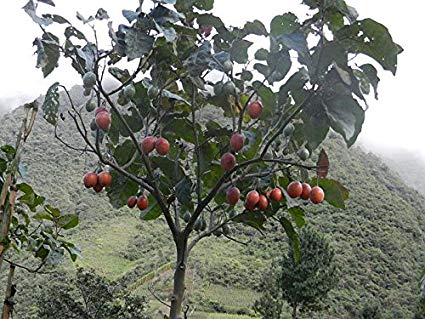
The first tamarillo crop sold on the international market in Australia was grown in 1996, although since the mid-1970s permaculture and exotic fruit enthusiasts had been growing the fruit across the country.
Until 1967 the fruit was known as «tree tomato», but the new name «tamarillo» (which was not a name in Spanish or any other language) was chosen by the New Zealand Tomato Promotion Council to distinguish it from the common garden tomato and to increase its exotic appeal.
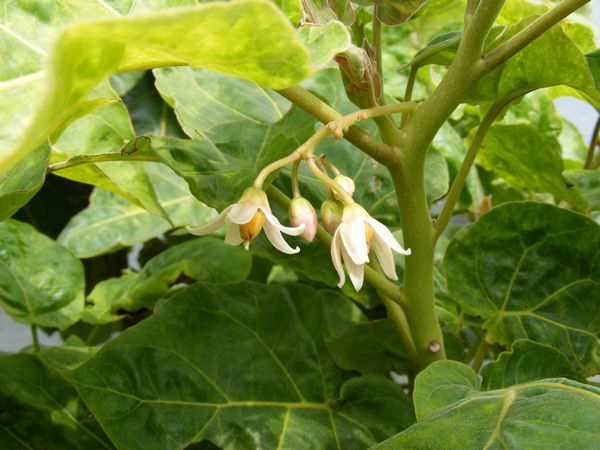
It is a small evergreen tree or shrub 2—3 metres high with large, oval, glossy leaves. It forms a single vertical trunk with lateral branches. Flowers are pinkish-white, fragrant, with a 5-part calyx, borne in clusters of 10-50 flowers. It begins to bear fruit at about 4 years of age, and the lifespan is about 12 years. Plants can fruit without cross-pollination, but the flowers are fragrant and attract insects. It can hybridize with other solanaceous plants.
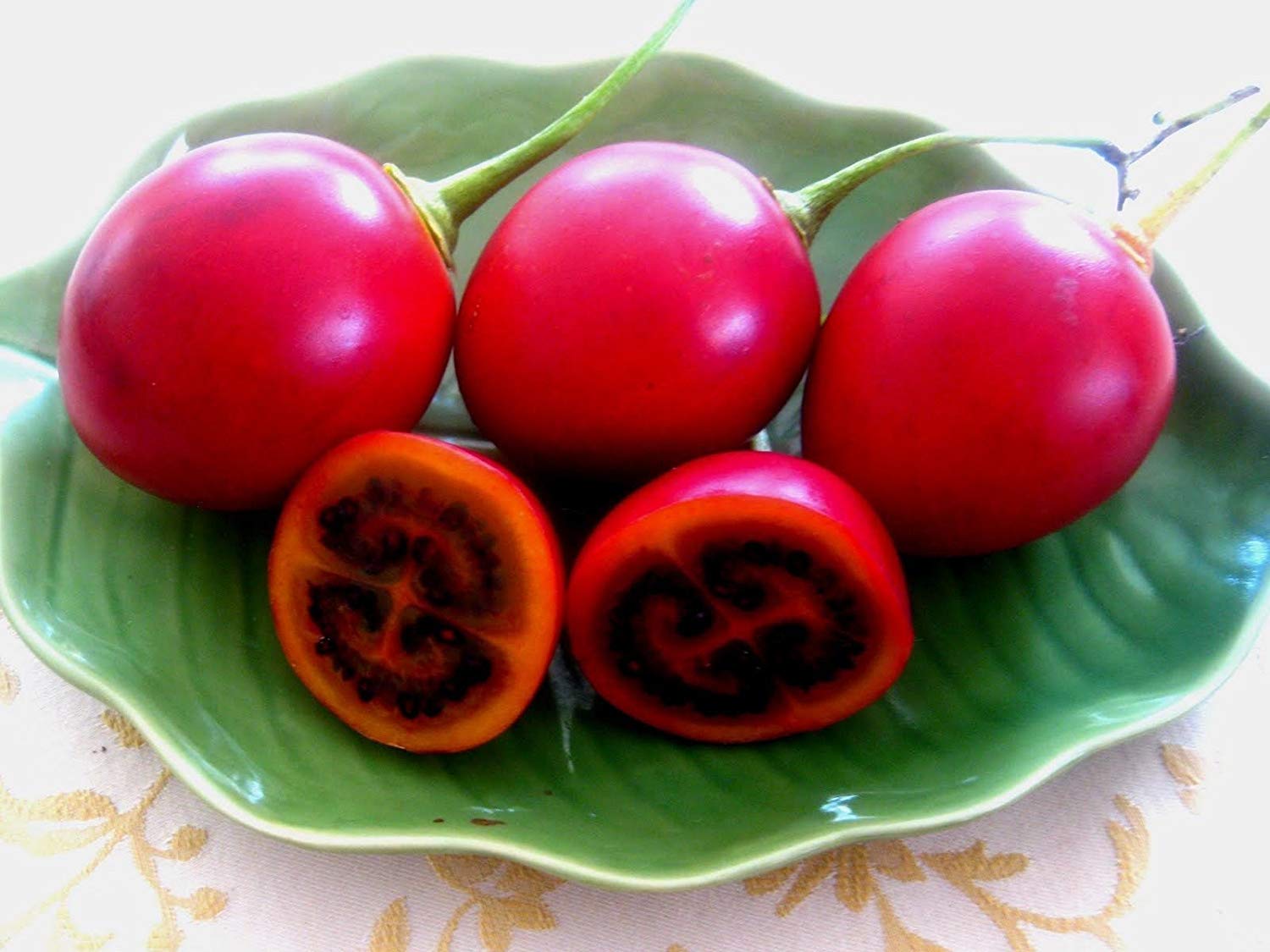
The fruits are ovoid, about 4-10 centimetres long. Colour ranges from yellow and orange to red and almost purple. Sometimes they have dark longitudinal stripes. Red fruits are more vinegary, while yellow and orange fruits are sweeter. The skin is glossy, firm and bitter, and the flesh has a dense texture and a sweet-sour-salty taste reminiscent of currant and somewhat gooseberry. The flesh colour is usually golden-pink, the seeds thin and round, black. The fruits are very rich in vitamins and iron and low in calories (only about 40 calories per fruit).
Hardiness zone: 12a (10°C).

Temperature: should be no less than 10 °C. With frosts (minus 1-2 °C) the foliage of mature trees falls and young shoots die.
Soil: loose, fertile with good drainage. For planting it is recommended to use a tub with an area of about 1-1.5 m² and a height up to 50 cm. The soil must be mulched. To grow a tamarillo tree takes 18-24 months, and during the first 8 months fruiting must be prevented in order to shape its crown. The tree grows and fruits for about 5-7 years.
Light: The permanent growing location should be slightly shaded.
Watering: requires fairly frequent watering, but standing water should be avoided.
Feeding: The plant is best fertilized with a cow manure infusion.
Transplanting: occurs 1-2 times a year. When transplanting use the rootball transfer method, which benefits the plant and its further development.
Propagation: propagated by seeds or cuttings. Seed propagation does not preserve parental characteristics. However, there is a tamarillo variety (red fruits with black flesh) for which parent qualities are retained when grown from seed. Before sowing, seeds are first washed free of pulp, dried in the shade, and then, to speed germination, placed in the refrigerator for a day. After that take a box, fill it with soil and sow the tamarillo seeds in rows spaced 60 cm apart. Distance between seeds about 30 cm. First shoots will appear in 5-6 days. When propagating Cyphomandra by cuttings they must first be rooted using water or an earthen substrate. Rooting in water is considered best because its transparency allows one to see when a callus forms and a swelling appears from which roots will emerge. This moment is the signal to plant into soil. Another vegetative method can also be used. For this, take fruiting tamarillo bushes, cut shoots with three buds and plant them in one-litre glass jars, leaving one bud above the soil. After watering and covering the jars with other jars or transparent polyethylene, place the containers in a warm place, protected from direct sunlight. With the onset of warm weather the rooted cuttings together with the clump of substrate should be planted in their permanent location. Propagation by cuttings produces fully formed plants that fruit in the same year, whereas plants obtained from seed fruit in 1.5–2 years. To encourage better branching of tamarillo trees, they are recommended to be pruned at a height of about 1 m. This agronomic operation is performed in spring one year after the first harvest.
Uses: Tamarillo fruits are eaten raw after removing the skin and the thin outer layer down to the flesh. They are ideal for adding a small amount of flesh to cocktails and smoothies to give a special aroma and unique taste. More often they are used for culinary processing and preserving. They do not store well and do not withstand long transport.