
Indoor plants
Cyperus, or Sedge, Sedge-like plant
Cyperus
Cyperus, or sedge, sedge-like plant (Cyperus) — a large genus of perennial herbaceous plants of the family Cyperaceae (Cyperaceae). Native to the island of Madagascar, and to swamps and marshes of Africa.
It most often grows near bodies of water, rivers and on marshy sites. It is one of the few aquatic plants that are grown indoors. Cyperus is an evergreen perennial herbaceous plant up to 1.7 m tall. It has erect reed-like stems ending in attractively curved narrow linear leaves. The flowers are small, inconspicuous, in spike-like inflorescences. This elegant herbaceous plant is generally undemanding. Cyperus does not have a pronounced dormancy period and grows equally well in cool and warm rooms.
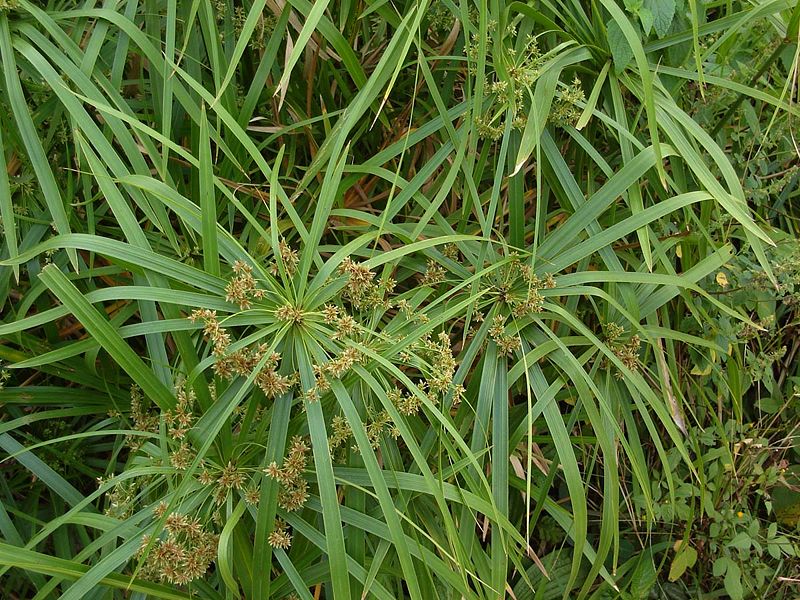
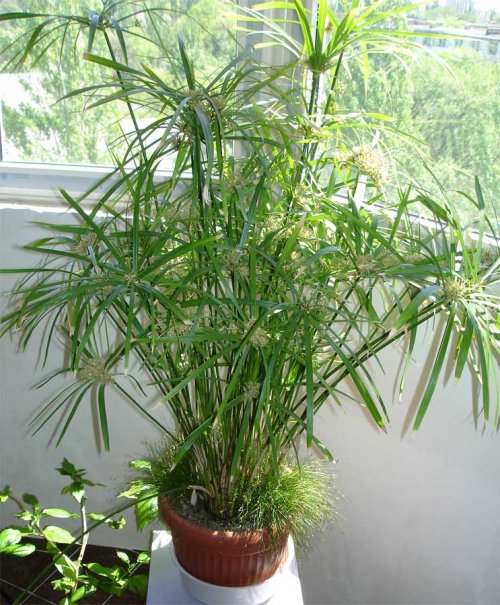
In indoor culture Cyperus is very often used to create a tropical plant corner. In addition to its very decorative appearance, this plant is an excellent companion for moisture-loving bromeliads, aroids, and orchids. Cyperus grows practically in water, evaporating a lot of moisture and enriching the air with it, which is vital for many plants.
In cultivation:
Spreading Cyperus - Cyperus diffusus
Grows widely in the tropics. Stems few, up to 90 cm tall. Leaves numerous, mostly basal (at the base of the stems), long, wide, 0.4—1.4 cm wide; in the upper part of the shoot in numbers of 6—12, 10—35 cm long and 0.4—1.2 cm wide.
Alternate-leaved Cyperus - Cyperus alternifoius
Grows on marshy riverbanks on the island of Madagascar. Evergreen, perennial herbaceous plants up to 1.7 m tall. Stem erect, usually rounded, sometimes triangular, ending above in a densely leaved umbrella-shaped crown. Leaves linear, narrow, drooping, up to 25 cm long and 0.5—1 cm wide; inflorescences — small panicles — emerge from the leaf axils.
There is a form with leaves that have a white stripe (Variegata).
Papyrus Cyperus - Cyperus papyrus
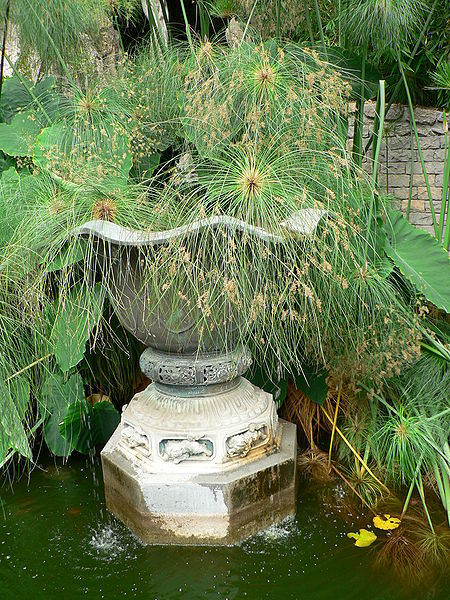
Abundant in the marshes of Egypt and Ethiopia, found in Tropical Central Africa. A perennial herbaceous plant, up to 3 m tall. Stems straight, strong, three-angled in the upper part, ending in a dense rosette of leaves: leaves long, pendulous. From the leaf axils emerge many-flowered (up to 100 flowers) inflorescences on thin peduncles. A highly ornamental plant, grown in moderately warm and warm rooms in a humid environment, in pots, but often planted in the ground (ensure abundant watering). As is known, the shoots of this papyrus can be used for boat construction and for making paper.
Temperature: Moderate in summer, between 18-25°C, in winter around 16-18°C, not below 12°C.
Light: A bright spot, light partial shade; shade from direct sun in summer, good illumination in winter.
Watering: Abundant at all times; the soil should never dry out. It is better to water from a tray.
Fertilizer: From March to September, feed every two weeks with a special balanced fertilizer for houseplants.
Humidity: Likes very humid air; regular misting and washing of the leaves is required. It is best to place the Cyperus on a water tray.
Repotting: Annually in spring; however the pot should not be too large. Soil - a mix of clayey loam (2 parts), leaf soil (1 part), peat (1 part) and sand (1 part). It is good to add some charcoal and crushed brick to the soil.
Propagation: By seeds, division of the clump, and by tip cuttings. For this, cut off the umbel after it has flowered or before flowering, and place it in a glass of water "head down", with the cutting end up. After some time it will produce roots.