
Indoor plants
Cymbidium orchid
Cymbidium
Synonyms: Jensoa Raf., Cyperorchis Blume, Iridorchis Blume, Arethusantha Finet, Pachyrhizanthe (Schltr.) Nakai, ×Cyperocymbidium A.D.Hawkes, 1964
The Cymbidium orchid (Cymbidium) – a genus of orchids in the family Orchidaceae. It was first described by the Swedish botanist Peter Olof Swartz in 1799. It was introduced into cultivation 2000 years ago (in China).
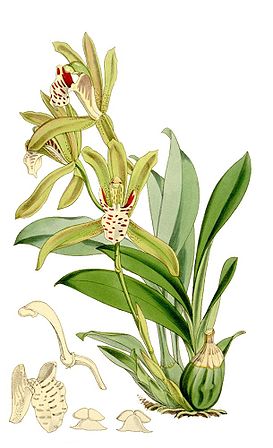
«Curtis’s botanical magazine» vol. 90 ser. 3 nr. 20 tab. 5457, 1864.
In nature they occur in tropical and subtropical Asia, as well as northern Australia. They grow on trees, rocks, and on the ground at altitudes up to 2000 m above sea level. They are epiphytic, lithophytic or terrestrial plants. Tuberoids ovoid in shape, densely covered by the bases of the leaves, gathered in compact clusters.
Leaves linear or sword-shaped, acute or obtuse, keeled, leathery.
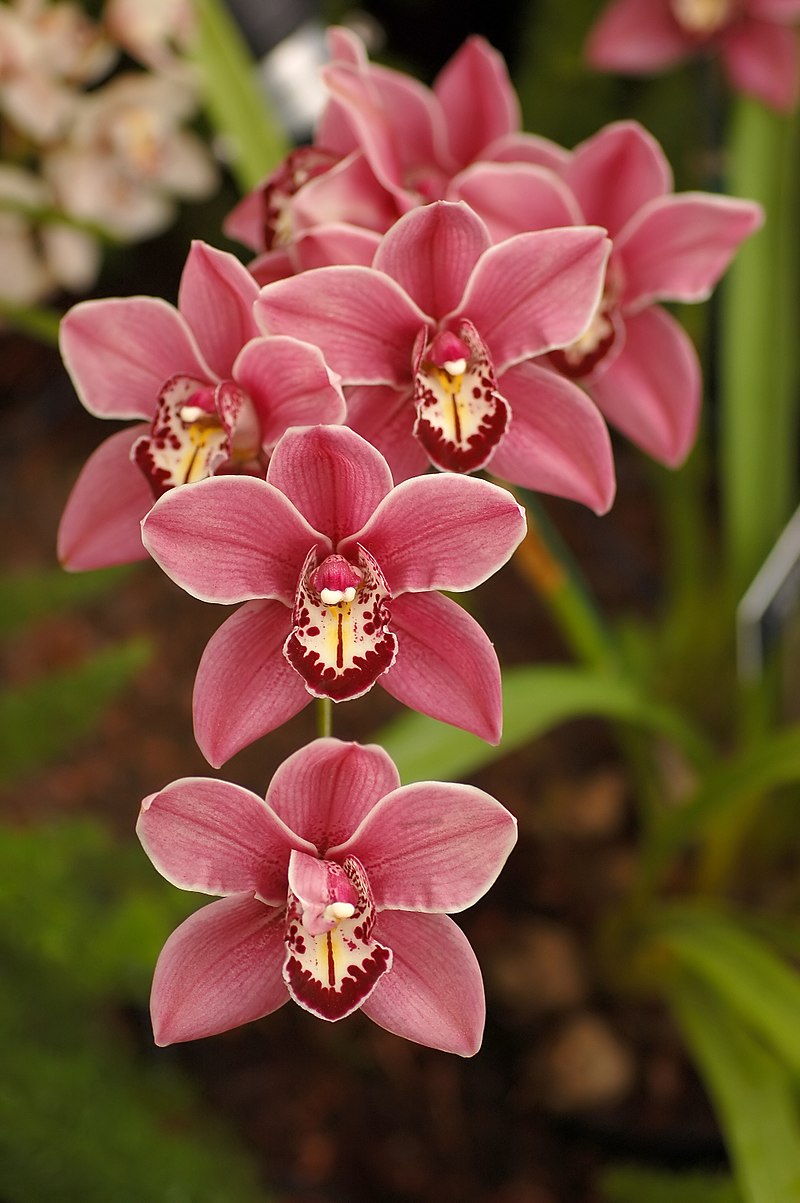
Inflorescence — a loose, erect, nodding or pendant few- or many-flowered raceme.
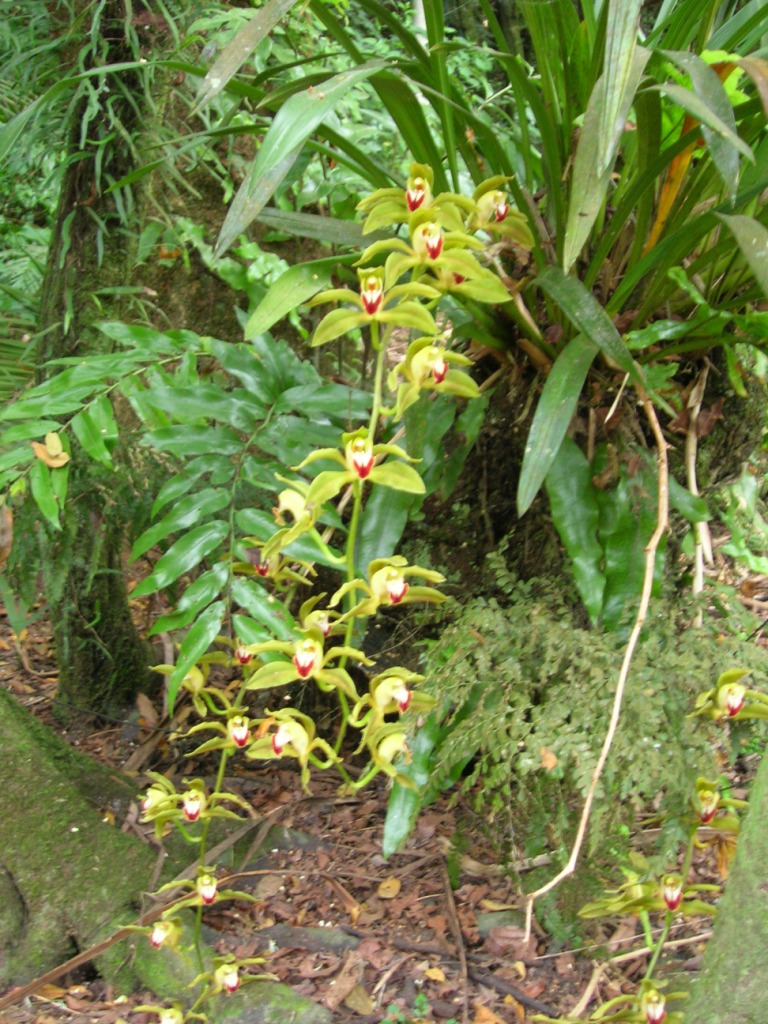
Flowers range from small to large. The color palette includes white, green, yellowish-green, cream, yellow, brown, pink and red in various shades. Sepals and petals are generally similar in shape and color, free, lanceolate or falcate. The lip is three-lobed, sessile, often brightly colored and variegated. The lateral lobes are straight and surround the column; the median lobe is arcuately curved. The column is long. Pollinia number 2–4. Sometimes the flowers have a pleasant fragrance.
Species: The genus comprises 64 species. Some of them:
- Cymbidium aloifolium (L.) Sw., 1799 — aloe-leaved cymbidium
- Cymbidium bicolor Lindl., 1833 — two-colored cymbidium
- Cymbidium canaliculatum R.Br., 1810 — grooved cymbidium
- Cymbidium ensifolium (L.) Sw., 1799 — sword-leaved cymbidium
- Cymbidium insigne Rolfe, 1904 — notable (or remarkable) cymbidium
- Cymbidium lancifolium Hook., 1823 — lance-leaved cymbidium
- Cymbidium lowianum (Rchb.f.) Rchb.f., 1879 — Low's cymbidium
- Cymbidium tigrinum C.S.P.Parish ex Hook., 1864 — tiger cymbidium
- Cymbidium tracyanum L.Castle, 1890 — Tracy's cymbidium
Hybrids: of natural origin
- Cymbidium ×ballianum Rolfe, 1904 (= Cym. eburneum × Cym. mastersii)
- Cymbidium ×baoshanense F.Y.Liu & Perner, 2001 (= Cym. lowianum × Cym. tigrinum)
- Cymbidium ×florinda auct., 1913 (= Cym. erythrostylum × Cym. iridioides)
- Cymbidium ×gammieanum King & Pantl., 1895 (= Cym. elegans × Cym. erythraeum)
- Cymbidium ×glebelandensis Rolfe, 1911 (= Cym. insigne × Cym. schroederi)
- Cymbidium ×rosefieldense auct., 1912 (= Cym. insigne × Cym. tracyanum)
- Cymbidium ×woodlandense auct., 1913 (= Cym. mastersii × Cym. tracyanum)
Hardiness zone: 12 (7°C).

Light: grown in partial shade. Leaves should be dark green. With excess light leaves become yellow-green. Insufficient light stimulates leaf growth; leaves may hang and curl into a spiral.
Temperature: summer - 24–29 °C by day and 10 — 16 °C at night; from autumn to spring - 18–24 °C by day and 7–13 °C at night. Seasonal and diurnal temperature fluctuations are necessary for the formation of flowering spikes.
Humidity: at least 50%.
Watering: even throughout the year. Reduced in winter.
Substrate: a mixture of small gravel or pieces of lava, pine bark, Osmunda roots, charcoal and sphagnum, providing good air permeability. When planting, special attention is paid to the absence of voids in the pot. Plants are kept in special pots resembling a vase. When cultivated in ordinary pots, flowering is less intensive.
Repotting: in spring, once every 2–3 years
Fertilization: use a balanced orchid fertilizer. From September to March plants are not fertilized.