
Indoor plants
Cymbidium
Cymbidium
Synonyms: Cyperochis Blume, Iridorchis Blume, Jensoa Raf., Pachyrhizanthe (Schltr.) Nakai
Cymbidium (Cymbidium Sw.) – a genus of epiphytic evergreen plants in the family Orchidaceae. The genus name comes from the Greek word «kymbes» - «boat», referring to the shape of the labellum. It was first described in 1799 by the Swedish botanist Peter Olof Swartz in his work «Nova Acta Regiae Soc. Sci. Upsal. 6: 70». Cultivated for more than 2000 years. The ancient Chinese philosopher Confucius called these flowers «the king of fragrances».
In the wild they are distributed in tropical and subtropical Asia and also in northern Australia. They occur in deciduous montane forests among epiphytic ferns and mosses at elevations of 1500–2400 m above sea level, where there are significant daily temperature fluctuations: daytime +21…+38°C, at night the temperature sometimes drops to 0 °C. In these areas there is also a monsoon climate with a cold dry winter with short frosts and a hot humid summer.
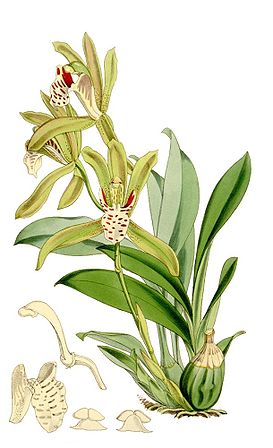
Cymbidium tigrinum - tiger Cymbidium. Illustration from the journal "Curtis's botanical magazine" vol. 90 ser. 3 nr. 20 tab. 5457, 1864.
Cymbidiums are epiphytic, lithophytic and terrestrial plants with ovoid stems (pseudobulbs), up to 15 cm high, densely covered with the bases of leaves and forming compact clumps.
Leaves linear or sword-shaped, acute or blunt-tipped, keeled, leathery.
Inflorescences erect or slightly inclined, pendulous or nodding, few- or many-flowered racemes. Flowers range from small to large. The color palette includes white, green, yellowish-green, cream, yellow, brown, pink and red tones. Sepals and petals are usually similar in shape and color, free, lanceolate or falcate. The labellum is three-lobed, sessile, often brightly colored and variegated. The lateral lobes are straight, surrounding the column; the middle lobe is arched. The column is long. Pollinia number 2—4.
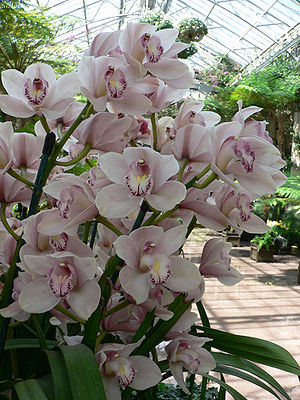
Species: more than 60 species are known and there is a huge number of hybrids. The best known species include:
- Cymbidium aloifolium (L.) Sw., 1799 — aloe-leaved Cymbidium
- Cymbidium ensifolium (L.) Sw., 1799 — sword-leaved Cymbidium
- Cymbidium floribundum (Cymbidium pumilum) – dwarf Cymbidium
- Cymbidium eburneum Lindl., 1847 - ivory Cymbidium
- Cymbidium insigne Rolfe, 1904 — notable Cymbidium
- Cymbidium lancifolium Hook., 1823 — lance-leaved Cymbidium
- Cymbidium lowianum (Rchb.f.) Rchb.f., 1879 — Low's Cymbidium
- Cymbidium dayanum Rchb.f., 1869 - Day's Cymbidium
- Cymbidium tracyanum Rolfe - Tracy's Cymbidium
- Cymbidium iridioides D.Don (Cymbidium giganteum), 1825 - giant Cymbidium
Hardiness zone: 10a (0°C).

Temperature: Cymbidiums are rather difficult to grow primarily because they require a cool winter rest at about 8-10 °C, as well as a mandatory lowering of the temperature at night to 12-14 °C. This is a required condition for successful flowering and growth. The nightly temperature drop is needed roughly from late August to mid-October.
Lighting: Cymbidiums are light-loving, but light should be diffused around midday. In winter illumination should be maximal – a south-facing window, as the day length is short.
Watering: Abundant during spring and summer growth; the substrate should remain moist. Excess moisture can cause root rot, and black spots may appear at the leaf bases. With insufficient watering, pseudobulbs shrivel, and buds and flowers may drop prematurely.
Fertilizer: During growth, budding and flowering feed with a special orchid fertilizer. The American Orchid Society states that the best fertilizer for Cymbidiums is balanced in N-P-K in equal parts – for example, NPK 12-12-12 or NPK 8-8-8; the absolute numbers are less important than equal proportions. The dose should be taken at half the recommended rate, and fertilizer applications should be made weekly over a moist substrate.
Air humidity: Around 50-60% is sufficient, however indoor humidity is often much lower. Therefore place a water reservoir nearby (fountain, tray with pebbles) or achieve higher humidity by misting in the morning and evening. If humidity is insufficient, leaf tips will dry and buds and flowers will drop.
Repotting: In spring, after flowering; substrate pH should be close to neutral. Preferable planting mix consists of turf soil (leaf mold can be used), pine bark and sphagnum moss. If moss or bark are not available, they can be replaced with chopped fern rhizomes. Pieces of charcoal are also added to the substrate. Cymbidiums do not like frequent repotting that disturbs the roots or overly spacious containers.
Propagation: By division during repotting. Each division should have at least three developed pseudobulbs. Water carefully after repotting and dividing. Wounds and cut sites should be dusted with charcoal.