
Fruit trees
Common quince
Cydonia
Common quince – a deciduous tree or shrub of medium height (4-5 m or 1.5 m), with a dense, spreading crown. The bark is thin, smooth; on old branches it is blackish-brown, dark gray or reddish-brown, on young ones – woolly-felted, brownish-gray. Young shoots are densely woolly-felted, gray-green. The root system is horizontal, lies within 1 m, forming many thin scaffold and semi-scaffold roots. In the wild it grows in the Caucasus, Transcaucasia and Central Asia. It is cultivated in almost all of Europe, North and South Africa, Australia and Oceania, and South and North America.
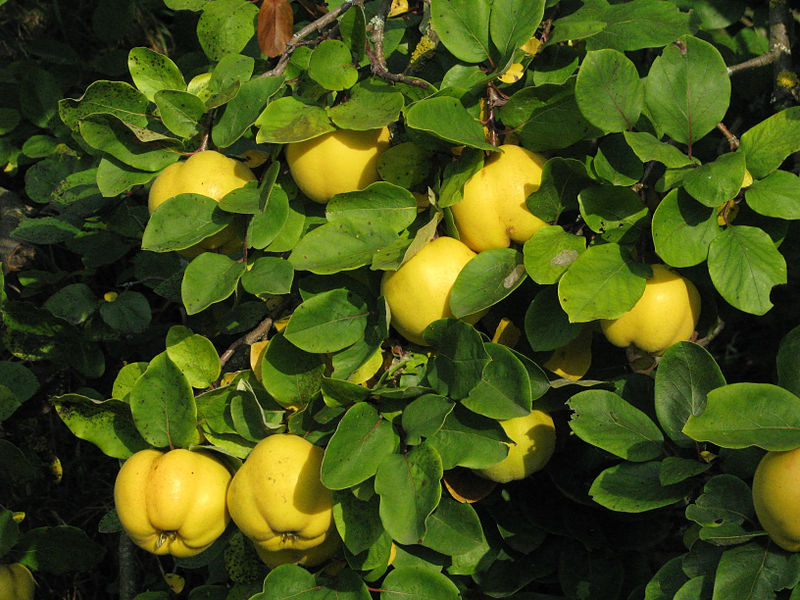
Leaves are alternate, ovate or oval, sometimes broadly elliptic, less often rounded, with entire margins, acute or obtuse at the apex, base cordate, cuneate, less often rounded. Dark green above, grayish beneath. Length 5-10 (12) cm, width 7.5 cm, on a short petiole up to 2 cm long. Stipules are oblong-ovate, sometimes lanceolate, 6-12 mm long and 4-6 mm wide.
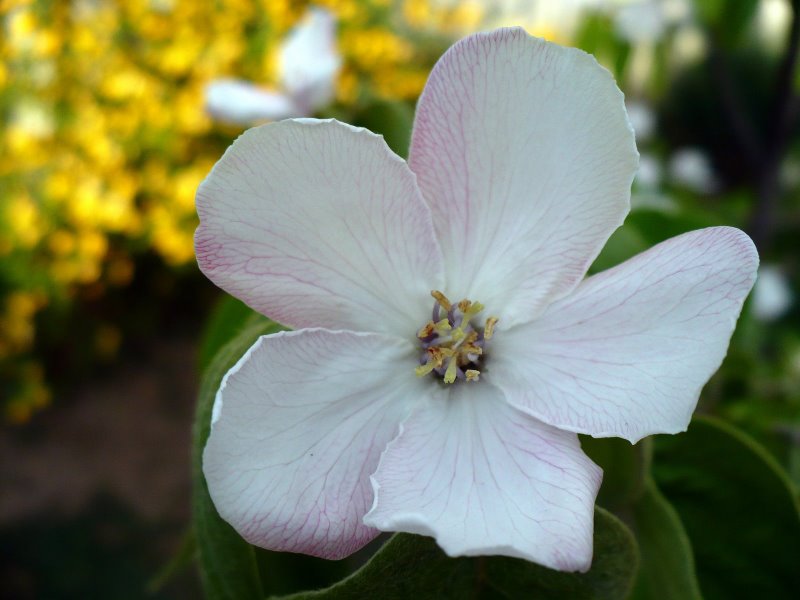
Blooms in May-June (about 3 weeks); flowers large, up to 5 cm in diameter, regular, solitary, on short pedicels, bisexual, white or pink, with five petals, pleasantly fragrant. Stamens 15-25, pistils 5, carpels 5 fused with the receptacle, sepals entire, reflexed, oblong, 5 in number.
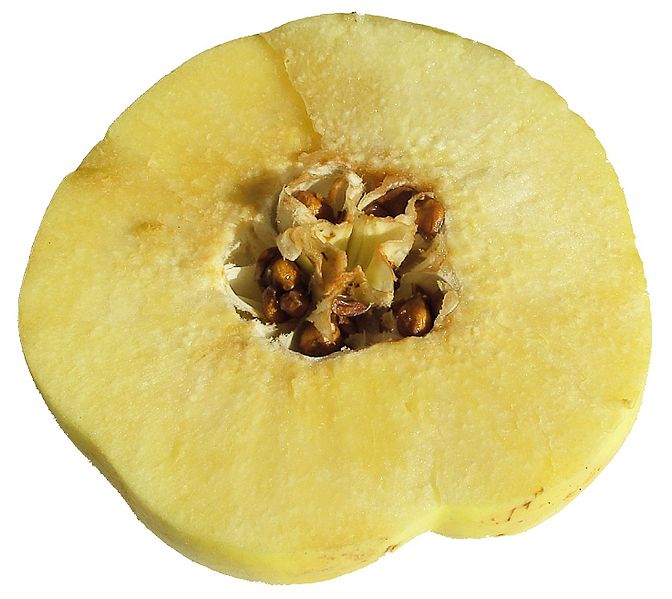
Fruits – pomes (false apples), oval, pear-shaped or rounded, woolly-felted, becoming smooth when ripe, dark yellow or lemon-colored, 7-12 cm long and 6-9 cm in diameter, very fragrant. The flesh is low-juiced, fairly firm due to numerous stone cells. Taste astringent, tart-sweet. Ripens in September-October.
Planting seedlings is preferably done in autumn, but can also be done in spring. Soil from the planting hole should be mixed with mineral fertilizer and bone meal. It is necessary to dig a hole that will freely accommodate the entire root system of the plant. Drive in a support stake, which should be slightly shorter than the lower branches of the seedling. Plant at a distance of at least 5 cm from the stake. Fill in the seedling with soil (the graft union should be 20 cm above the soil). Firmly cover with soil and tie the plant to the support stake. Distance between trees – 3-6 m depending on the cultivar (rootstock).
Diseases and pests: the most common diseases are scab and monilial blight. Pests: apple codling moth and oriental fruit moth.
Uses: fruits are used fresh and for preserving. The wood is used for small handicrafts. Mucilage is used in the textile industry to increase the sheen of fabrics. Widely used in traditional medicine. Also used as a rootstock for grafting pears and for hedges.