
Conifers
Japanese yew
Т. cuspidata
Synonyms: тис дальневосточный, тис японский, Taxus baccata subsp. cuspidata (Siebold & Zucc.) Pilger (1903), Taxus baccata var. cuspidata (Siebold & Zucc.) Carrière (1867), Cephalotaxus umbraculifera Siebold ex Endlicher (1847),Taxus baccata var. microcarpa Trautv. (1859), Taxus caespitosa Nakai (1938), Taxus caespitosa var. angustifolia Spjut (2007), Taxus cuspidata f. aurescens Rehder (1920), Taxus media f. hicksii (1923), Taxus umbraculifera (Siebold ex Endl.) C.Lawson (1851), Taxus umbraculifera subsp. laxa Spjut,, Taxus umbraculifera var. hicksii (Rehder) Spjut (2007), Taxus umbraculifera var. microcarpa (Trautv.) Spjut (2007), Taxus umbraculifera var. nana (Hort. ex Rehder) Spjut (2007).
Japanese yew (Taxus cuspidata Siebold & Zucc.) – a species of evergreen coniferous shrubs from the genus Taxus of the family Taxaceae. It was first described in the "Abhandlungen der Mathematisch-Physikalischen Classe der Königlich Bayerischen Akademie der Wissenschaften" ("Abh. Math.-Phys. Cl. Königl. Bayer. Akad. Wiss." 4(3):232 (Fl. jap. fam. nat. 2:110.)) by botanists Joseph Gerhard Zuccarini and Philipp Franz von Siebold in 1843. It was introduced to Europe by Robert Fortune in 1855, where most cultivars were developed, and also introduced to the USA. In Ukraine it has been in cultivation since the 20th century, mainly used in botanical gardens, dendraria and dendroparks – grows in the Ustimovskyi Dendropark (Poltava region), ChP SVM "Dendrarij derzhsortomerezhi", and in the Park of the Partizan state farm (Kryvorudskyi).
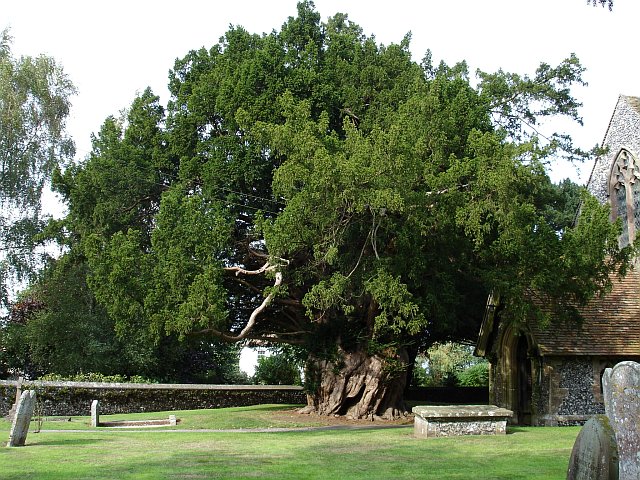
In nature it grows in southern Priamurye, Primorye, Korea, the DPRK, China, Japan including Sakhalin Island and the Kuril Islands. It is rare in mixed coniferous and coniferous-broadleaf forests from lowlands to low mountains, from 100 m to 1600 m above sea level. It grows singly on steep or gentle mountain slopes, in river valleys, on ancient terraces and rocks. It mainly grows on weakly podzolized loamy soils, shallow but with a sufficient humus layer.
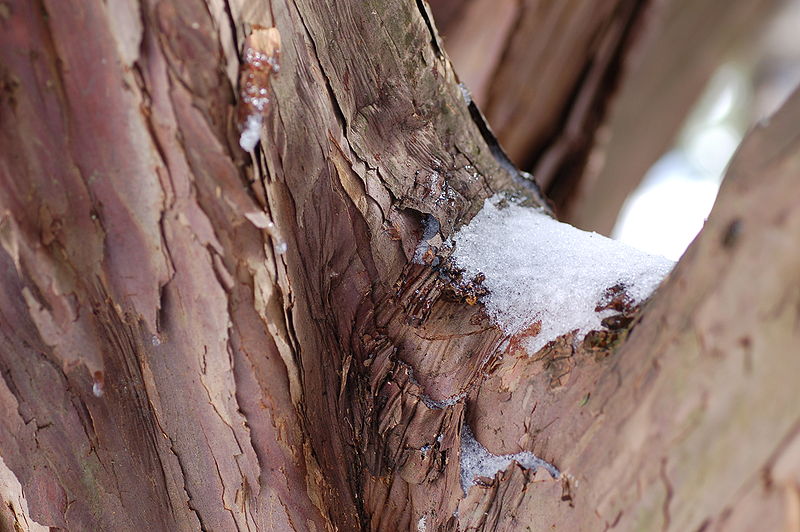
It is an evergreen coniferous tree up to 20 m tall, in cultivation reaching 3–7 m; on the Kuril Islands it takes the form of a prostrate shrub up to 1.5 m high. It grows slowly and can live up to 1500 years. Crown irregular or oval, with horizontal branches. The trunk can reach 1–1.2 m in diameter. Bark thin, reddish-gray, flaking. Young shoots and leaf petioles yellowish, especially on the lower side. Bud scales acute at the apex, keeled on the back, buds elongated.
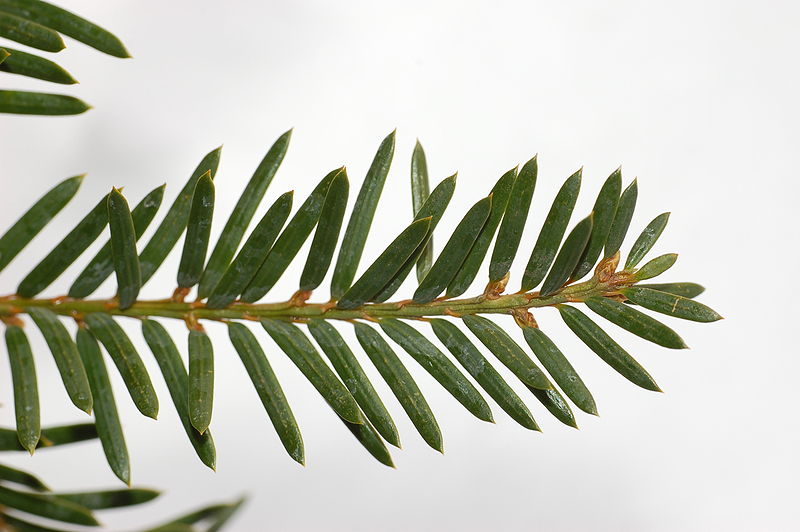
Needles sickle-curved, soft, flat, sharply pointed, 18–26 mm long and 2.5–3 mm wide, abruptly tapering to a short spine, petiole yellowish, upper side dull green to almost dark green with a strongly prominent midrib, underside light green with two brownish-yellow bands.
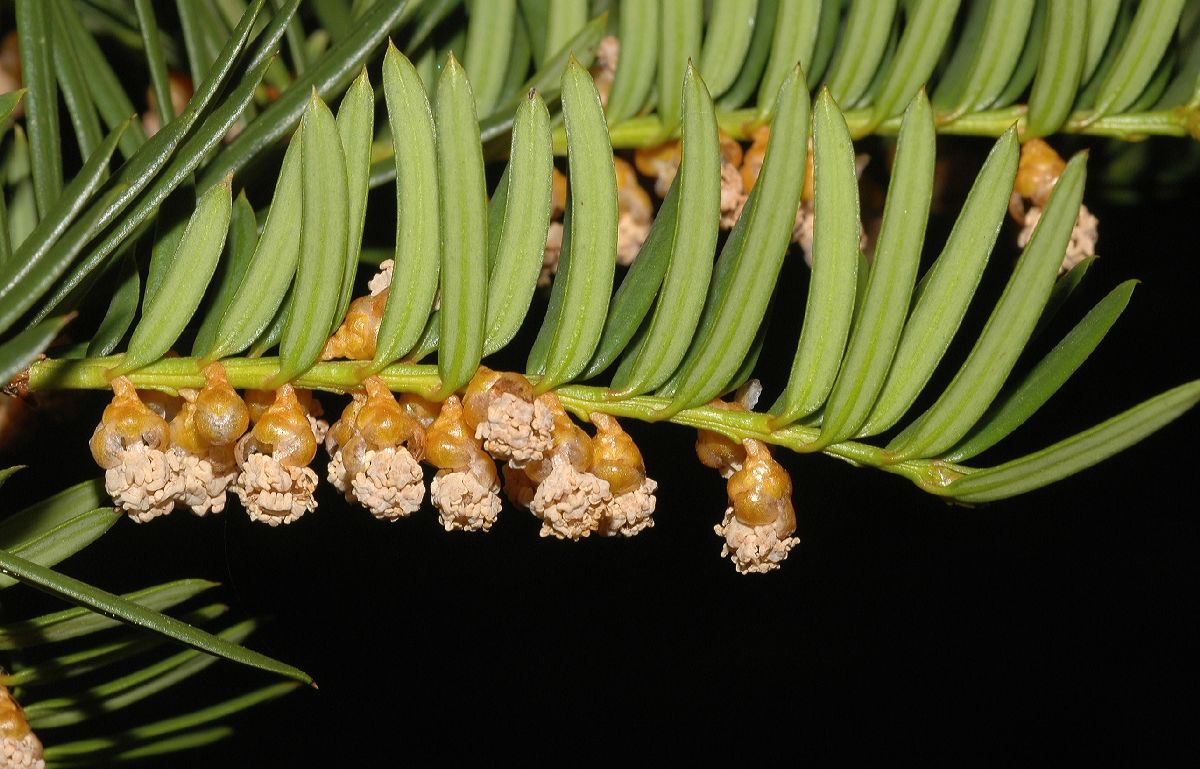
The plant is dioecious, less often monoecious. Microsporophylls spherical, with 2–8 sporangia, in the form of sessile "spikes", located in the leaf axils at the ends of last year's shoots. Megasporophylls are reduced, consisting of ovules that grow singly and are located on the tips of short axillary shoots.
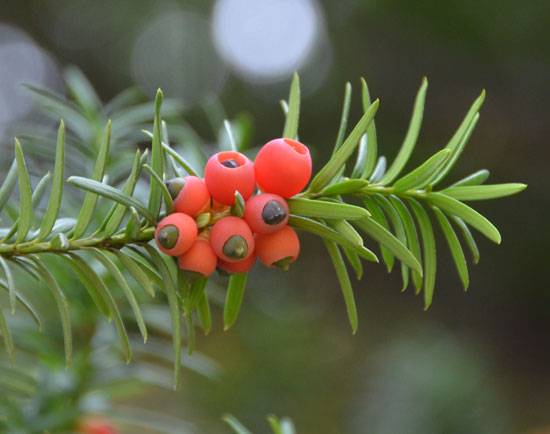
Seeds are surrounded by a fleshy pink or reddish edible aril up to half their length, from which the pointed seed is visible. Seeds are oval, slightly flattened, 4.7–6.5 mm long and 3.6–5 mm wide, with an almost smooth surface, olive-brown in color, ripening in August-September. Begins to fruit at 25 years.
Varieties:
- Taxus cuspidata var. ambraculifera Makino (1925).
- Taxus cuspidata f. aurescens Rehd. (Taxus tardiva aurea hort.)
- Taxus cuspidata var. caespitosa (Nakai) Q. L.Wang (1995).
- Taxus cuspidata var. hicksii Rehder ex Bailey (1923).
- Taxus cuspidata var. microcarpa (Trautv.) Kolesnikov (1935).
- Taxus cuspidata var. nana Hort. ex Rehder (1902).
- Taxus cuspidata var. umbraculifera Makino (1931).
- Taxus cuspidata f. pygmaea Hornib.
- Taxus cuspidata f. densa Rehd.
Cultivars: 'Aurescens', 'Capitata', 'Columnaris', 'Expansa', 'Nana''Dwarf Bright Gold', 'Densa', 'Farmen', 'Hitii', 'Minima', 'Rustique'.
Hybrids:
- T. baccata x T. cuspidata = T. media Rehd. (1900, USA)
- T. cuspidata x T. canadensis – T. Hunnewelliana Rehd.
Hardiness zone: 3b (-40°C)
Site/exposure: Shade-tolerant, requires locations sheltered from sun and wind. Tolerates partial shade; in shade it is more cold-hardy and better colored. Demands adequate air and soil moisture. Drought-tolerant and undemanding, but does not tolerate stagnant waterlogging. Resistant to air pollution and smoke.
Soil: Grows on any garden soil; not demanding of fertility, but more ornamental on calcareous, fertile soils with good drainage.
Planting: Soil mix – garden soil, peat and sand in proportions 3:2:2. Transplants well, even at an advanced age. Optimal spacing between plants 0.6–2.5 m, for large specimens 3–4 m. Planting hole is dug to a depth of 70 cm, root collar at ground level. For hedges, trenches 50 cm deep and wide are dug.
Care: In hot and dry summers, to maintain ornamental appearance, it is recommended to water the plant 1-2 times a month at a rate of 11-12 L per plant and mist once every 2 weeks. In the first years after planting, loosen the soil to a depth of 10-15 cm. Young trees are recommended to be covered for winter with a 5-7 cm layer of peat and protected from sunscald with boughs.
Pruning: has a high ability to produce shoots. Easily tolerates clipping and heavy pruning, removing up to half of a shoot when forming hedges or crowns.
Diseases: phomopsis juniperovora, phytophthora cinnamomi
Pests: yew gall midge, yew false scale, parthenolecanium pomeranicum, cecidophyopsis psilaspis, vine weevil (otiorhynchus singularis).
Propagation: produces abundant suckers. Propagated by seed; ornamental cultivars and forms by cuttings, grafting or layering. Seeds do not lose viability for up to 4 years. Seed viability 23%. After collection, store them in a dry place at 5-6 °C, but it is recommended to sow them in autumn immediately after collection. First seedlings appear after 1-2 years. For spring sowing, stratification for 7 months is recommended. Cuttings root 100% when treated with a 0.02% solution of succinic acid for 24 hours.
Uses: widely used in ornamental groups or as specimens, for decorating parterre lawns, creating borders, hedges, rockeries and heather gardens, for decorating the lower tier under tree canopies, and for creating green sculptures. Can be grown as bonsai.