Indoor plants
Turmeric
Curcuma
Turmeric (lat. Curcuma) — a genus of monocotyledonous herbaceous plants in the ginger family (Zingiberaceae). The native range of turmeric is southeastern India. This is the only place where it is found in the wild.
Domestic turmeric, long turmeric or turmerik (Curcuma damеstica, Curcuma longa) - a perennial herbaceous plant up to 1 m tall. The rhizome is fleshy, with elongated roots from which tuberous swellings develop. A cluster of leaves and a shoot bearing a long inflorescence arise from the rhizome. The leaves are long, ovate-lanceolate or lanceolate-elongated and sheathing. The flowers are yellow, gathered in an apical inflorescence 15–25 cm long with a spirally arranged bract on a sturdy tall scape. With proper care the flowers remain on the plant for up to 3 months. A well-developed plant produces up to 7 scapes. It blooms from July to October. Fruits are formed very rarely. Known since ancient times as a spice and a dye.
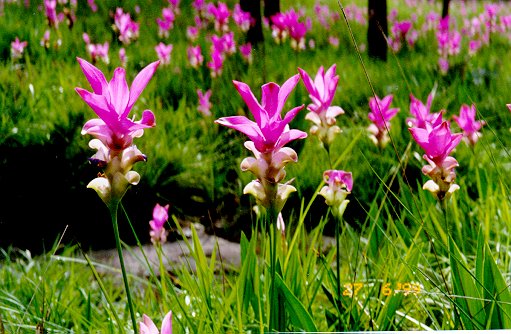
Curcuma Siam tulip, patumma, (Curcuma alismatifolia) - a plant 50–80 cm tall native to Thailand, with many forms having different flower colors: primarily yellow, white, purple, and pink. A compact form, Curcuma alismatifolia compact, has been developed, reaching up to 25 cm in height with a small rhizome.
Location: turmeric prefers warm, humid conditions and a long day length. It requires a period of dormancy. After the above-ground parts die back (although there are varieties whose leaves do not die back in winter) the rhizome is either dug up or the pot is placed in a dry cool place at about 7 °C, avoiding complete drying out. At the end of March–April the plant is planted into fresh soil.
Light: the plants are sun-loving but prefer diffused rather than direct sunlight; with insufficient light growth slows, flowering duration shortens, and the intensity of petal coloration decreases.
Watering: during growth and flowering it needs abundant watering and feeding every two weeks.
Air humidity: requires high air humidity and regular misting during the summer period.
Propagation: by dividing the rhizome into parts, leaving at least two lateral roots on each part.
Uses: grown as a houseplant and for cut flowers. As cut material the exotic inflorescences last 2–3 weeks. Domestic turmeric is used as a spice and medicinal plant. Powder made from dried turmeric rhizome is consumed, which, in addition to its aromatic properties, has a beneficial effect on the liver and gallbladder.