
Indoor plants
Cupressus macrocarpa "Goldcrest Wilma"
Cupressus macrocarpa "Goldcrest Wilma"
Synonyms: lemon cypress, Monterey cypress 'Wilma', Lemon cypress 'Wilma'
Cupressus macrocarpa Goldcrest Wilma (Cupressus macrocarpa Goldcrest Wilma) - a cultivar of Monterey cypress (Cupressus macrocarpa) of the genus Cupressus (Cupressus) in the family Cupressaceae (Cupressaceae). The cultivar was discovered in 1987 at Goldcrest and introduced into cultivation in Poland by P. Overkleeft.
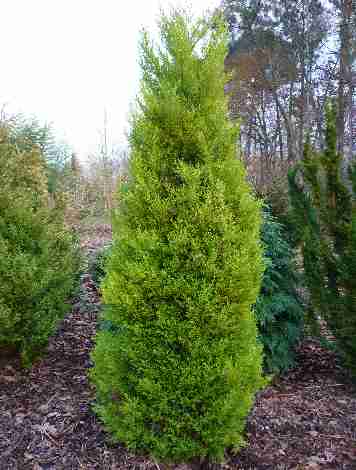
It is a dwarf evergreen tree with a conical crown 1.5-2 m in height and 90-120 cm in diameter. Branches are directed obliquely upwards.
The root system is poorly developed; roots are located mainly at the surface.
Foliage is very bright, yellowish-green (the younger the more yellow), scaly, ovate-rhomboid, tightly appressed to the shoots; when crushed it has a lemon scent.
Hardiness zone: 7a (5°C)
Temperature: requires moderate temperatures – minimum in winter -5°C, optimal for wintering 8-10°C. From the end of May until the end of August it is preferable to keep it outdoors in a shaded and draft-protected place.
Light: should be kept in diffused light and shaded from direct summer rays. In winter it is better to place it in a well-lit position. In summer it can be placed on a north-facing window, and in winter – on a south-facing one, until bright spring sunlight. With insufficient sun the cypress elongates and loses the crown shape; with excess light the foliage yellows and falls off.
Watering: from spring to autumn water abundantly; in winter – moderately. Does not tolerate excess water or soil drying. In the winter period watering depends on room temperature – at 8°C water once every 10 days, at 12-14°C – once every 5-7 days.
Fertilization: from May to August you can feed with a liquid mineral fertilizer for indoor conifers. Fertilization is recommended once a month.
Air humidity: in spring and summer requires daily misting. In the winter period, if it is not possible to keep it in a cool room, it should also be sprayed with warm water in the morning and evening.
Transplanting: transplanting is carried out annually in April-May. It tolerates transplanting poorly, so a full transplant with soil replacement is performed only when necessary. Usually a potting-up method is used, with partial replacement of the topsoil layer.