
Conifers
Cypress
Cupressus
Cypress (lat. Cupressus) — a genus of evergreen trees and shrubs of the cypress family (Cupressaceae) with pyramidal or spreading crowns.
Cypresses grow in the subtropical and tropical climates of the Northern Hemisphere; they are widespread in the Mediterranean, on the Black Sea coast of the Caucasus and Crimea, in the Sahara, the Himalayas, southern China, and in the Americas from Guatemala to Oregon.
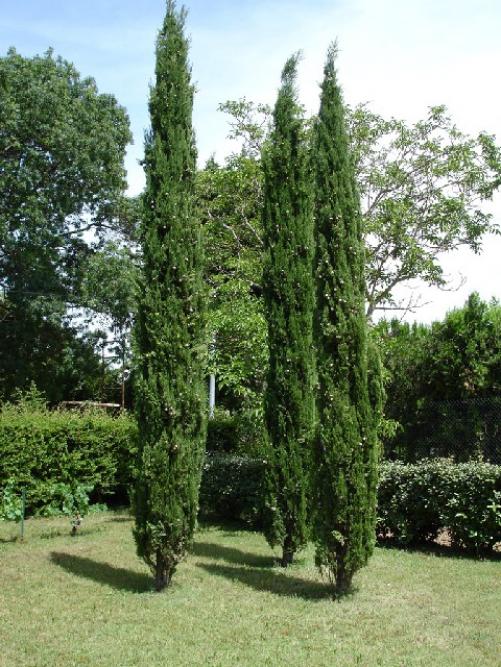
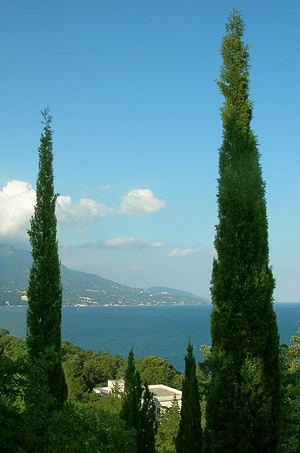
Cypresses are trees or shrubs. Leaves are small; in young plants needle-like, in adults scaly and pressed to the branches. Cypress is a monoecious plant. Cones mature in the second year, becoming spherical or ovoid, and the scales take the form of thick, multifaceted woody shields. The seed is somewhat flattened and equipped with a narrow wing.
In cultivation:
Arizona cypress (Cupressus arizonica Greene)
Evergreen tree. Naturally occurs in the southwestern USA and in Mexico. An undemanding tree up to 21 m tall, tolerates frosts down to -20…-25 °C. It has heavier and stronger wood compared with other cypresses. Propagated both vegetatively by cuttings and by seeds. When propagated by seed, with good cultivation techniques one can obtain plants 30-40 cm tall with a well-developed root system in a single growing season. A very attractive tree in both winter and summer. Often used where the evergreen cypress does not grow. Hardy and frost-resistant, but young plants should be covered for the winter during the first two to three years to avoid partial freezing or death.
Large-fruited cypress (Cupressus macrocarpa)
Evergreen coniferous tree, reaching 20—25 m in natural conditions. The crown of young plants is columnar. With age the branches arch, forming a spreading crown. The foliage has a lemon scent. Several cultivars have been developed that are considered most suitable for greenhouse conditions and for bonsai culture. The plant is light-loving, prefers ventilated rooms with moderate temperature and high humidity. Watering is moderate. Several cultivars allow creating almost all Japanese bonsai styles, though the upright style is preferable. The foliage color of cultivated forms of Cupressus macrocarpa is generally lighter than the wild type, yellowish-green or golden. The native range of this plant is California, USA.
Weeping cypress (Cupressus funebris Endl.)
Evergreen tree of the cypress family. In nature the weeping cypress is found in China. The tree reaches up to 18 m, with drooping branches. The plant is often planted in cemeteries in China and Japan. Some researchers place this plant in the genus Chamaecyparis under the name Chamaecyparis funebris (Endl.) Franco.
Evergreen cypress (Cupressus sempervirens)
An evergreen tree up to 30 m tall, with a narrow conical (columnar) crown and short ascending branches pressed close to the trunk. Foliage small, scaly, elongated-rhomboid, arranged in a crosswise manner and tightly appressed to the shoots. Grayish-brown, rounded cones up to 3 cm in diameter hang on short twigs. Seeds are reddish-brown with a narrow wing, up to 20 under each scale. Grows fairly quickly, especially when young, reaching its maximum height by about 100 years. Shade-tolerant. Tolerates prolonged drought and short-term temperature drops down to —20°C. Undemanding to soil, tolerates rocky and calcareous, dry and slightly saline soils, but prefers deep, fresh soils. On excessively wet soils it is short-lived and suffers from windthrow. Resistant in urban conditions, tolerates pruning well. Long-lived. Begins to fruit at 5-6 years.
In cultivation since ancient times. Lives to 2000 years and more. In Turkey it is often planted in cemeteries.