
Flowers for the garden
Saffron or Crocus
Crocus
Saffron or Crocus (lat. Crocus) — a genus of perennial cormous herbaceous plants of the family Iridaceae (Iridaceae). The genus comprises about 80 species, distributed in the subtropical and temperate zones of the Mediterranean, Central and Eastern Europe, the Caucasus, and Central and Western Asia.
The name derives from the Greek word 'kroke' — thread.
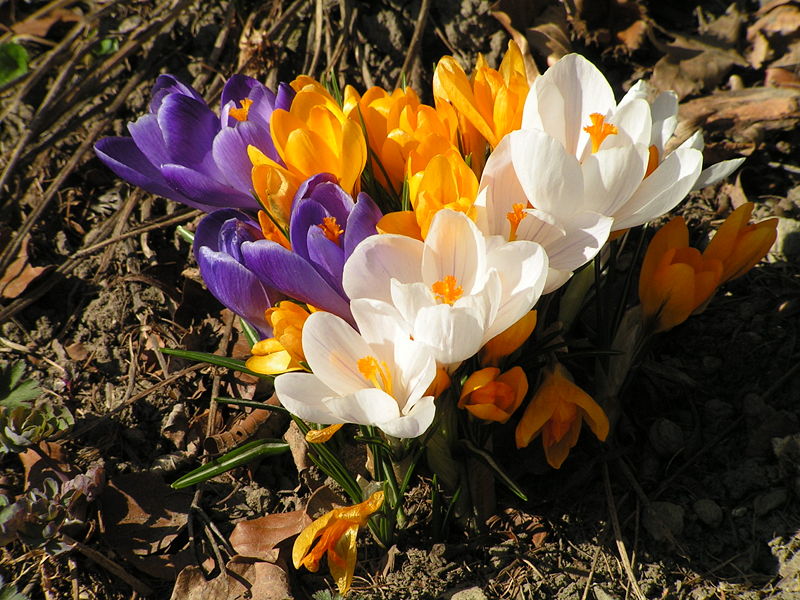
Perennial herbaceous cormous plant, corms up to 3 cm in diameter, rounded or flattened, covered with scales, producing a tuft of fibrous roots, the structure and coloration of which vary among different species. A stem does not develop. Leaves are basal, linear, enclosed at the base by membranous sheathing scales, appearing during or after flowering.
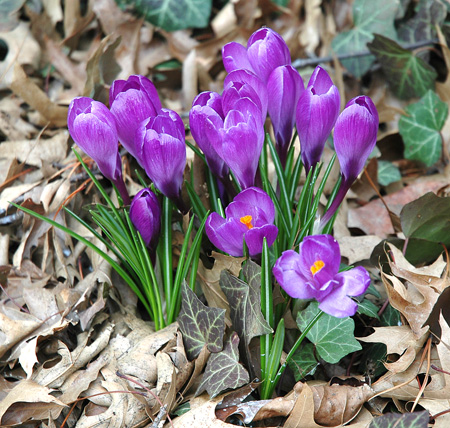
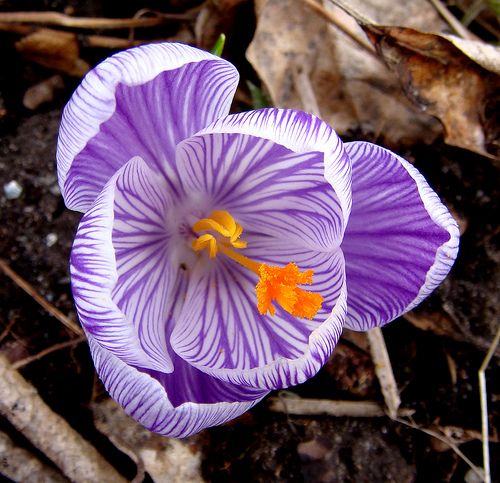
Flowers are solitary, sometimes 2—3 from a single corm, surrounded by membranous scales. The perianth is large, long-funnel-shaped. Fruits are three-chambered capsules, seeds small and angular. Flowering period — spring or autumn (depending on species). By flower color species are divided into two groups: yellow-flowered (color from yellow to orange) and blue-flowered (color from pale lilac to dark purple); albinistic forms also occur — often among the blue-flowered, less often among the yellow-flowered.
In cultivation:
Saffron - Crocus sativus
Perennial cormous herbaceous plant, reaching 10—30 cm in height. The corm is globular, with fibrous roots, reaching 2.5 cm in diameter. Leaves are erect, linear, a few millimetres wide, thick, 6—15 in a cluster. Flowers are pale violet, yellow, or white. The flower consists of a six-lobed perianth and three stamens.
Saffron has a strong distinctive aroma and a slightly bitter, spicy taste. The stigmas of saffron are used to color and flavor confectionery, in cooking, and also in the production of cheese, sausages and liqueurs.
Spring saffron, or spring crocus - Crocus vernus
Perennial herbaceous cormous plant; reaches 15 cm in height. The corm is flattened, covered with netted scales. The mother corm is replaced annually by a new one. No aboveground stem develops.
Leaves are dark green with a silvery-white longitudinal stripe, narrow, linear, at the base surrounded by a membranous sheath.
The flower is bell-funnel-shaped; 1—3 flowers develop from one corm, lilac or white, sometimes striped, the throat of the flower is pubescent. Anthers are lemon-yellow. Blooms in April.
Location: grow well in sunny, warm sites. In shade the flowers do not open fully. During the period of vegetative dormancy they require a dry environment. They usually do not suffer from spring and autumn frosts.
Soil: crocuses prefer light loams that do not retain water, although some tolerate planting in heavy soil. They respond to fertility, although they can grow in rather poor soil, but preferably with a neutral pH.
Care: almost none required. Fertilizer can be applied in spring.
Propagation: by daughter corms, less commonly by seeds.
Zone: 3-9.