
Flowers for the garden
Crocosmia
Crocosmia
Crocosmia (lat. Crocosmia) is a bulbous plant from the iris family (Iridaceae). The genus includes up to 55 species, naturally occurring in southern Africa. Crocosmias have been known in European garden culture since the 19th century. The plant's name comes from the Greek words "krokos" — "crocus, saffron" and "osme" — "smell", because dried crocosmia flowers resemble saffron by scent. The obsolete name Montbretia (lat. Montbretia), given after the French botanist De Montbret, is still used colloquially.
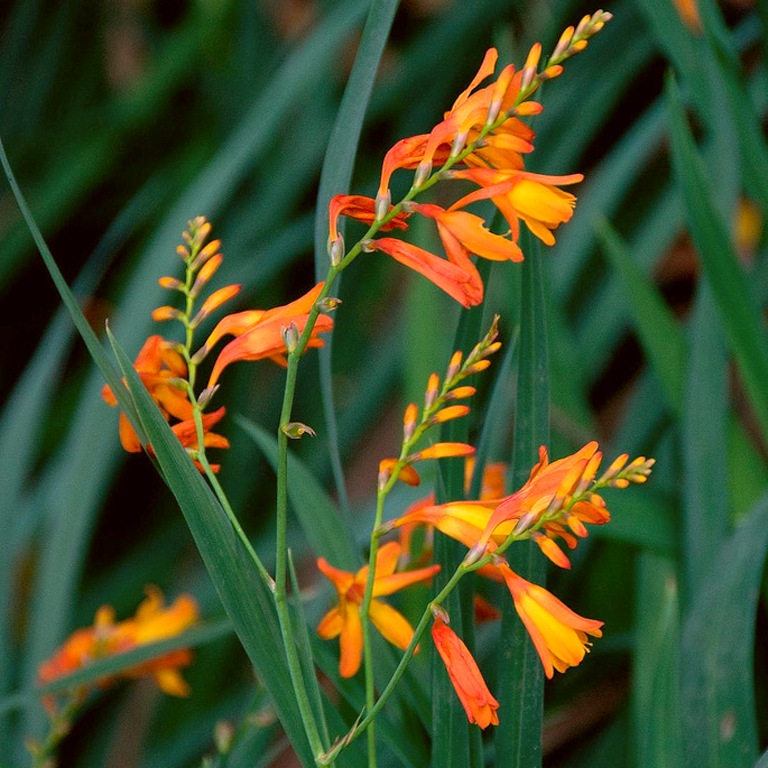
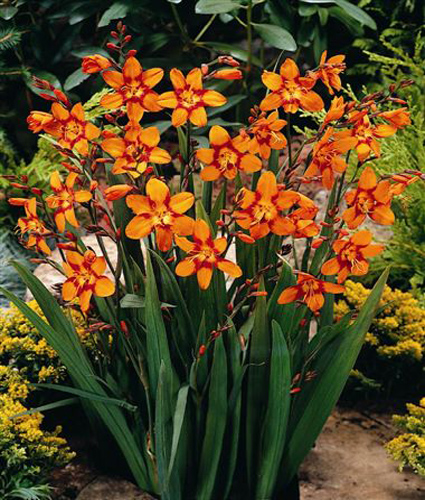
Herbaceous, cormous perennial plants. The corm is not large, covered with netted tunics. The stem is branching, with many linear or sword-shaped leaves, 60 cm tall. Flowers 2–4 cm in diameter, pink, orange, yellow and white, 3–5 in a paniculate inflorescence. The flower is funnel-shaped and widening. Fruit — a many-seeded, rounded capsule.
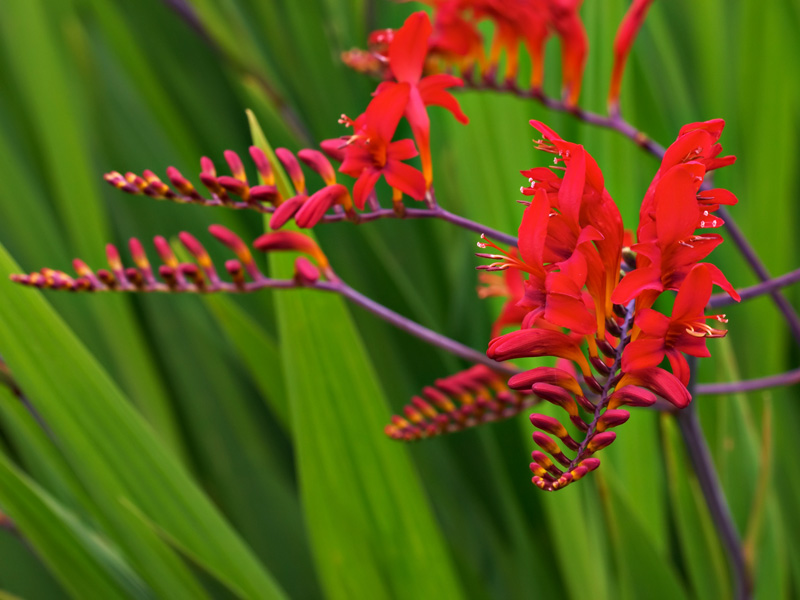
Crocosmias are bright, attractive plants. They are planted in large or small groups in mixed flower beds among lower-growing plants. Crocosmia is especially valued for cut flowers. Inflorescences for bouquets are cut when the second bud opens. Cutting is also beneficial for the growth of the corms. In water Montbretia lasts 12–14 days, gradually opening all the buds. Inflorescences can be dried and used for winter bouquets. The shape and colour of the flowers are preserved.
In culture:
Crocosmia masonorum — Crocosmia masonorum
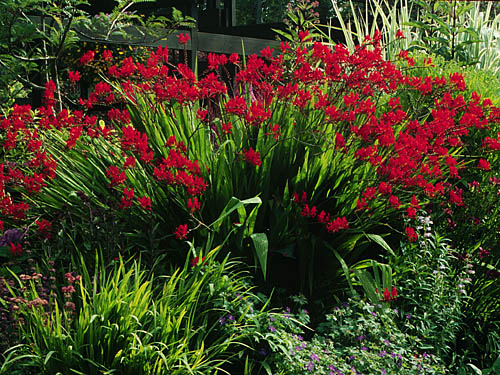
The plant's native range is South Africa. Herbaceous, cormous perennial plant. Stem 60–80 cm tall. Leaves sword-shaped, up to 5 cm wide, ribbed. Flowers small, bright orange, gathered in a dense, horizontally nodding raceme. The corm is fairly large. Very beautiful, long-flowering plants. Blooms in mid-summer.
Crocosmia common — Crocosmia х crocosmiiflora
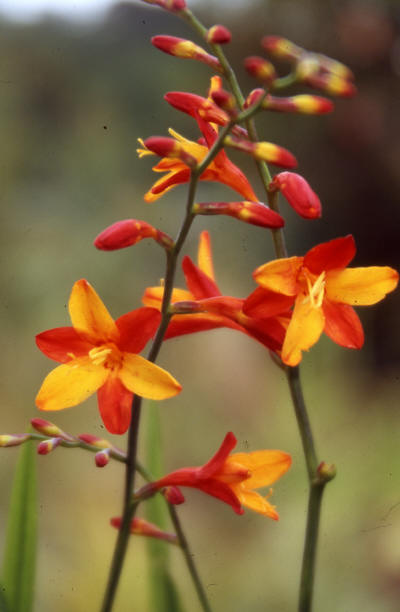
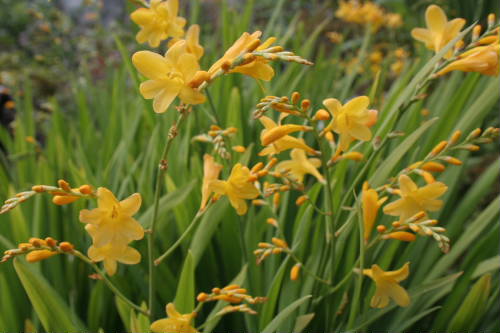
A garden hybrid obtained by the French breeder Lemoine in 1880 by crossing Crocosmia aurea and Crocosmia Pottsii, often called Garden Montbretia.
The plant reaches up to 100 cm in height. Stem erect, slender, branched. Leaves light green, broad-linear up to 2.5 cm wide, upright, in dense tufted clusters. Flowers small, 3–5 cm in diameter, funnel-shaped, orange-red or yellow, gathered in a terminal small paniculate inflorescence. Blooms in July–August, with up to 10 flowers opening at once. Fruits. Seeds are large, brownish-red. Corms resemble gladiolus corms, bulbous in shape, up to 2.5 cm in diameter.
Location: light-loving, requires an open location, otherwise flowers may not appear.
Soil: prefers humus-rich, sufficiently moist soil. Waterlogging is unacceptable.
Care: during the summer feed every 10 days with cow manure infusion (1:10) and a complete mineral fertilizer (2–3 g/l), starting from the appearance of the second leaf. During bud formation add potassium fertilizers (2 g/l). Water plants abundantly once a week and loosen the soil periodically. In the temperate zone the species with relatively small flowers overwinters successfully under a mulch of dry leaves or shavings at least 20 cm thick with a film on top to protect against dampness during thaws. Corms that have overwintered in the ground are often more robust, bloom earlier and flower longer. In the south they overwinter without cover. But large-flowered cultivars are still better to dig up for the winter, and in the south to cover.
Propagation: by corms, offsets (daughter bulbs) and seeds. Each year 5–6 offsets form around a single mature plant, which bloom already the following year. At the same time the mother plant continues to bloom and form a new offset, and thus the plant multiplies quite rapidly. Plant at the end of April, when the soil warms to 6–10°: large corms — at a depth of 6–8 cm (spacing 10–12 cm); offsets — at a depth of 3–5 cm (5–6 cm). Before planting they can be grown on in pots and then planted into open ground with a clump of soil in May–June. Offsets are separated in spring and used for propagation. Seeds are easily propagated. It is advisable to sow fresh, previously washed seeds. With an early spring sowing in protected ground, flowering occurs in the second year.