
Deciduous shrubs
Hawthorn
Crataegus
The name hawthorn comes from «krataios» (from Greek – strong), which fully reflects the properties of its strong and hard wood. This plant belongs to the genus of deciduous small trees or tall shrubs, rarely semi-evergreen, of the family Rosaceae (the rose family). Hawthorn is widely used as a medicinal and ornamental plant, and its fruits are edible. The genus Crataegus includes approximately 1250 species, which most often occur in temperate and sometimes in subtropical regions of the Northern Hemisphere. The medicinal properties of hawthorn are well known worldwide. Preparations containing this plant improve cerebral and vascular circulation, relieve physical and mental fatigue, and reduce the excitability of the human central nervous system.
Hawthorns are unique not only because of their properties but also because of the wide range of uses and methods of application. Most hawthorn species were described by the American scientist Sargent. Hawthorns growing in North America differ little from one another in external appearance. As a rule, North American plants have stout large thorns and are characterized by shallowly lobed leaves, sometimes entire. Asian and European species have deeply lobed leaves and almost no thorns, or only very small ones. The natural range of hawthorn is very large and covers not only the subtropical zones of the northern parts of America but also Eurasia.
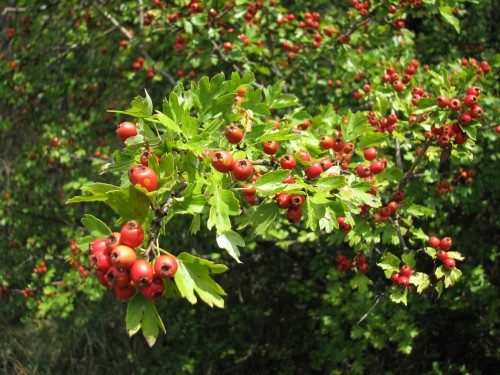
Varieties of the plant
Hawthorn blood-red (Latin: Crataegus sanguinea) – a small tree or shrub up to 6 meters high, with a brown-gray or dark brown trunk up to 10 cm in diameter. Hawthorn flowers are yellowish-white with purple specks, 12-15 mm in diameter.
Hawthorn with large fruits (Latin: Crataegus aestivalis) – one of the most beautiful, winter-hardy and widespread among the extensive selection of species (about 1250). It grows as a small tree or shrub. Hawthorn flowers are very attractive, white or slightly pink, fairly large, however they have a not very pleasant smell.
Care tips
The plant is fairly tolerant of adverse urban climates, not too demanding with regard to soil mix, but it is better to add some lime to the soil. Most are drought-tolerant and winter-hardy, and tolerate shading. They tolerate shaping and pruning well and also have a high ability to produce shoots.
- Location: best planted in a sunny position. In shade it flowers poorly and produces few fruits.
- Planting: planting depth should be approximately 60-70 cm, spacing between plants – 1-2 m (sometimes 3 m). Soil: 2 parts humus, 2 parts leaf soil, 1 part peat compost, 1 part sand, 300 - 400 g of rock phosphate, 5-4 kg of lime. Plant in spring or autumn. The plant begins to bear fruit at the age of 8-10 years.
- Watering: water once a month, approximately 10-12 liters of water per bush; in dry periods – the same amount twice a month.
- Feeding: in spring fertilize with nitroammofoska or Kemira-Universal (120 g/m2). Before flowering feed with diluted (1:10) manure slurry – 8 liters per mature plant.
- Propagation: hawthorn, which is propagated in several ways, has seeds with a hard shell. It can be propagated by seeds, as well as by root cuttings, layering and grafting (garden forms). Seed stratification, depending on the species, occurs over the course of a year or six months.