
Deciduous shrubs
One-flowered cotoneaster
Cotoneaster uniflorus Bunge
Synonym: Cotoneaster integerrimus var. uniflorus (Bunge) C.K.Schneid., Cotoneaster vulgaris var. uniflora (Bunge) Regel, Cotoneaster integerrima var. uniflora (Bunge) C.K. Schneid.
One-flowered cotoneaster – a species of unarmed shrubs of the genus 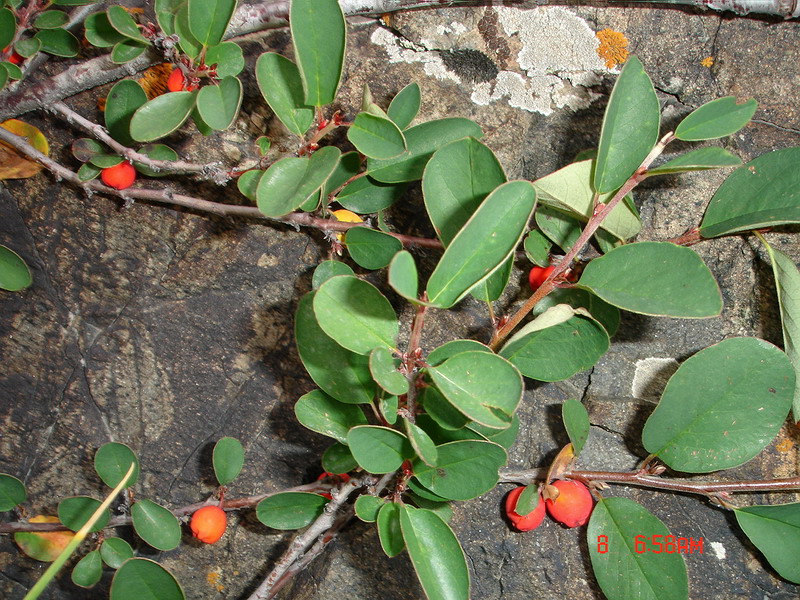
Petiole 2.5-3.5 mm long, slightly pubescent. Stipules purple-red, lanceolate, hairy. Leaf blade ovate, more rarely ovate-elliptic, 1.8-3.5 × 1.3-2.5 cm, initially pubescent, later glabrous, base cuneate-rounded, apex acute, more rarely obtuse or emarginate, dark green above, yellowish beneath, sparsely hairy or almost glabrous.
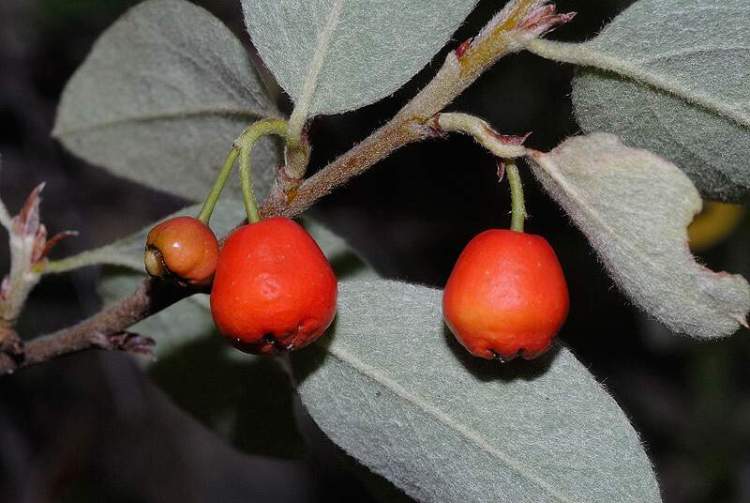
Inflorescences axillary, flowers borne singly or in pairs. Pedicel very short, hairy. Flowers 7-8 mm in diameter. Hypanthium campanulate, glabrous. Sepals triangular, slightly longer or almost the same length as the petals, margins sometimes finely serrate, apex acute or obtuse. Petals pink or greenish-white, erect, almost rounded, 3-3.5 mm long, with an acute base and a blunt apex. Stamens 15-20, shorter than the petals. Ovary pubescent at the apex. Flowers in May-June, for 5-10 days.
Fruits globose, red, 6-7 mm in diameter, with 2-3, more rarely seeds inside. Fruits in August – September, regularly from 5 years of age.
Chromosome number: 2n = 34
Hybrids: forms a hybrid with Cotoneaster melanocarpus
Hardiness zone: zone 4-8 (-29°C).
Site/exposure: Xerophyte-petrophyte. Oligotrophic, light-loving. Tolerant to air pollution. Requires locations sheltered from cold winds.
Propagation: Propagated by seeds and summer cuttings. Seeds require stratification for 8-10 months at 1–5 °C.
Soil: not demanding regarding soil fertility. Grows on all well-drained garden soils.
Planting: planting mix – compost consisting of turf soil, peat and sand in proportions 2:1:2.
Care: in hot and dry summers, to maintain decorative appearance it is recommended to water the plant 1-2 times per month at a rate of 1-2 buckets per plant.
Pruning: tolerates clipping and pruning well. Regenerates well after pruning while retaining its growth habit. When shaped provides dense hedges and sculptural groups. Recommended pruning – to one-third of the length of the annual shoot, where a dense and compact habit is required.
Diseases: Fusarium (remove and burn infected parts)
Pests: apple aphid, plum sawfly, cotoneaster mite.
Uses: widely used in solitary and group plantings on rockeries and rock gardens. Can be used for creating borders.