
Deciduous shrubs
Many-flowered cotoneaster
Cotoneaster multiflorus Bunge
Many-flowered cotoneaster (Cotoneaster multiflorus Bunge) – a species of non-spiny shrubs of the genus Cotoneaster in the Rosaceae family. It was first described in the book by K. F. Ledebour and A. A. Bunge «Flora of Altai» in 1829. Introduced into cultivation in Europe in 1837.
In the wild it occurs in China (Gansu, Hebei, Heilongjiang, Henan, Hubei, Liaoning, Qinghai, Shaanxi, Shanxi, Sichuan, Xinjiang, Tibet Autonomous Region, Yunnan Province), as well as in Central Mongolia, Afghanistan, Turkey, Armenia, Georgia, Kazakhstan, Kyrgyzstan, Tajikistan, Turkmenistan and Russia (mountains of Altai Krai). It grows in river valleys, dense mixed forests, on slopes, forest glades and thickets, and on stream banks. In the mountains it ascends to 1200-3500 m above sea level.
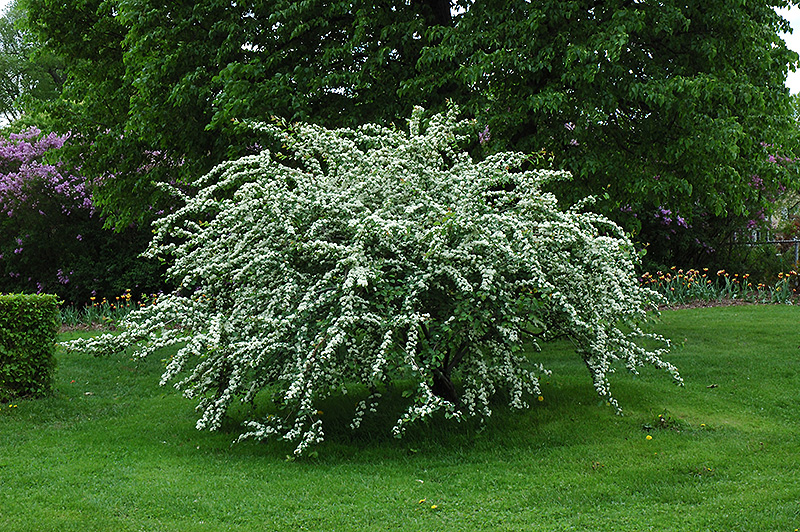
It is a large deciduous shrub or a small tree with a rounded dense crown. It reaches 3-5 m in height and width. Branches are arching or spreading, thin. Shoots are thin, pendulous, initially thinly pubescent, later glabrous, reddish-brown or brown in color.
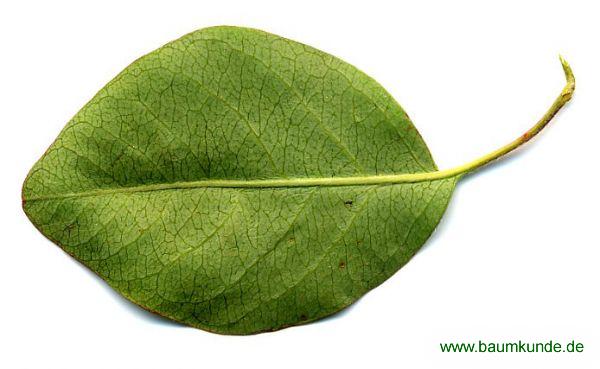
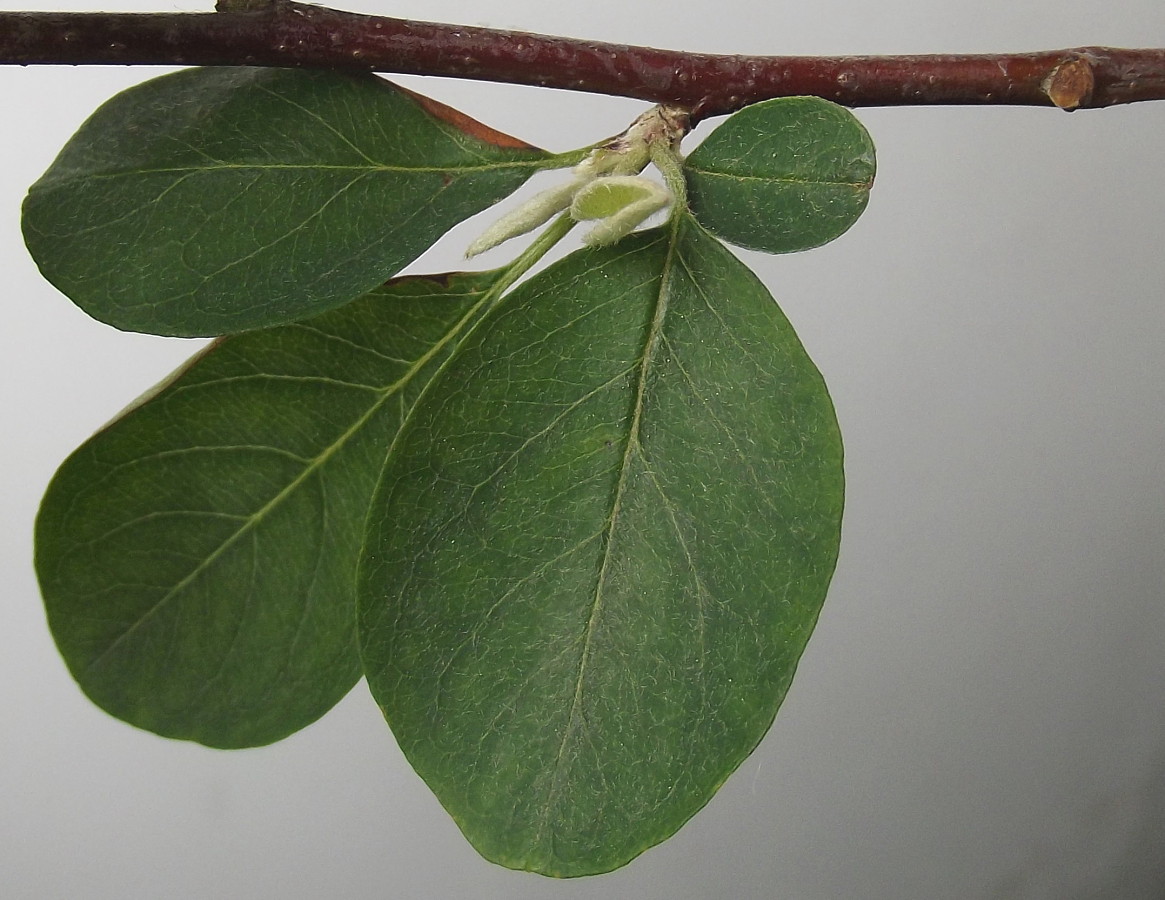
Leaves are ovate or elliptic, 1.5-5 cm long and 1.2-4 cm wide, with a cuneate or rounded base, narrowed to a point with a blunt apex, silvery gray-brown when unfolding, later becoming dark green and glabrous above, and almost glabrous or thinly pubescent beneath with gray hairs. In autumn they turn golden-yellow to deep purple-red. Petioles 3-10 mm long, at first pubescent, later glabrous.
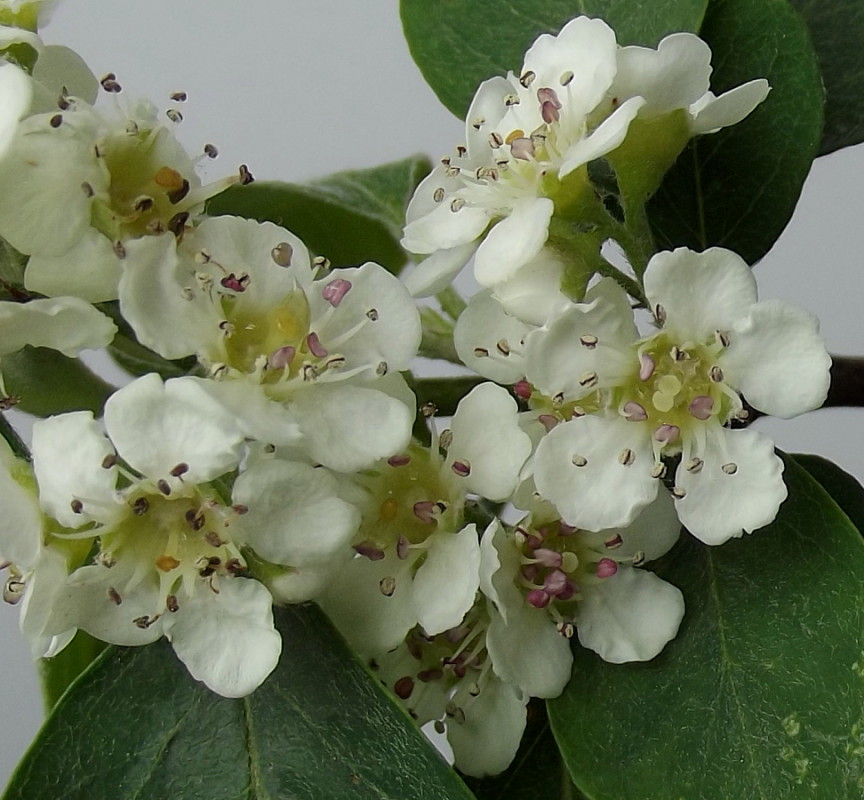
Flowers small, white, grouped in 3-20 in complex dichotomously branched corymbs. Petals are nearly rounded, spreading, 4-5 mm in diameter. Pedicel glabrous, less often slightly pubescent, 4-6 mm long. Bracts linear, 2-4 mm long, glabrous or slightly pubescent. Flowers 1-1.2 cm in diameter. Hypanthium campanulate. Sepals triangular, 1.5-2 × 2-2.5 mm, with an acute tip and ciliate margin. Stamens 20, slightly shorter than the petals. Ovary hairy at the apex. Flowers in May–June, for about 25 days.
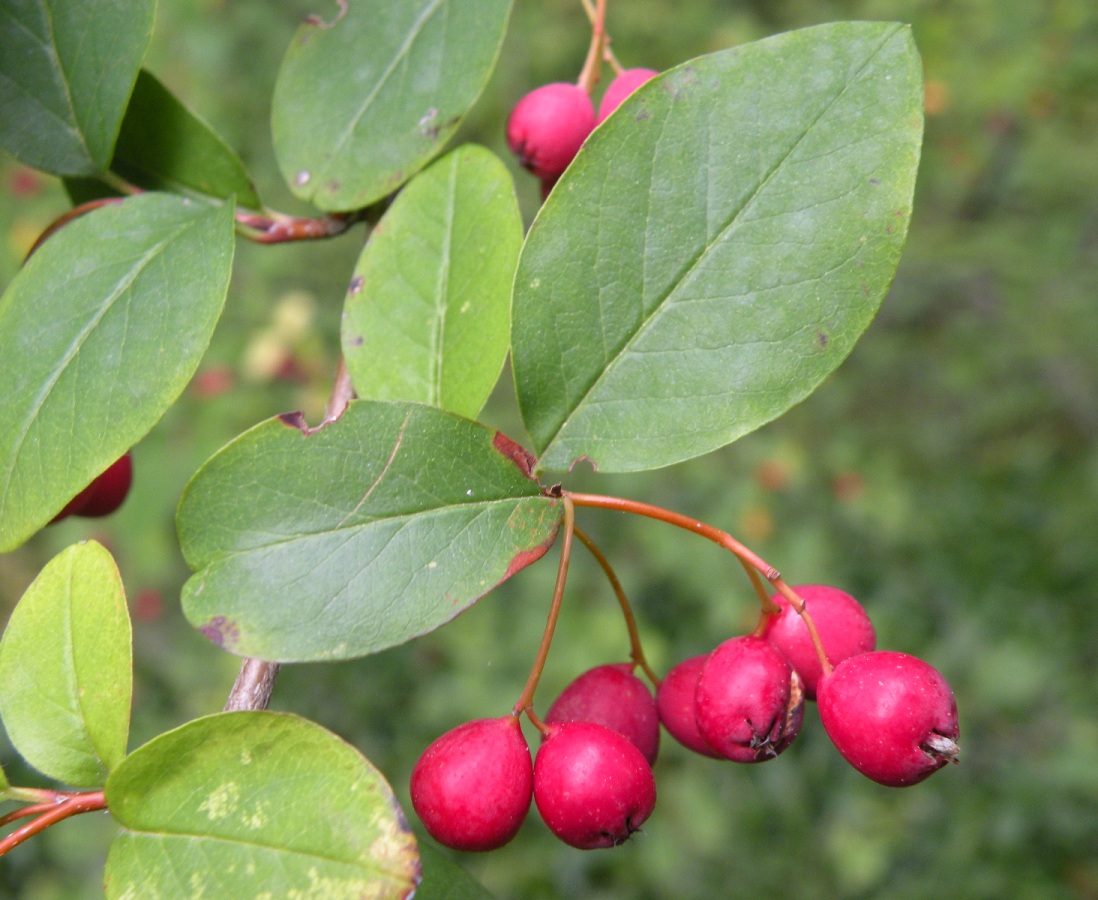
Fruits red or purplish-red, almost globose or obovoid, 7-12 mm in diameter, with 2 seeds fused into 1 inside. Fruit ripening in August-September.
Chromosome number: 2n = 68
Forms:
- Cotoneaster multiflorus Bunge var. multiflorus
- Cotoneaster multiflorus var. borealichinensis Hurus.
- Cotoneaster multiflorus var. calocarpus Rehder & E.H.Wilson
Hardiness zone: zone 4 (-29°C).
Site/exposure: A light-loving mesoxerophyte, mesotrophic, mesothermic. Tolerates urban conditions well. Drought-resistant.
Propagation: propagated by seeds and vegetatively. Green cuttings root faster under film. Cuttings are taken in the second half of July. Substrate – peat and sand in equal proportions. Seeds require stratification.
Soil: prefers calcareous soils. Does not tolerate prolonged waterlogging and stagnant moisture, requires good drainage.
Planting: planting mix – compost consisting of sod (top) soil, peat and sand in proportions 2:1:2.
Care: in hot and dry summers, to maintain its decorative appearance it is recommended to water the plant 1-2 times per month at a rate of 1-2 buckets per plant.
Pruning: tolerates clipping and pruning well. After pruning it regrows well while retaining its growth habit. When shaped it forms dense hedges and sculptural groups. Recommended pruning – by one-third of the length of the annual shoot, but only where a dense and compact habit is desired.
Diseases: Fusarium (remove and burn affected parts)
Pests: apple aphid, plum sawfly, cotoneaster mite.
Uses: valued for its attractive pyramidal crown, striking dark-green glossy foliage, and fragrant corymb-like white to purplish flowers. Used in solitary and group plantings.