
Deciduous shrubs
Glossy cotoneaster
Cotoneaster lucidus Schlecht.
Synonym: Cotoneaster acutifolius var. lucidus (Schltdl.) L.T.Lu, Cotoneaster lucidus
Glossy cotoneaster (Cotoneaster lucidus Schlecht.) – a species of non-spiny shrubs in the genus Cotoneaster of the Rosaceae family. It was first described in 1856 by the German botanist Diederich Franz Leonhard von Schlechtendal. In 2000 Chinese researchers determined that glossy cotoneaster is a variety of Cotoneaster acutifolius var. lucidus (Schltdl.) L.T.Lu.
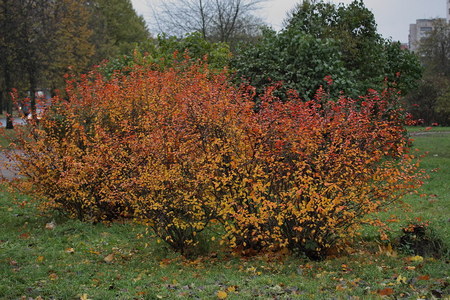
Distributed in China (Gansu province) and the Russian Federation – in Altai (Republic of Buryatia (northern macro-slope of the Eastern Sayan, Tunkin Valley, southern part of Baikal)) and Irkutsk Oblast (on the shore of Baikal from the mouth of the Anga River to the town of Slyudyanka, less often in the valley of the Irkut River). Occurs on rocky slopes, river shingle, in shrub thickets, and also in larch-mixed forests.
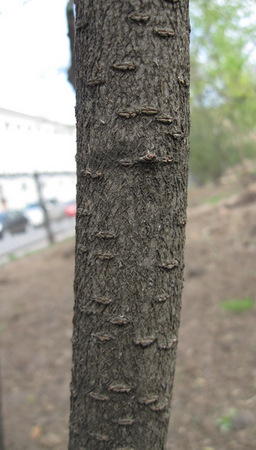
It is an upright deciduous shrub up to 3 m tall. The crown diameter is 1.5 times the height, formed by straight shoots growing in all directions. Growth rate is medium. Young shoots are densely pubescent, later glabrous, pinkish-brown.
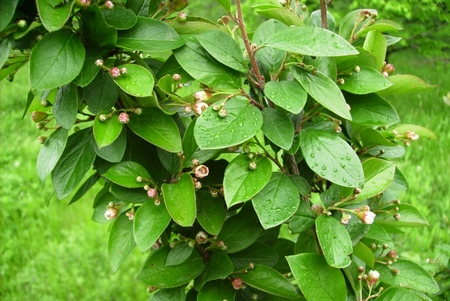
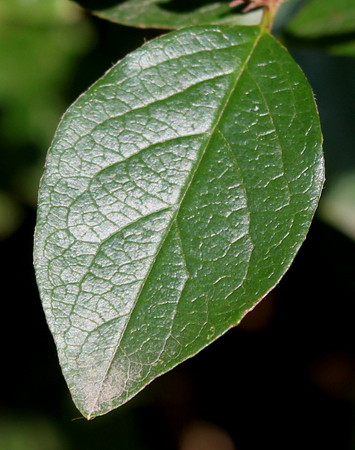
Leaves elliptic to ovate, acute, 1.7-5 cm long and 0.8-3.5 cm wide, dark green and glossy above, glabrous; beneath at first pubescent, yellowish-woolly, later becoming nearly glabrous, yellowish. In autumn the leaves take on dark brownish-red shades.
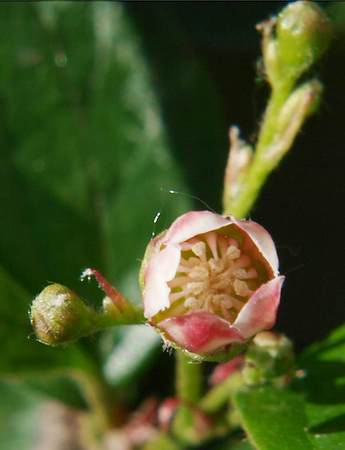
Flowers in May-June, for about a month. Inflorescences are loose corymb-like racemes consisting of 5-12 flowers. Sepals broadly triangular, 2.5-3 times shorter than the petals. Stamens 20, styles 3, rarely 4. Flowers small, pink, arranged along the entire length of the shoot, practically covering the leaves.
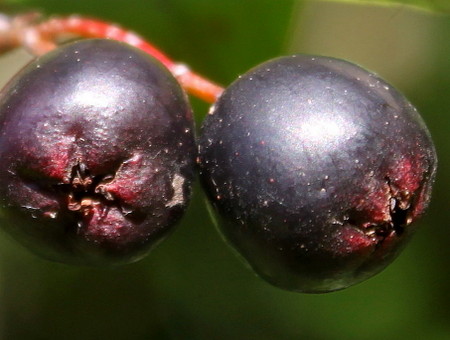
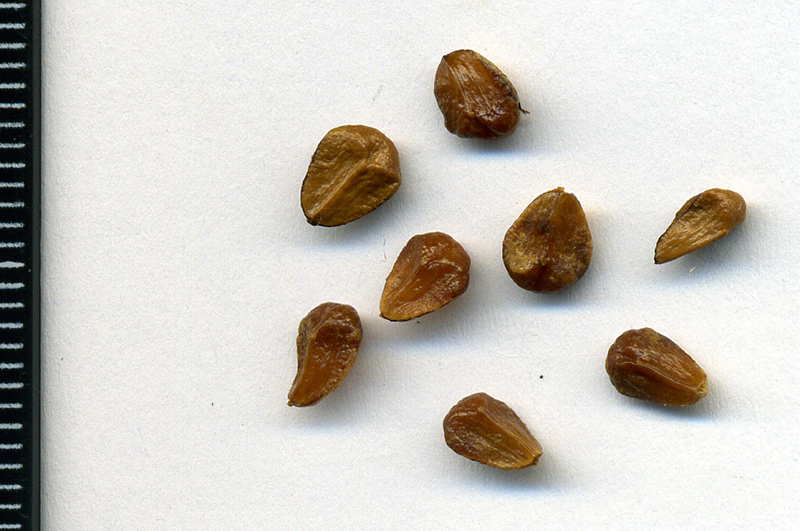
Fruits black, glossy, globose to slightly elongate, 7-9 mm in diameter, densely hairy at the apex. Flesh brownish-red, juicy, glossy. Stones in number 3, rarely 2. Fruits ripen in late September - early October. Fruits persist on the shrubs until the frosts. Begins fruiting in the fourth year.
Cultivars: `Romsdal´
Hardiness zone: zone 4 (-35°C).
Location: sun-loving but shade-tolerant. Tolerates urban conditions well. Drought-resistant.
Propagation: propagated by seed and vegetatively. Green cuttings root faster under film. Cuttings are taken in the second half of July. Substrate – peat and sand in equal proportions. Does not tolerate prolonged waterlogging and stagnation of moisture, requires good drainage. Seed germination rate 14%. Rooting rate of cuttings 52% with 0.005% IМК solution for 16 hours. Seeds require 12-15 months of stratification (can be treated with sulfuric acid for 5-20 minutes and stratified for 1-3 months). Sowing rate 5 g per 1 sq. m.
Soil: undemanding to soil fertility, can grow on any garden soils. Prefers light, peaty, neutral or slightly acidic, moderately fertile or rather poor loams. On slightly alkaline soils most species grow poorly (except Cotoneaster multiflorus).
Planting: planting mix – compost consisting of topsoil, peat and sand in proportions 2:1:2.
Care: in hot, dry summers to maintain decorative appearance it is recommended to water the plant 1-2 times a month at a rate of 1-2 buckets per plant.
Pruning: tolerates clipping and pruning well. After pruning it regrows well while retaining its growth habit. When shaped it forms dense hedges and sculptural groups. Recommended pruning is by 1/3 of the annual shoot length, but only in places where a dense, compact habit is required.
Diseases: Fusarium (remove and burn affected parts)
Pests: apple aphid, plum sawfly, cotoneaster mite.
Propagation: in cultivation it is propagated by seed and green cuttings, which are harvested two weeks after the end of flowering.
Status: rare species. Endemic to the southern part of Central Siberia. The species is included in the "Red Book of the USSR", "Red Book of the RSFSR", "Red Book of the Buryat ASSR", "Red Book of Irkutsk Oblast". Protected within the territory of the Pribaikalsky State National Park.
Uses: used for creating freely growing and clipped hedges, in group and solitary plantings on lawns, forest edges, and also as an understory. Widely used for urban landscaping.