
Deciduous shrubs
Milky cotoneaster
Cotoneaster lacteus W.W.Sm.
Synonyms: Cotoneaster coriaceus Franch., Cotoneaster oligocarpus C.K. Schneid., Cotoneaster smithii G. Klotz, Cotoneaster parneyi hort. ex R.Hoyt
Milky cotoneaster (Cotoneaster lacteus W.W.Sm.) – a species of spineless shrubs of the genus Cotoneaster in the family Rosaceae. It was first described as Cotoneaster coriaceus Franch. by the French botanist and systematist Adrien René Franchet in 1890 in the book «Plantae Delavayanae» and in 1917 as Cotoneaster lacteus W.W.Sm.
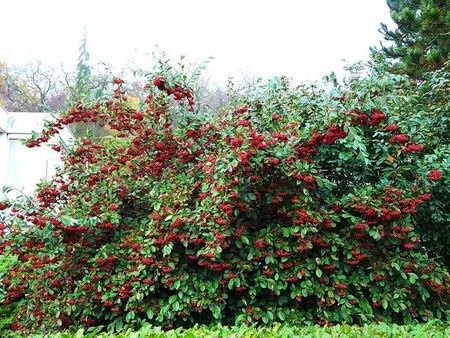
In the wild it occurs in China in the provinces of Guizhou, Sichuan, the Tibet Autonomous Region and Yunnan. It grows on grassy slopes, along rivers and in thickets. In the mountains it ascends to altitudes of 1800-2700 m above sea level.
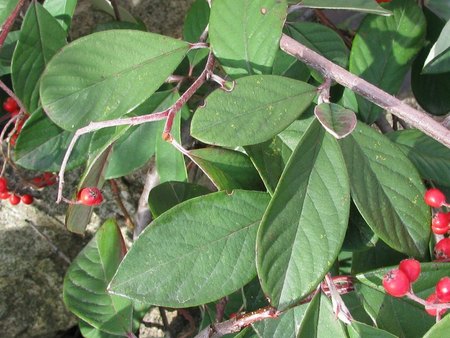
It is an evergreen shrub 1-3 m tall. Shoots are dark purple-brown or grayish-brown, cylindrical, at first densely yellow-woolly, later glabrous, curved.
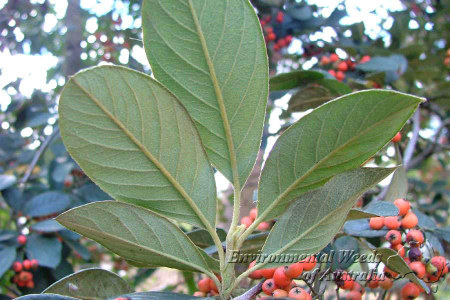
Petiole 4-8 mm long, initially densely yellow-woolly, later almost glabrous. Stipules linear-lanceolate, 4-5 mm long, rarely pubescent, more often caducous when fruiting. Leaf blade obovate or elliptic, 2-4.5 cm long and 1.2-2.8 cm wide, leathery, dark green, midrib noticeably raised on the upper side, lateral veins 7-10 pairs, underside densely yellow-woolly, upper surface glabrous, shiny, base cuneate, apex obtuse, acute or acuminate.
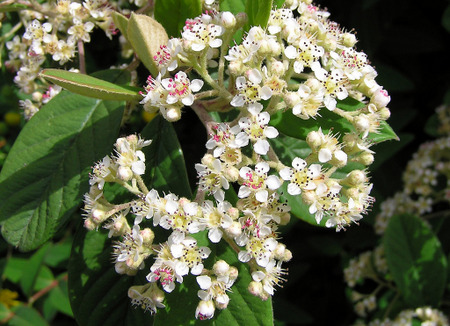
Flowers are grouped in dense corymb-like inflorescences of 3-5 (6) flowers, 4-7 cm in diameter. Flower axis and pedicel densely pubescent. Bracts yellow, deciduous, linear-lanceolate, 2-4 mm long, slightly pubescent. Pedicel 1-2 mm long. Flowers 4-5 mm in diameter. Hypanthium bell-shaped, densely pubescent. Sepals triangular, 1.5-2 mm long, with acute tips. Petals erect, milky-white, broadly ovate or nearly rounded, 2.5-3.5 mm long and 2.5-3 mm wide, clawed at the base, pubescent, apex obtuse. Stamens 20, shorter than the petals. Ovary woolly-pubescent at the apex. Styles 2, free, almost the same length as the stamens. Flowers in May-June.
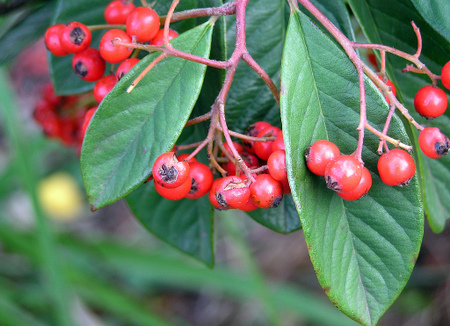
Fruits red, obovoid, 4-5 mm long and 4-5 mm wide, rarely pubescent, with 2 stones. Fruits in September-October.
Hardiness zone: zone 5-8 (-29°C).
Site/exposure: prefers sunny sites but can also grow in shade. Grows even in heavily polluted locations. Tolerates urban conditions well.
Propagation: Propagated by seed and green cuttings. Seed viability – 80%. Rooting of cuttings – poor.
Soil: Planting: Care: Pruning: Diseases: Fusariosis (remove and burn affected parts) Pests: apple aphid, plum sawfly, cotoneaster mite. Uses: a highly ornamental species. Widely used in group and solitary plantings in parks, landscape plantings and urban greening. Suitable for creating hedges; also looks effective in naturalistic gardens. A good source of nectar. From its hard wood can be made walking sticks, pipes and other handicrafts. Young shoots, leaves and fruits are used in traditional medicine.