
Deciduous shrubs
Entire-leaved cotoneaster
Cotoneaster integerrimus Medic
Synonyms: Кизильник цельнокрайний, Кизильник обыкновенный, Кизильник цельнокрайний, Кизильник цельнокрайнолистный, Кизильник цельнолистный, Кизильник цельный, Cotoneaster cotoneaster Degen (invalid name), Cotoneaster cotoneaster H.Karst. (invalid name)., Cotoneaster vulgaris Lindley, Mespilus cotoneaster Linnaeus, Ostinia cotoneaster (Linnaeus) Clairville.
Кизильник цельнокрайний (Cotoneaster integerrimus Medic.) – a species of non-spiny shrubs of the genus Cotoneaster in the Rosaceae family. The species was first scientifically described in 1793 by the German botanist Friedrich Kasimir Medicus in the book «Geschichte der Botanik unserer Zeiten» as Cotoneaster integerrima. In cultivation since 1656.
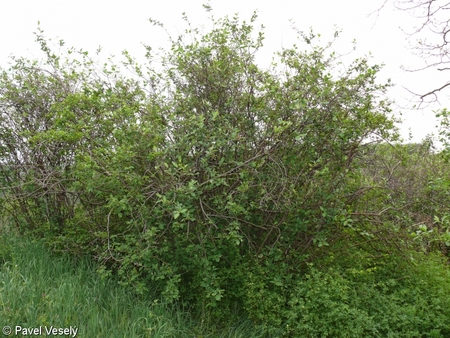
In the wild it occurs in China (provinces Hebei, Heilongjiang, Inner Mongolia, Qinghai, Xinjiang), Korea, Russia, Southwest Asia, Central and Eastern Europe (from southern Belgium and eastern France, south to Italy, and east through Germany to the Balkans, in the northern part of Crimea, found in northern Turkey, in the Caucasus and northern Iran). Grows on rocky slopes and in forests. It rises into mountains up to 2500 m above sea level.
It is an upright deciduous shrub up to 2 m in height. Crown densely branched, broad, spreading. Shoots brown or grayish-brown, circular in cross-section, initially densely grey-woolly, later becoming glabrescent, glossy.
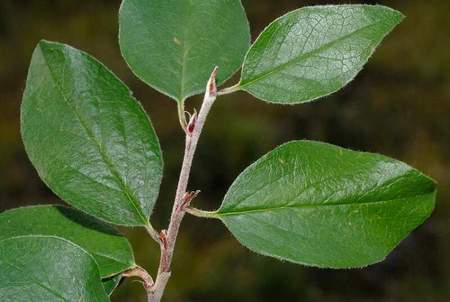
Petioles 2-5 mm long, woolly. Stipules persist until fruiting, lanceolate, slightly pubescent. Leaf blade broadly elliptic or rounded, 2-5 cm long and 1.3-3 cm wide, shortly acute with an implanted cartilaginous tip, leathery, light green at the apex, matte above, rarely covered with hairs, whitish or grey-woolly beneath.
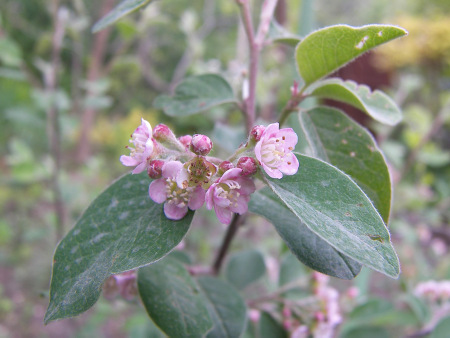
Flowers small, 1.5-3.5 (8) mm in diameter, grouped 1-4, rarely up to 7, in corymb-like inflorescences. The main axis of the flowering shoot and the pedicel glabrous or becoming glabrescent. Pedicel 3-6 mm long. Hypanthium campanulate, glabrous or becoming glabrescent. Sepals triangular-ovate, 1-1.5 mm long and 1-2 mm wide, obtuse at the apex. Petals erect, pink, almost round, up to 3 mm in diameter, clawed at the base and obtuse at the tip. Stamens 15-20, almost as long as the petals. Ovary hairy at the apex. Styles 2, rarely 3, free, not exceeding the stamens. Flowers in May-June.
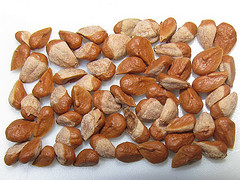
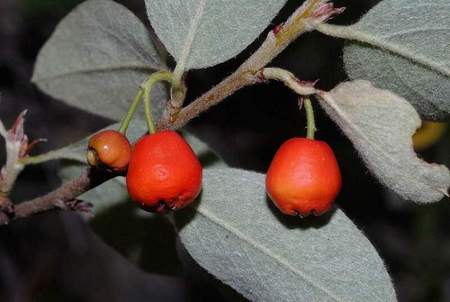
Fruits red, when ripe dark red, nearly spherical or less often ovoid, 6-8 mm in diameter, glabrous, with 2-3, rarely 4 stones inside. Fruits ripen in August-September. Fruits edible, persist on the branches for a long time.
Chromosome number: 2n = 68
Hybrids: with Cotoneaster melanocarpus Fisch. ex Blytt – Cotoneaster × matrensis Domokos
Varieties:
- Cotoneaster integerrimus var. fr-nigro Medik.
- Cotoneaster integerrimus var. Uniflorus (Bunge) C.K. Schneid.
Hardiness zone: zone 5-8 (-29°C). Overwinters without shelter.
Site/exposure: Light-loving mesophyte and mesotroph. Tolerates urban conditions well. The most undemanding species among cotoneasters.
Propagation: Seed germination is moderate. Propagated by layering and cuttings.
Soil: grows on all well-drained garden soils. In the wild it occurs on moderately dry to fresh soils, from slightly acidic to strongly alkaline, on sandy-loam gravel rich in nutrients.
Planting: planting mix – compost consisting of topsoil, peat and sand in proportions 2:1:2.
Care: In hot, dry summers, to maintain ornamental value it is recommended to water the plant 1-2 times a month at a rate of 1-2 buckets per plant.
Pruning: tolerates clipping and pruning well. After pruning it regrows well while retaining its growth habit. When shaped it forms dense hedges and sculptural groups. Recommended pruning is by 1/3 of the annual shoot length, but in places where a dense, compact habit is required.
Diseases: Fusarium (remove and burn affected parts)
Pests: apple aphid, plum sawfly, cotoneaster mite.
Uses: ornamental for foliage, flowering and fruits throughout the growing season. Widely used in solitary and group plantings, for creating large masses, large and small hedgerows, shaped topiary, and stabilizing slopes and embankments.