
Deciduous shrubs
Dammer's cotoneaster
Cotoneaster dammeri
Synonym: Cotoneaster dammeri var. typicus C.K.Schneid., Cotoneaster dammeri C.K. Schneid., Cotoneaster dammeri C.Schneider, Cotoneaster humifusa Praeger, Cotoneaster humifusus Duthie ex J.H. Veitch.
Dammer's cotoneaster (Cotoneaster dammeri) – a species of non-spiny shrubs in the genus Cotoneaster of the Rose family (Rosaceae). Naturally occurs in northern and central China (Gansu, Guizhou, Hubei, Sichuan, Tibet, Yunnan). It grows in mountainous areas, on mountain slopes, and in open mixed forests on dry and calcareous soils. Occurs at elevations of 1300-4000 m above sea level. Naturalized in Europe. In cultivation since the 1900s. First described in 1906 by the Austrian botanist Camillo Karl Schneider.
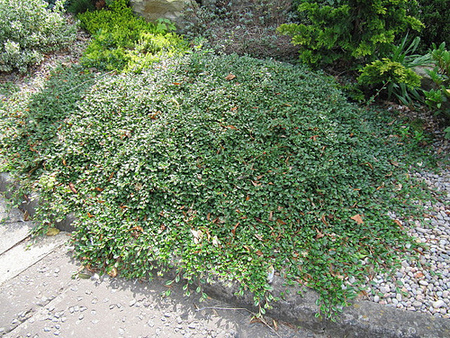
It is an evergreen shrub with a creeping crown. It reaches 20-30 cm in height, spreading up to 1.5 m in width. Grows rapidly, up to 50 cm per year. Shoots are reddish-brown, almost appressed to the ground and partially rooting, branching in one plane. Bark dark gray-brown to grayish-black.
Root system consists of finely branched and very fine roots.
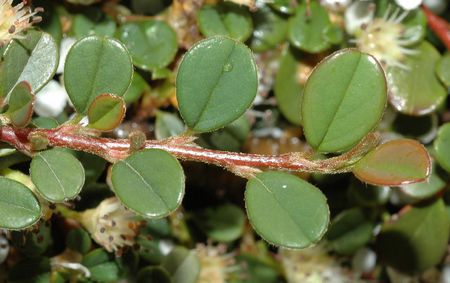
Leaves dark green and glossy above, gray-green beneath, small, 1-2 (3) cm long and 0.7-2.2 cm wide, leathery, elliptic to oblong-elliptic or obovate, with a blunt apex and 4-6 pairs of lateral veins, remaining on the plant for a long time. They turn purple in autumn. Petioles 2-3 (10) mm long, yellowish-hairy, later becoming glabrous. Stipules mostly deciduous, linear-lanceolate or lanceolate, 2-4 mm long, sparsely hairy.
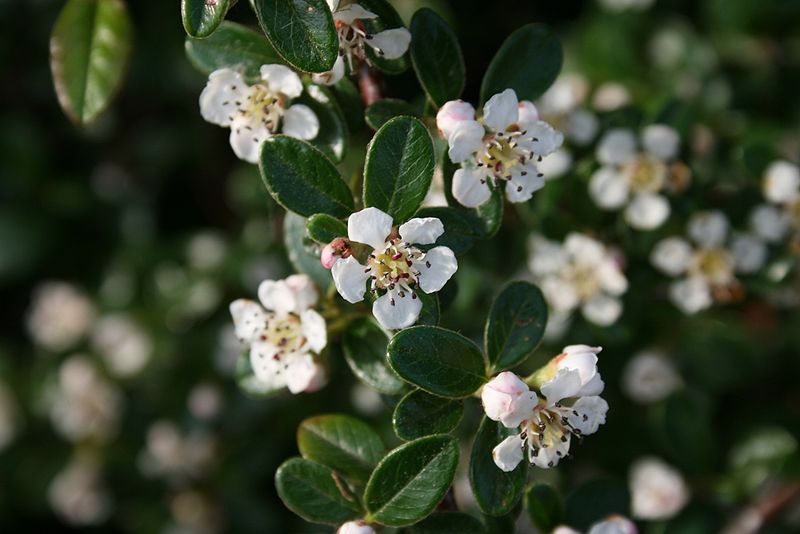
Flowers small, 0.5-1 cm in diameter, sessile, whitish-pink, fragrant, borne singly or 2-3 together in leaf axils, numerous. Stamens 20, of varying lengths, anthers purplish-violet. Bracts linear-lanceolate, 2-3 mm long, hairy. Pedicel 4-6 mm, rarely up to 1.5 cm, hairy. Hypanthium bell-shaped. Sepals triangular, 1.5-2 mm long and nearly as wide, with an acute apex. Petals white, rounded or broadly ovate, 4-5 mm in diameter. Ovary hairy at the apex. Flowers from May to June.
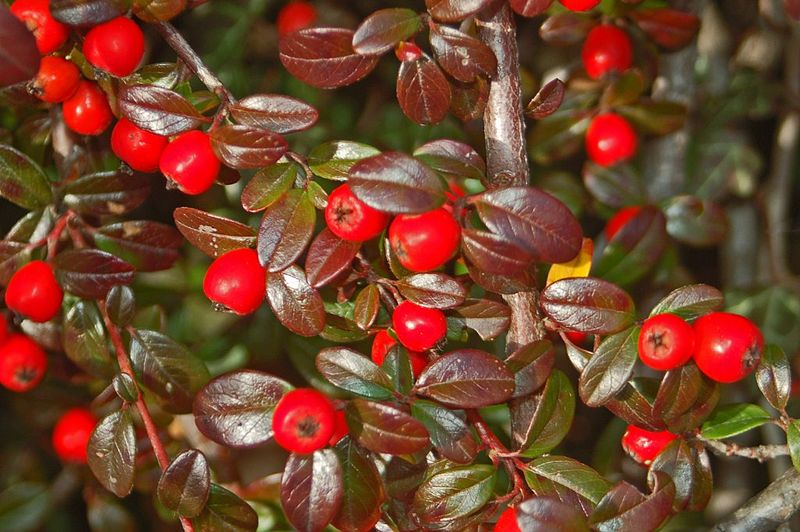
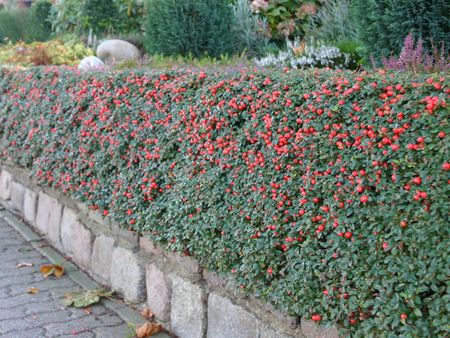
Fruits bright red, nearly spherical berries, 6-7 mm in diameter, with 5, rarely 4, seeds inside, persisting on the branches until spring. Ripen in September -
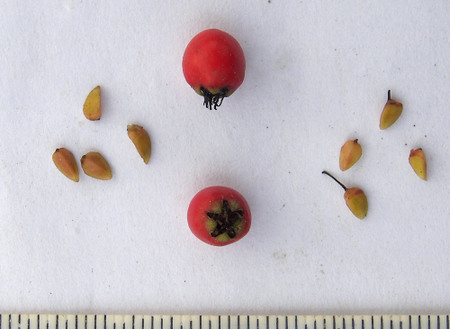
Forms:
- Cotoneaster dammeri var. dammeri
- Cotoneaster dammeri var. radicans (Dammer ex C.K. Schneid.) C.K. Schneid.
Cultivars: 'Lowfast', 'Coral Beauty' (‘Pink Beauty, Royal Beauty’), 'Skogholm', 'Eichholz' (‘Oakwood’), 'Major', 'Radicans', 'Streib's Findling', 'Mooncreeper' (‘Moon Creeper’), 'Jurgl'.
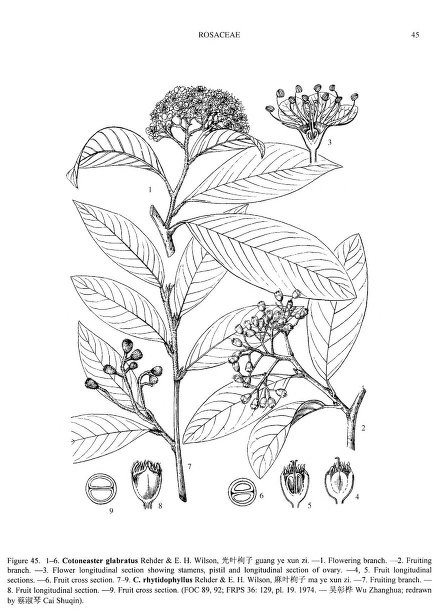
Flora of China Illustrations
Hardiness zone: zone 5-8 (-23°C). Overwinters under snow.
Location: Light-loving mesoxerophyte, mesotroph, mesotherm, can tolerate light shade. Tolerates urban conditions well. Drought-tolerant.
Propagation: easily propagated by cuttings. Cuttings are taken from May to mid-July. Root best in a greenhouse. 97% of cuttings root when treated with phyton for 16 h. Seed germination is average. Can also be propagated by layering.
Soil: not demanding regarding soil fertility. Grows on all well-drained garden soils.
Planting: planting mix – compost consisting of garden topsoil, peat and sand in proportions 2:1:2.
Care: in hot and dry summers, to maintain ornamental appearance it is recommended to water the plant 1-2 times per month at a rate of 1-2 buckets per plant.
Pruning: tolerates trimming and pruning well. Regenerates well after pruning while retaining its growth form. When shaped it forms dense hedges and sculptural groups. Recommended pruning is to shorten by 1/3 of the annual shoot length, but in places where a dense and compact habit is required.
Diseases: Fusarium (remove and burn affected parts)
Pests: apple aphid, plum sawfly, cotoneaster mite.
Uses: one of the best groundcover plants. Can be used to create large evergreen carpets. Shows well in rock gardens and alpine gardens, on terrace walls, retaining walls, and slopes. Can be used to create borders and low clipped hedges.