
Deciduous shrubs
Conspicuous cotoneaster
Cotoneaster conspicuus
Synonym: Cotoneaster conspicuus (Messel) Messel, Cotoneaster conspicuus J.B.Comber ex C.Marquand, Cotoneaster conspicuus var. decorus P.G.Russell, Cotoneaster microphyllus var. conspicuus Messel, Cotoneaster nanus, Cotoneaster permutatus, Cotoneaster pluriflorus, Cotoneaster conspicuus var. decora Russel, Cotoneaster conspicuus var. nanus G. Klotz, Cotoneaster nanus (G. Klotz) G. Klotz, Cotoneaster permutatus Klotz, Cotoneaster pluriflorus G. Klotz., Cotoneaster conspicuus Comber ex C.Marquand & G.Klotz, Tibetan cotoneaster.
Cotoneaster conspicuus – a species of non-spiny shrubs in the genus Cotoneaster of the Rosaceae family. The species was first described in 1937 by Thomas Comber and Ernest David Marquand in the journal «Bulletin of Miscellaneous Information Kew». The first description of the species (but without a Latin name) was written by the British traveler and botanist Frank Kingdon-Ward in 1924 from a plant grown from seed brought from the province of Xizang.
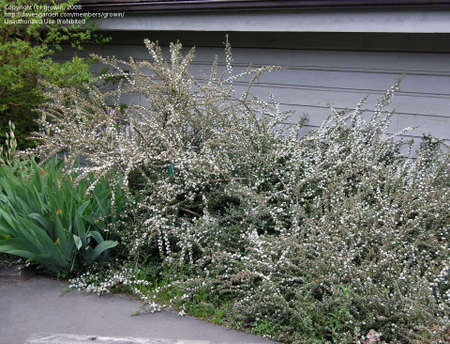
In nature it grows on open sunny sites among rocks, in river valleys. It ascends the mountains to an altitude of 2400-3300 m above sea level. Occurs in China in the provinces of Sichuan, Yunnan and the Tibet Autonomous Region (Xizang).
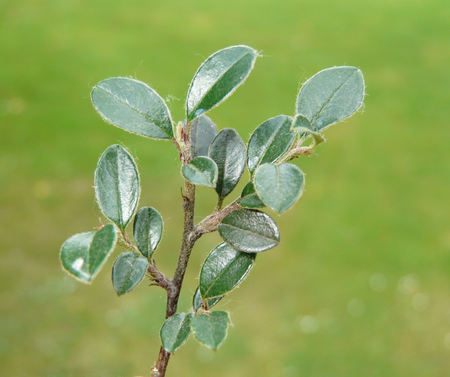
It is an evergreen shrub with a densely branched crown. Branches are erect or arching, at first covered with hairs, later glabrous.
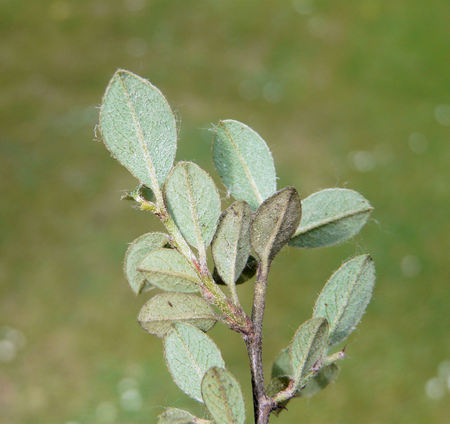
Petiole 1.5-2.5 mm long. Stipules subulate, hairy, almost as long as the petioles. Leaf blade elliptic, oblanceolate, less often oblong, dark green, glossy, lighter green beneath, 6-16 (20) mm long and 2.5-6.5 (10) mm wide, midrib raised abaxially, lateral veins weakly expressed, glabrous, sparsely or moderately covered with coarse hairs, base cuneate, margins revolute, apices obtuse or rounded or mucronate.
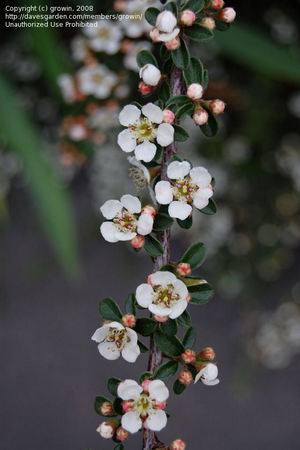
Flowers solitary, more rarely in groups of 2-3. Peduncle 1.5-2 mm long, glabrous, rarely hairy. Flowers 8-10 mm in diameter. Hypanthium campanulate, rarely hairy. Sepals broadly triangular, 1.5 mm long and as wide. Petals 5, white with pink tips, spreading, nearly orbicular, 3-4 mm long and 4-5 mm wide. Filaments nearly equal in length. Anthers purple, almost globose. Ovary glabrous. Styles 2, about 3 mm long. Flowers in May-June.
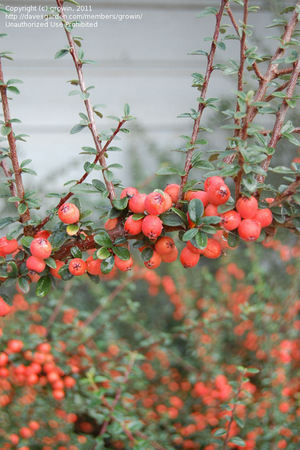
Fruits numerous, bright scarlet, globose or obovoid, glabrous, 8-10 mm in diameter, with 2 seeds inside. Sepals persist on the fruits. Fruits ripen in August-September.
'Decorus', 'Flameburst', 'Red Pearl', 'Tiny Tim'.
Hardiness zone: zones 6-8 (-23°C).
Location: Prefers sunny or semi-shaded sites.
Propagation: Propagated by seeds and summer cuttings. Seeds require stratification for 8-10 months at 1–5 °C.
Soil: prefers moderately moist soil. Grows on sandy-loam, loam-sandy, sand-clay or loamy soils with pH around 6.5-7.5.
Planting: planting mix – compost consisting of topsoil, peat and sand in proportions 2:1:2.
Care: in hot and dry summers, to maintain decorative appearance it is recommended to water the plant 1-2 times per month at a rate of 1-2 buckets per plant.
Pruning: tolerates clipping and pruning well. After pruning it regrows well while maintaining its growth form. When shaped it forms dense hedges and sculptural groups. Recommended pruning – cut back to 1/3 of the length of the annual shoot, in places where a dense and compact habit is required.
Diseases: Fusarium (remove and burn affected parts).
Pests: apple aphid, plum sawfly, cotoneaster mite.
Use: looks spectacular in groups (more than 15 plants). Can grow in boggy gardens, rockeries and on roofs, for decorating cemeteries.