
Deciduous shrubs
Bullate cotoneaster
Cotoneaster bullatus Bois
Synonyms: Cotoneaster moupinensis Stapf, wrinkled cotoneaster.
Bullate cotoneaster (Cotoneaster bullatus Bois) – a species of spineless shrubs of the genus Cotoneaster in the Rose family (Rosaceae). It was first described by the French botanist Désiré Georges Jean Marie Bois in 1904. «bullatus» from Latin is translated as «bullate», which refers to the wrinkled leaves. Introduced in 1898.
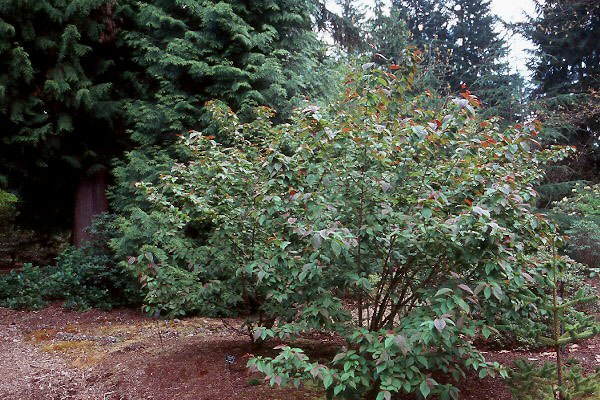
In the wild it occurs in China (provinces Hubei, Sichuan, Xizang, Yunnan). It grows in mountain forests and on river banks, where it ascends to 900-3200 m above sea level.
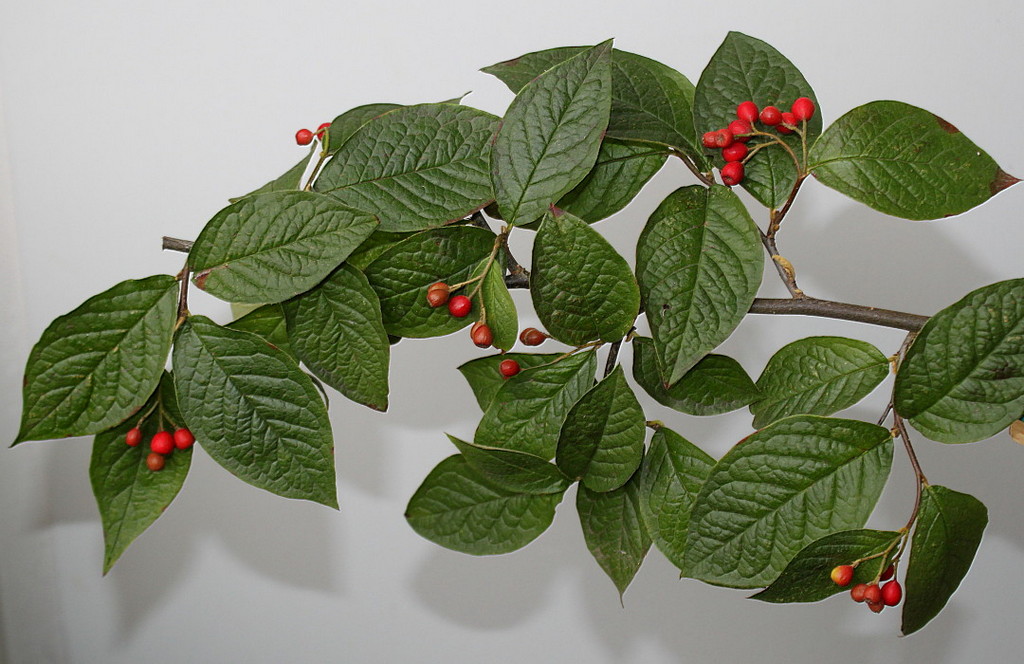
It is a deciduous shrub 3-4 (4.5) m in height and 4-5 m in width. The crown is spreading and graceful. Bark on young shoots is blackish-brown, later brownish-gray, covered with white lenticels. Young shoots are densely and appressed-pubescent.
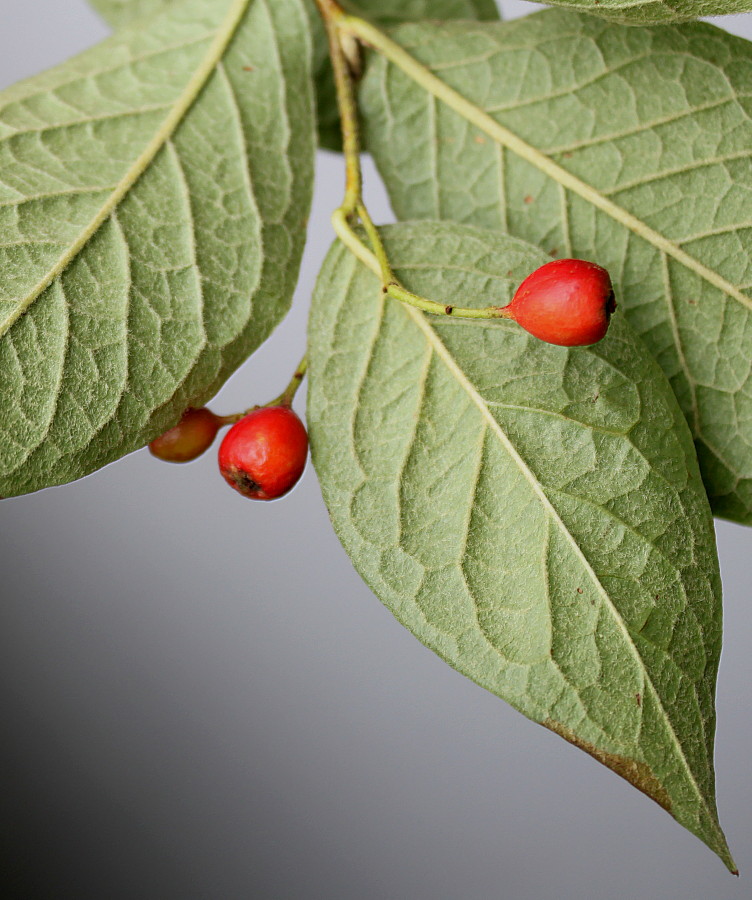
Leaves nearly sessile, large, 3.5-7 cm long and 2-4 cm wide, oblong-ovate to nearly elliptic, acute, often shortly acuminate, dark green above, glabrous, bullate-wrinkled; beneath gray-green, woolly-pubescent. Petiole hairy, 3-6 mm long. Stipules deciduous, lanceolate, brown, hairy, 3-5 mm long. In autumn the leaves take on yellow and fiery red tones.
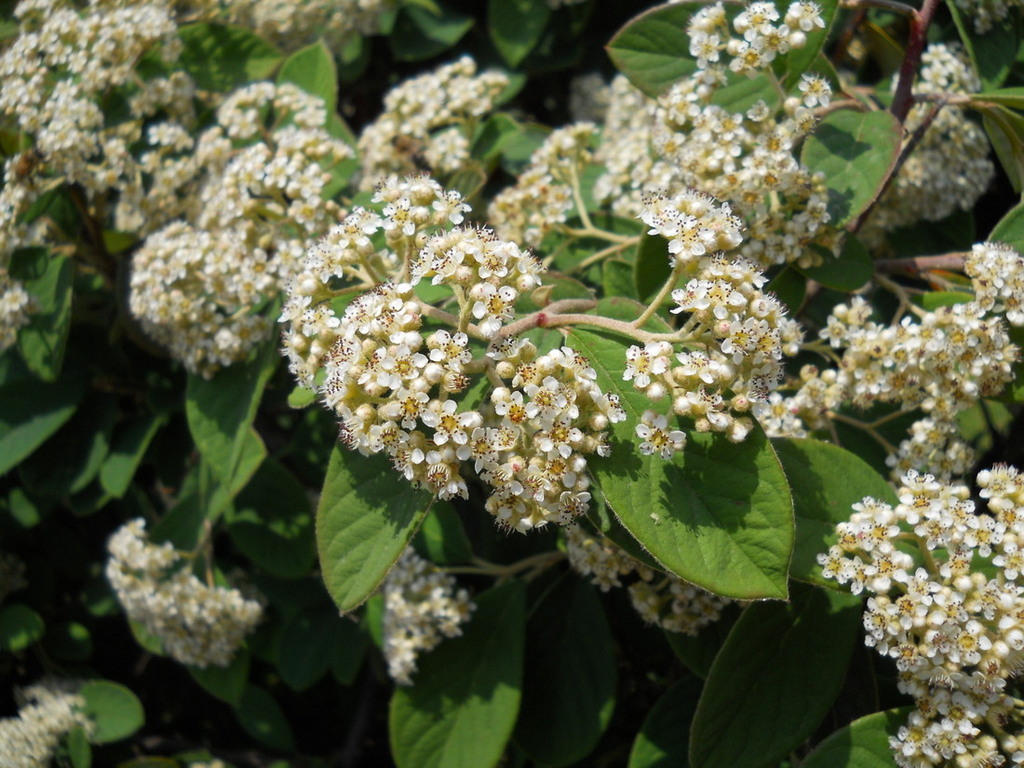
Flowers small, white with a red-pink margin at the edge, arranged 5-13 (31) in corymbiform inflorescences 2-2.5 (3) cm in diameter. Pedicels pubescent, 1-3 mm long; bracts lanceolate, 2-3 mm long, pubescent. Flowers 7-8 mm in diameter. Sepals triangular, 1-1.5 mm long and 1.5-2.5 mm wide, with acute apex. Petals small, 4-4.5 mm long and almost the same in width, erect, obovate, narrowed at the base and blunt at the apex. Stamens 20-22, they are shorter than the petals. Ovary pubescent at the apex. Styles 4-5, free, very short. Flowers in May-June.
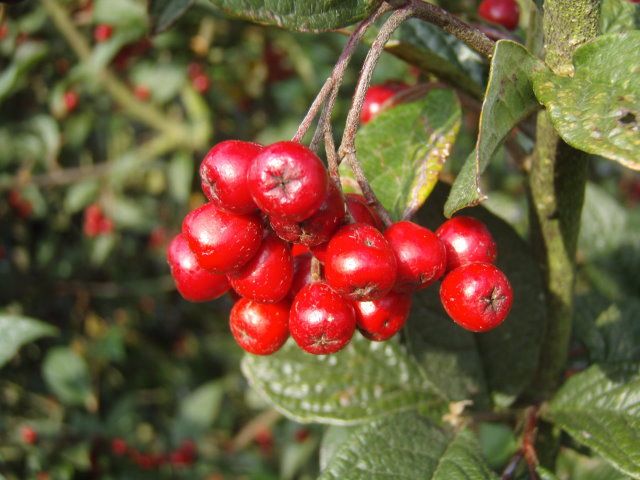
Fruits scarlet-red, globose or obovoid, 6-8 mm in diameter, borne several together in numerous clusters, with 4 or 5 stones. Fruits ripen in August-September.
Varieties:
- Cotoneaster bullatus var. bullatus
- Cotoneaster bullatus var. Floribundus (Stapf) L. T. Lu & A. R. Brach
- Cotoneaster bullatus var. macrophyllus Rehder & E. H. Wilson
Hardiness zone: zone 5 (-29°C).
Site: sun-loving, but tolerates light shade. Tolerates urban conditions well. Drought-tolerant. Prefers fresh, moist, slightly acidic to alkaline soil rich in nutrients.
Propagation: propagated by seed and vegetatively. Cuttings root poorly. Cuttings are taken in the second half of July. Substrate – peat and sand in equal proportions. Seeds require stratification.
Soil: prefers sandy, loamy-sandy, sandy-clay, loamy moderately moist soils. Optimal pH 5.5-7.5.
Planting: planting mix – compost consisting of topsoil, peat and sand in proportions 2:1:2. Planting should be carried out to a depth of at least 40-50 cm. Recommended spacing between plants – 1.5-2.4 m.
Care: in hot and dry summers to maintain ornamental value it is recommended to water the plant 1-2 times a month at a rate of 1-2 buckets per plant.
Pruning: tolerates clipping and pruning well. After pruning it regrows well while retaining its growth habit.
Diseases: Fusarium (remove and burn affected parts)
Pests: apple aphid, plum sawfly, cotoneaster mite.
Uses: Ornamental for its graceful spreading crown, unusual dark-green foliage, many small white flowers, autumn leaf coloration, and numerous scarlet-red fruits. Used for creating low and high hedges; also effective as a free-standing specimen, in compositions with other shrubs or perennials. Attracts bees, butterflies and birds to the garden.