
Fruit trees
Tibetan hazel
Corylus thibetica Batalin
Synonyms: Corylus ferox var. tibetica (Batalin) Franch., Corylus ferox Wall. var. thibetica (Batalin) Franchet, Tibetan hazel
Tibetan hazel – a variety of Himalayan hazel of the genus Corylus (Betulaceae). Naturally occurs in East Asia (in China in the provinces Gansu, Guizhou, Hubei, Ningxia, Shaanxi, Sichuan, Xizang, Yunnan) at altitudes of 1500-3600 m above sea level. Found in broad-leaved forests. Mesotherm, a moderately shade-tolerant mesophyte. Rarely used in cultivation, known in cultivation since 1897.
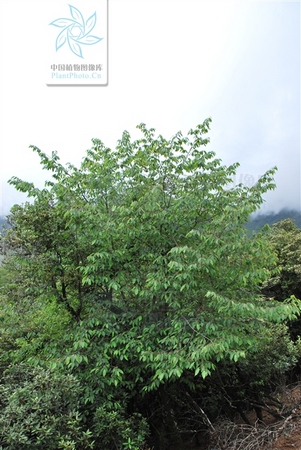
Represents a fast-growing tree or shrub up to 10 (20) m in height, the trunk reaches 30 cm in width. Crown rounded, spreading. At 19 years reaches 1.9 m in height and 210 in crown diameter. Vegetation occurs from late April until mid-October. Does not flower under conditions in Ukraine.
Bark gray or dark gray, fissured. Young shoots purple-brown, pubescent.
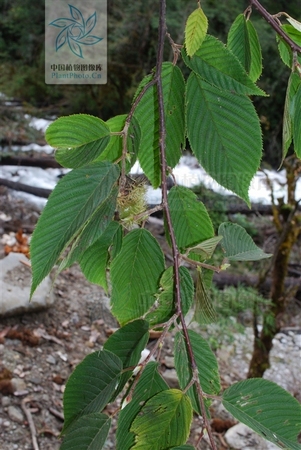
The leaf blade is narrowly ovate or oblong-ovate, 5-15 cm long and 3-9 cm wide, slightly rough, drawn out into a long acuminate tip, rounded or slightly cordate at the base, doubly finely serrate. Petioles reach 10-14 mm in length.
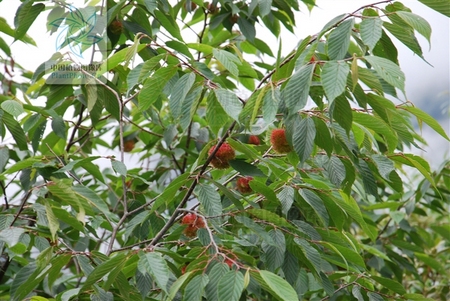
Flowers from May to June. Male catkins up to 2 cm long, with broadly ovate bracts and purple anthers. Female flowers grow 3-4 per bud, with bell-shaped bracts, densely pubescent.
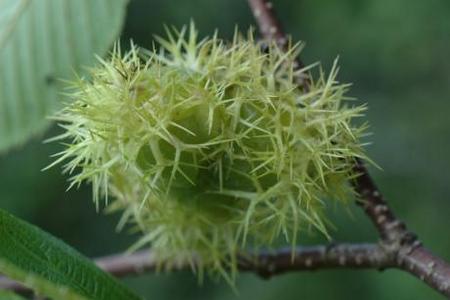
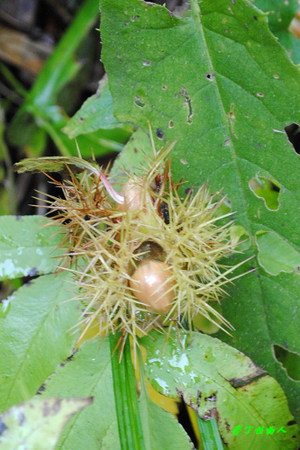
Fruits – edible ovoid-globose nuts 1-1.5 cm in diameter, with a pubescent apex. Involucre spiny, longer than the nut, deeply two-lobed, up to halfway divided into spiny pinnately branched lobes, ashy-velvety inside and out, green in color. Fruits ripen in September.
Hardiness zone: 8-10 (-10°C).
Location: Moisture-loving. Light-loving, but can also grow in shade. Prefers fresh, humus-rich soil. Does not tolerate waterlogging or saline soils.
Planting: Optimal seedling age – 2 years. Planting is best done in autumn. Size of the planting hole 50х60 cm. Into the hole pour 10-15 kg of humus, 200 g of superphosphate, 50 g of potash salt and mix with the top layer of fertile soil. Before planting, seedlings should be pruned back to 20-25 cm, and the roots dipped into a slurry of clay and manure. Distance between plants 4-5 m from each other, slightly closer in a hedge. For good pollination requires several pollinator cultivars.
Care: care consists of shallow loosening of the root circles and mulching (for example, with mown grass). Watering is recommended at least once every 2-3 weeks with 2-3 buckets per plant.
Pruning: should be carried out in early spring before the start of sap flow. Only sanitary pruning is required.
Propagation: the rooting rate of cuttings when treated with fiton for 16 hours is 20%.
Pests: hazel leaf beetle, nut weevil, hazel leaf-roller, bud mite, rodents.
Diseases: anthracnose, gray and fruit rot.
Uses: practically not used in landscape design. Grown for obtaining valuable nuts.