
Fruit trees
Beaked hazelnut
Corylus cornuta March.
Synonyms: Beaked hazelnut, beak-shaped hazel
Beaked hazelnut – a species of the genus Corylus (hazel) of the birch family (Betulaceae). Naturally grows in North America – practically throughout the United States and in southern Canada. Found among shrubs, on riverbanks, in shady canyons and on moist slopes where it forms thickets. Mesotherm and mesophyte. In cultivation in Europe since 1745, in North America – since the 18th century. Lives more than 55 years.
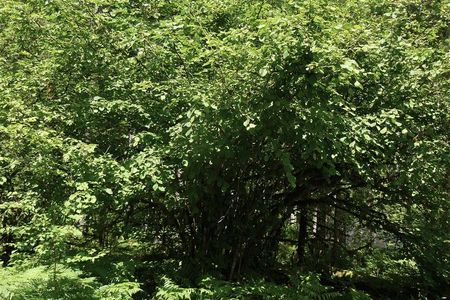
It is a multi-stemmed shrub 1-3 (6) m high and 3 (5) m wide. Grows quickly; at the age of 55 years it reaches 5.6 m in height with a spread of 5 m. Crown densely leaved, rounded. Shoots glabrous or slightly pubescent, without glandular hairs. One-year-old shoots brown, glabrous. Mature branches covered with lenticels.
Root system penetrates deeply into the soil, with a taproot and numerous fine roots.
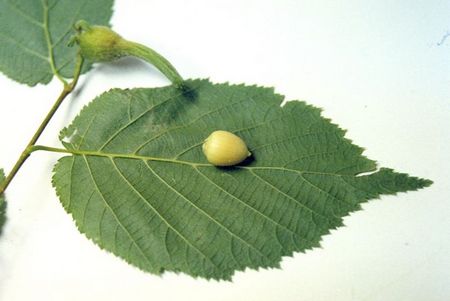
Leaves obovate or oval, slightly cordate at the base or rounded, 6-10 cm long, finely serrated, acute or acuminate, glabrous above, pubescent beneath along the veins. Petioles hairy, not glandular, 5-15 mm long. In autumn they turn yellow and yellow-orange.
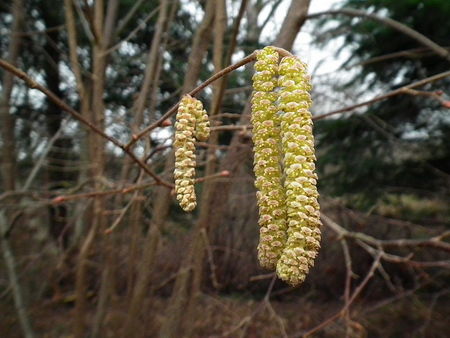
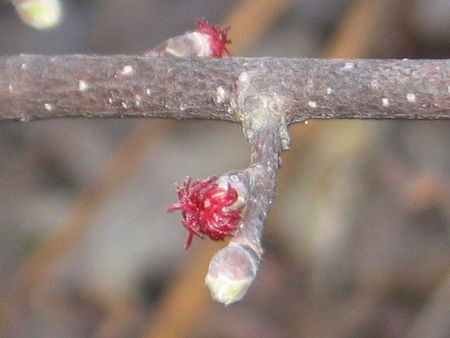
Flowers from late April to early May. The plant is monoecious. Male catkins yellow, 0.5-0.8 x 4.5-6 cm in length, grouped in twos, less often threes. Female flowers small, hidden in ovoid buds.
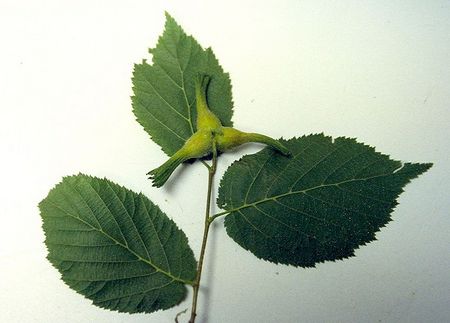
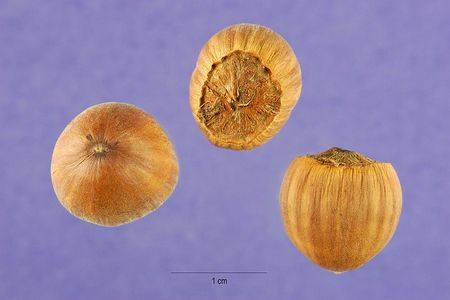
Fruits single or paired one-seeded nuts borne on a hairy peduncle. The involucre is tubular, entire, densely bristly-hairy, tightly envelops the nut and is distinctly drawn out into a narrow and longer (2-3 times longer than the nut) tube covered with dense pubescence. Externally the involucre resembles a horn, which gave the species its name. The nut is oval, ribbed, reaching 10-14 mm in length, has high taste qualities but is difficult to separate from the involucre and its bristly hairs. Fruits annually and abundantly from about 7 years. Fruits ripen in September.
Subspecies: Corylus cornuta subsp. Cornuta (synonyms: Corylus rostrata Aiton, Corylus rostrata Du Roi ex Steud., Corylus mexicana K.Koch, Corylus rostrata Dippel), Corylus cornuta subsp. californica (A.DC.) A.E.Murray (synonym: Corylus californica (A.DC.) A.Heller).
Hardiness zone: 4 (-28°C).
Location: Moisture-loving. Light-loving, but can also grow in shade. Prefers fresh, humus-rich soil. Does not tolerate waterlogging or saline soils.
Planting: Optimal seedling age is 2 years. Planting is best carried out in autumn. Planting hole size 50x60 cm. Put 10-15 kg of humus, 200 g of superphosphate, 50 g of potassium salt into the hole and mix with the top layer of fertile soil. Before planting, seedlings should be pruned to 20-25 cm, and the roots dipped in a clay-manure slurry. Distance between plants 4-5 m from each other, slightly denser in a hedge. For good pollination it needs several pollinator varieties.
Care: care consists of shallow loosening of the soil around the trunk, and mulching (for example, with mown grass). Watering is recommended during dry periods.
Pruning: should be carried out in early spring before the onset of sap flow. Only sanitary pruning is required.
Propagation: seed germination 35%. Cuttings root poorly. Produces abundant suckers from the stump. Can also be propagated by root suckers and layering.
Pests: hazel leaf beetle, nut weevil, hazel leaf roller, bud mite, rodents.
Diseases: anthracnose, gray rot and fruit rot.
Uses: used for obtaining valuable nuts. Widely used for ornamental purposes in amateur gardens and landscape plantings.