
Fruit trees
Chinese hazel
Corylus chinensis
Synonyms: Corylus chinensis Franch., Chinese nut, Chinese filbert
Chinese hazel – a species of deciduous shrubs of the genus Corylus (Corylus) in the family Betulaceae (Betulaceae). Mesotherm, mesophyte. In nature it grows in China in the provinces of Guizhou, Gansu, Hubei, Sichuan, Shaanxi, Yunnan, where it occurs in mountain forests at elevations of 1200-3500 m above sea level.
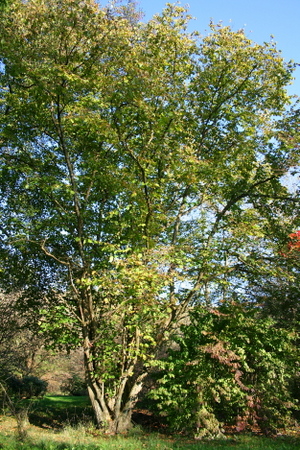
It appears as a tree 36-40 m tall. Annual increase 8-10 cm in height and 3-5 cm in width. Young shoots are bristly-hairy, purplish-brown. It is in leaf from late April until late September.
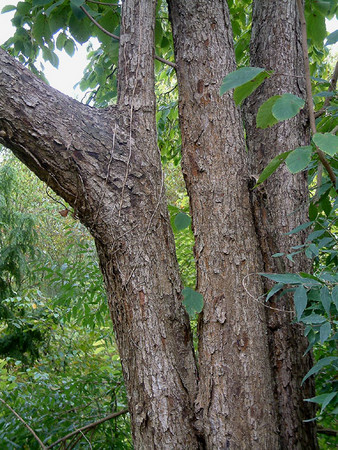
Bark on the trunk is gray-brown, fissured, peeling off in plates.
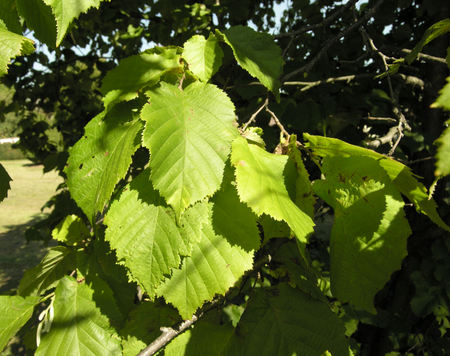
Leaves are large, oblong- and broadly-ovate, up to 8-18 cm long and 6-11 cm wide, cordate at the base and asymmetrical, finely doubly-toothed, acute, glabrous above, light green, paler beneath. They grow on bristly-pubescent petioles 6-20 mm long.
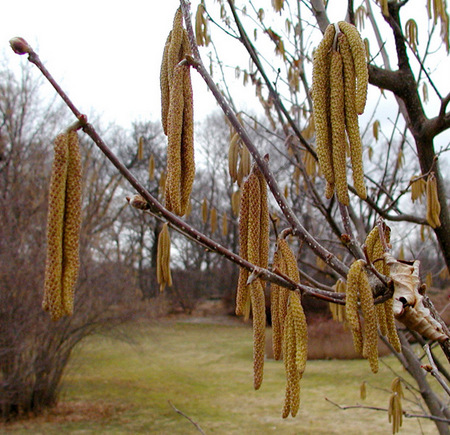
Flowers in late April. Male inflorescences are cylindrical catkins, 1.5-2 cm long, grouped 4-6 together. Bracts rhombic-ovate, cylindrical.
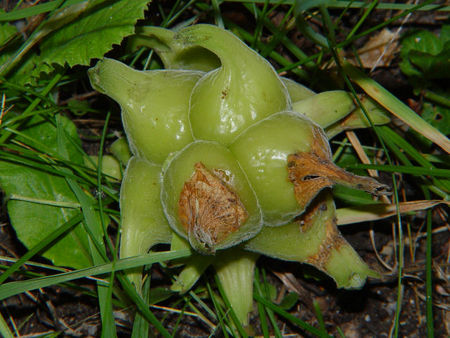
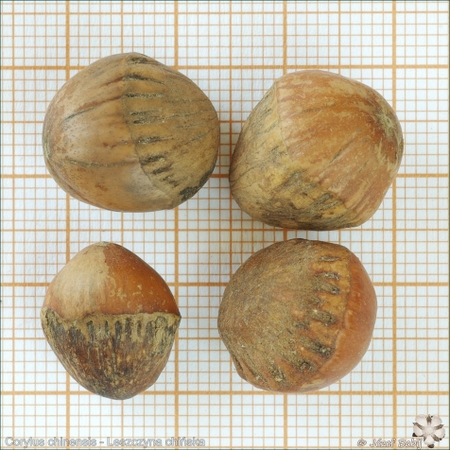
Fruits – small nuts, borne in groups of 4-6. The involucre is strongly grooved, constricted over the top and further divided above into forked, sickle-shaped curved, acute, toothed lobes. Nuts are ovoid-globose, 1-1.5 cm in diameter. Fruits ripen in October. Does not fruit under conditions in Ukraine.
Hardiness zone: 6-8 (-18°C).
Site: undemanding to soil and its moisture. Does not like very fertile, heavy, acidic or clayey soils. Grows well on alkaline soils. Shade-tolerant, but fruits poorly in shade.
Planting: Optimal seedling age is 2 years. Planting is best done in autumn. Planting hole size 50x60 cm. Into the hole add 10-15 kg of humus, 200 g superphosphate, 50 g potassium salt and mix with the top layer of fertile soil. Before planting seedlings should be pruned to 20-25 cm, and roots dipped in a clay-and-manure slurry. Distance between plants 4-5 m from each other, slightly closer in a hedge. For good pollination several pollinator cultivars are required.
Care: care consists of shallow loosening of the tree circle and mulching (for example, with mown grass). Watering is recommended during dry periods.
Pruning: should be carried out in early spring before the onset of sap flow. Only sanitary pruning is needed.
Propagation: cuttings root poorly. Seeds require stratification. For this they are first soaked in warm water for 48 hours, then kept in warmth for 2 weeks, after which they undergo 3-4 months of cold stratification. Germinates in 1-6 months at a temperature of 20 °C.
Pests: hazel leaf beetle, nut weevil, hazel leaf-roller, bud mite, rodents.
Diseases: anthracnose, gray rot and fruit rot.
Conservation status: protected in China.
Uses: planted for the production of valuable nuts. Attractive in solitary and group plantings. Can be used for creating hedges and in alleys, and for urban landscaping.