
Fruit trees
Common Hazel 'Contorta'
Corylus avellana Contorta
Synonyms: Hazelnut 'Contorta', Harry Lauder's Walking Stick, Contorted Filbert, Corkscrew Hazel, contorted European filbert, European hazel
Contorta common hazel – an exotic form of the common hazel. The form arose spontaneously in the early 1860s in Gloucestershire. The well-known Victorian gardener Canon Ellacombe noticed a bush among a common hazel hedge and propagated it for his friend Edward Augustus Bowles. The alternative name Harry Lauder's Walking Stick was given in honor of the Scottish comedian and singer Sir Harry Lauder (1870-1950), who always appeared at his performances with a crooked walking stick made from this tree.
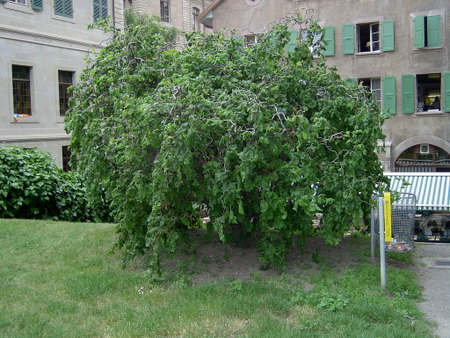
It is a small tree or shrub up to 1.5-2.5 (4.5) m in height and 1.5-2.5 m in width. The crown is dense, umbrella-shaped, and spreading. The plant is slow-growing. Annual growth reaches 25 cm in height and width. Shoots are very decorative, twisted and contorted, strongly interlaced. The root system is superficial, shallow, well developed, with a large number of fine roots.
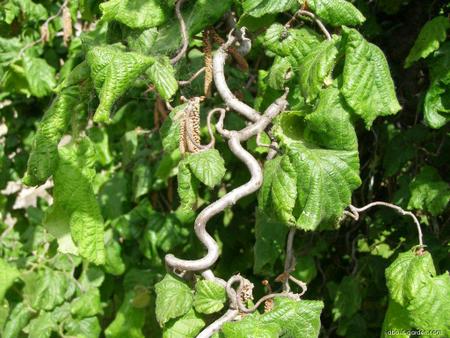
Leaves are asymmetric, slightly twisted, strongly wrinkled, up to 12 cm long, dark green, hairy along the veins. In early November the leaves change color to yellow or orange-yellow and fall at the end of the month.
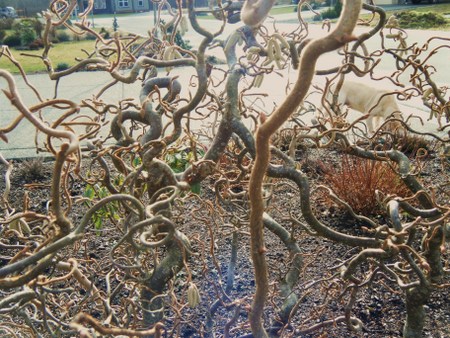
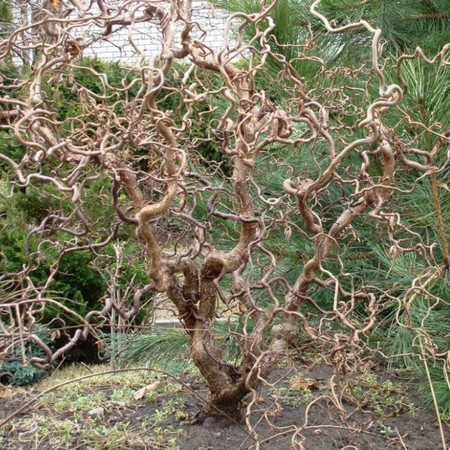
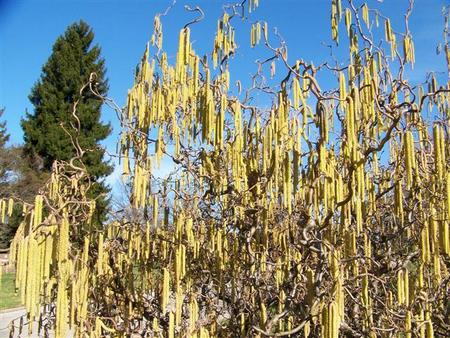
Flowers in early spring before leaf budburst (in April). The plant is monoecious (male and female flowers grow separately on the same plant). Male flowers are graceful pendulous yellow catkins that remain for some time after leaf fall. Female flowers are inconspicuous bud-like inflorescences, small and red in color.
Fruits rarely. The fruits are edible nuts of round or elongated shape. They ripen in September-October.
Hardiness zone: 4-8
Site: Tolerates shade but does not fruit in shade; prefers sunny and open locations. Does not like waterlogging. Sensitive to salinity and drought. Can grow on all soil types, from dry to moist and from slightly acidic to alkaline. Prefers fertile soil. Does not tolerate strongly acidic soils.
Planting: Best carried out in spring or early summer.
Care: Requires regular watering, especially during dry periods. In the second year after planting it can be fed with balanced fertilizers.
Pruning: Straight, normal shoots that appear should be removed. Pruning is carried out in late spring, leaving several of the most attractive branches. Rootstock suckers should also be removed.
Propagation: Propagated mainly by grafting, rarely by root suckers.
Uses: Looks good as a specimen and as part of small planting compositions in small gardens. Very decorative after leaf fall, during winter and in early spring before leaf budburst. Ideal for creating autumn graphic studies. Suitable companions include rhododendrons, Juniper 'Holger', early spring flowers such as pink and blue hellebores, white snowdrops, orange crocuses, Lungwort 'Leopard', and the poppy 'Patty's Plum'.