
Fruit trees
Common Hazel
Corylus avellana
Synonyms: hazel, filbert.
Common Hazel – a species of deciduous shrubs and trees of the genus Hazel (Corylus) of the birch family (Betulaceae). It is the type species for the genus.
Occurs naturally in Europe, the Caucasus and the Middle East. Widely cultivated. Grows in mixed, broadleaf and coniferous forests, where it appears as an understory and at forest edges. In the mountains of the Caucasus it rises to 2100-2300 m above sea level. In the steppe zone it grows in oak groves, along river or lake banks, in shrub thickets, as well as in steppe gullies and on hill slopes, where it coexists with blackthorn, single-seeded hawthorn, alder-leaved buckthorn, field and Tatar maples, common guelder-rose, wild rose and blood-red cornelian cherry. Can form pure thickets. In forestry it is considered a weed species because it actively produces root suckers.
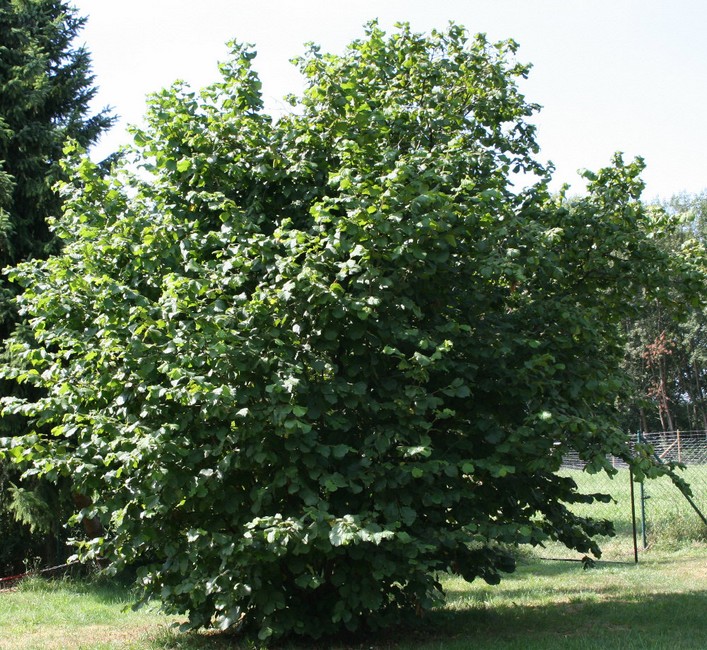
It is a shrub, less often a tree, 2-5 (7) m tall. Initially grows slowly, later faster. Crown is flat-globular or ovoid. Bark brownish-gray, smooth, transversely striped. Shoots brownish-gray, pubescent, glandular-hairy.
Lives up to 100 years.
Root system superficial, powerful. Initially a taproot develops; by the 3rd year strong, knotty roots form, as well as one longer and more powerful lateral root.
Buds rounded or ovoid, slightly compressed, appressed, up to 3 mm long, reddish-brown in color, glabrous, more rarely thinly pubescent, ciliate at the margins.
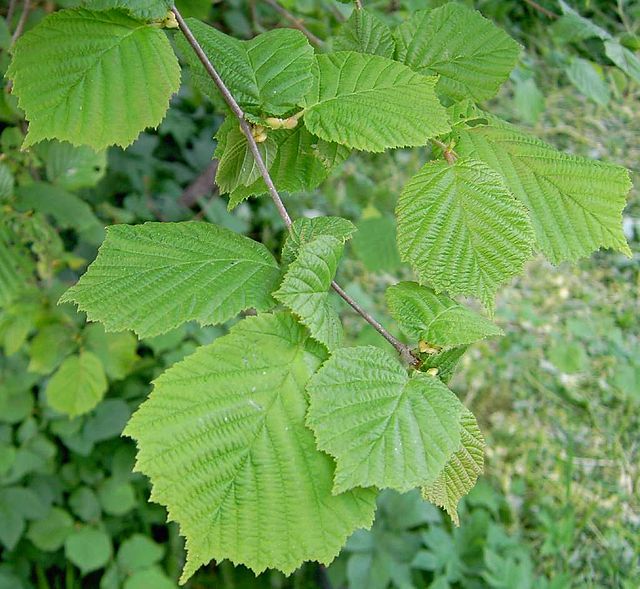
Leaves rounded, rounded-obovate, more rarely rounded-ovate or oval, 6-12 cm long and 5-9 cm wide, short-acuminate or narrowed to a tip at the apex, sometimes truncate with a marginal point, cordate at the base, irregularly doubly toothed with 5-6 lobate teeth on the upper part, dark green and matte above, green below. Young leaves are sparsely hairy, later glabrous above and hairy below, especially along the veins. Petioles short, 7-17 mm long, glandular-bristly. Stipules oblong-ovate, blunt, hairy, falling off early. In the south leaves unfold at the end of March, in the north in May.
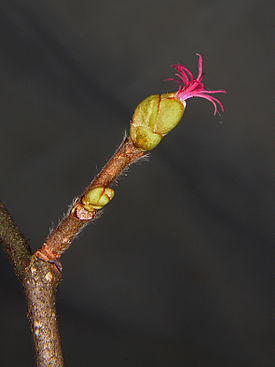
Male catkins reach 5 cm in length. Covering scales densely hairy. Anthers glabrous, topped with a tuft of hairs. Blooms before leafing, in February-April; this period is taken as the reference point in the phenological calendar of plant flowering.
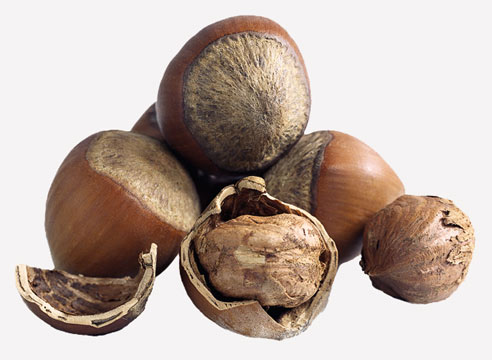
Fruits are grouped in 2-5 pieces, more rarely solitary. The fruit involucre is light green, velvety-hairy, broadly cup-shaped or bell-shaped, open or almost the same length as the nut, consisting of 2 irregularly divided lobed bracts.
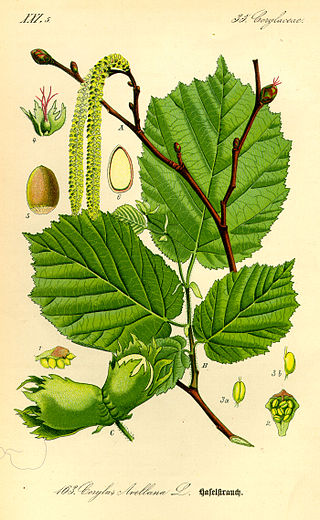
The nut is globose or oblong-globose, up to 18 mm long and 13-15 mm in diameter, from light to dark brown. Fruits in August-September. 1 kg = 870 fruits.
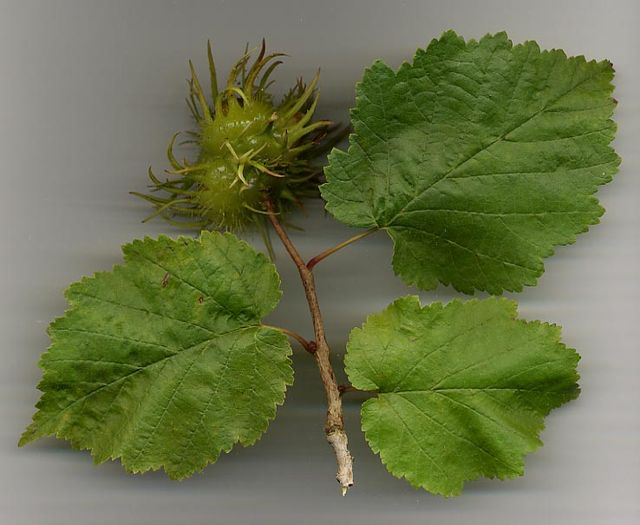
Average yield per 1 ha (600 shrubs) reaches 900 kg.
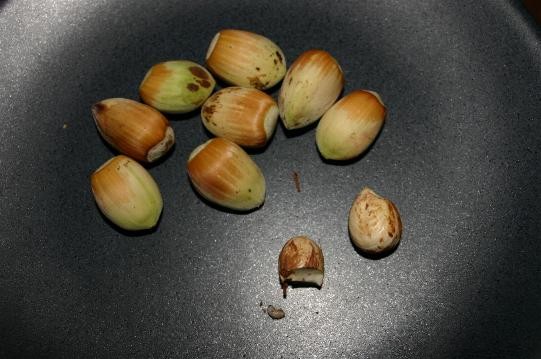
Varieties: Corylus avellana var. avellana, Corylus avellana var. pontica or Corylus imeretica — Lещина имеретинская
Forms: Corylus avellana f. pendula Goeschke, Corylus avellana f. albovariegata Schneid., Corylus avellana f. atropurpurea Petz & Kirchn., Corylus avellana f. aurea Petz & Kirchn., Corylus avellana f. aureomarginata Schneid., Corylus avellana f. laciniata Petz & Kirchn., Corylus avellana f. quercifolia Petz & Kirchn., Corylus avellana f. zimmermannii Hahne., Corylus avellana Contorta.
Hybrid cultivars: Hazel No.72a, Northern 42, Pervenets, Academician Yablokov, Hybrid No.468, Hybrid No.490, Ekaterina.
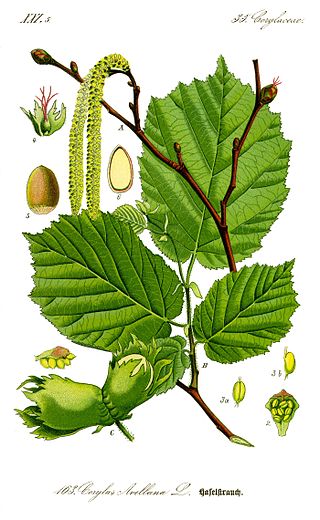
О.В.Томе Flora von Deutschland, Österreich und der Schweiz», 1885
Hardiness zone: 4-8
Location: Shade-tolerant, but does not fruit in shade; prefers sunny and open sites. Does not like waterlogging. Sensitive to salinity and drought. Can grow on all soil types, from dry to moist and from slightly acidic to alkaline. Prefers fertile soil. Does not tolerate strongly acidic [soils].
Planting: best carried out in spring or early summer.
Care: requires regular watering, especially during dry periods. In the second year after planting it can be fertilized with complex fertilizers.
Pruning: tolerates trimming and pruning well.
Propagation: propagated by root suckers, layering, cuttings and seeds. Seed germination – 50%. Cuttings root poorly.
Uses: Used in parks or forest parks as understory. Planted at forest edges and for protective shelterbelts. Can be used to create hedges and to decorate or stabilize slopes. Cultivated as a nut-bearing plant. Nuts are used in confectionery and the food industry – halva, oil, chocolate, candies are made from them. From dried nuts a nutritious flour is obtained, from raw nuts – milk. Wood is used to make bent wicker products – furniture, baskets, hoops, walking sticks. Charcoal from it is used for hunting powder and drawing pencils. Sawdust is used to clarify vinegar and to refine cloudy and coarse wines. Bark can be used for tanning leather. In early spring it provides a large amount of pollen that can be harvested for winter bee feed.