Flowers for the garden
Corydalis
Corydalis
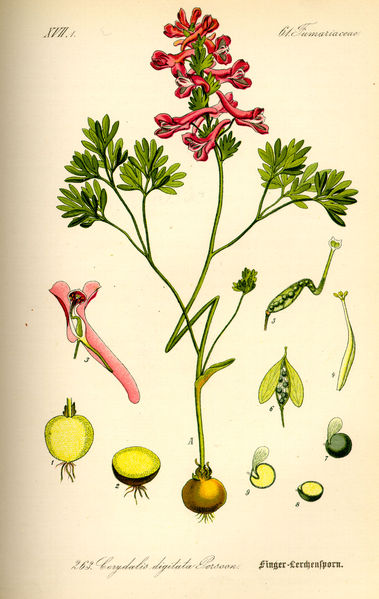
Corydalis (lat. Corydalis) — a genus of herbaceous plants of the fumitory family (Fumariaceae), widespread in the temperate regions of the entire Northern Hemisphere. The genus includes about three hundred species.
The Latin name of the genus comes from the Greek word 'cons' — helmet, after the shape of the flower. The folk name "khokhlatka" also, apparently, refers to the whimsical shape of the flower.
Members of the genus are mostly perennial plants, but annuals also occur. Thanks to tuberous thickening of the root that stores nutrients, corydalis can sprout in early spring.
Leaves are fern-like, bi- or tripinnate.
Inflorescences are racemose or single flowers on long peduncles. The upper petal has a sharply pronounced spur in which nectar accumulates. The fruit is a dry pod-like capsule.
Ants play an active role in seed dispersal.
The following species are used in ornamental gardening and landscaping:
Corydalis solida — Corydalis solida (L.) Clairv.
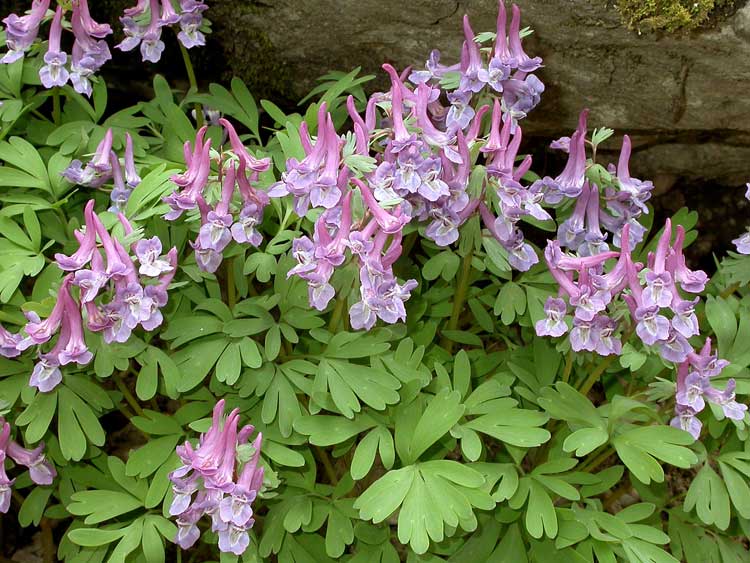
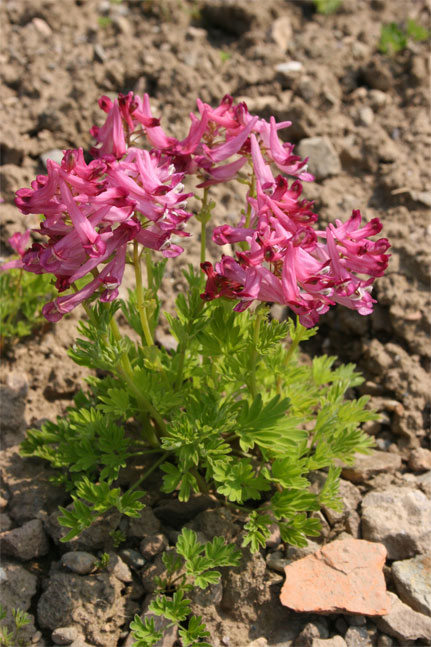
A perennial plant with a small tuber up to 1.5 cm in diameter, with a scale-like leaf at the base of the stem, in the axil of which a shoot develops. The stem reaches 10-25 cm in height; leaves are petiolate with bi- or triply ternate leaflets.
Flowers are small, fragrant, pink-violet, gathered in a dense racemose inflorescence. The capsule is oblong, 10-12 mm long, pendulous. Flowers in April-May; seeds ripen in May. Hardy in winter without cover.
Corydalis cava, or bulbous corydalis — Corydalis cava = Corydalis bulbosa
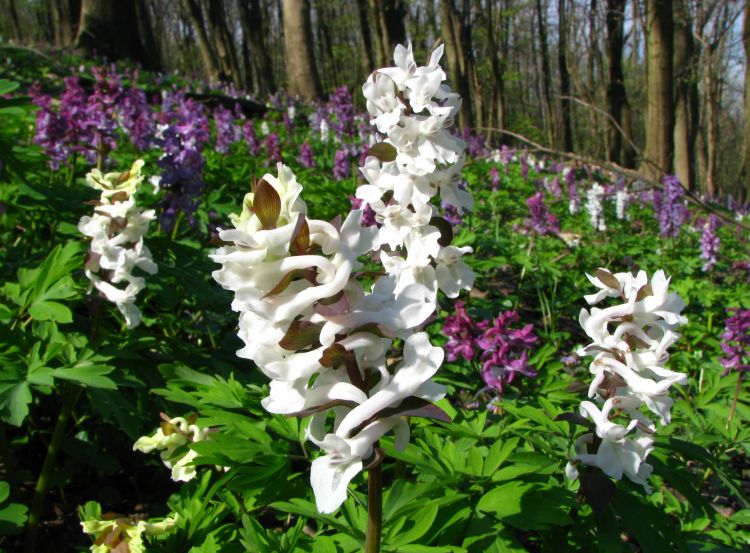
A perennial plant with a large globular tuber. The stem reaches no more than 40 cm in height. Leaves two, bi- or triply ternate; leaf segments on long petiolules. The flower raceme on a long peduncle is cylindrical. Flowers are dark violet, violet-pink, or white. Flowers in late April-May; seeds ripen in late May–early June.
Corydalis bracteata — Corydalis bracteata (Steph.) Pers.
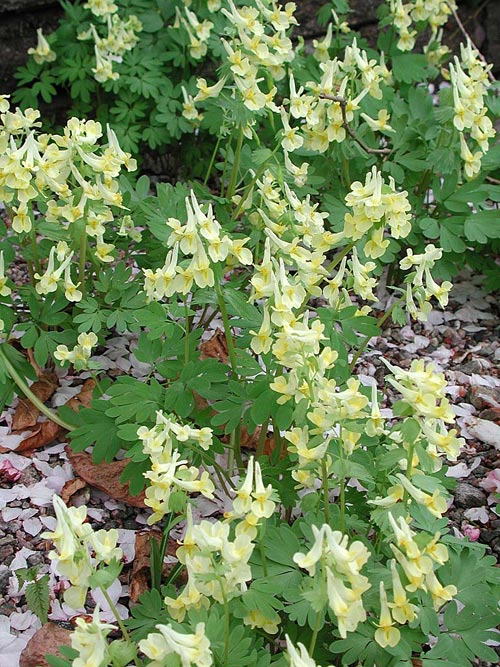
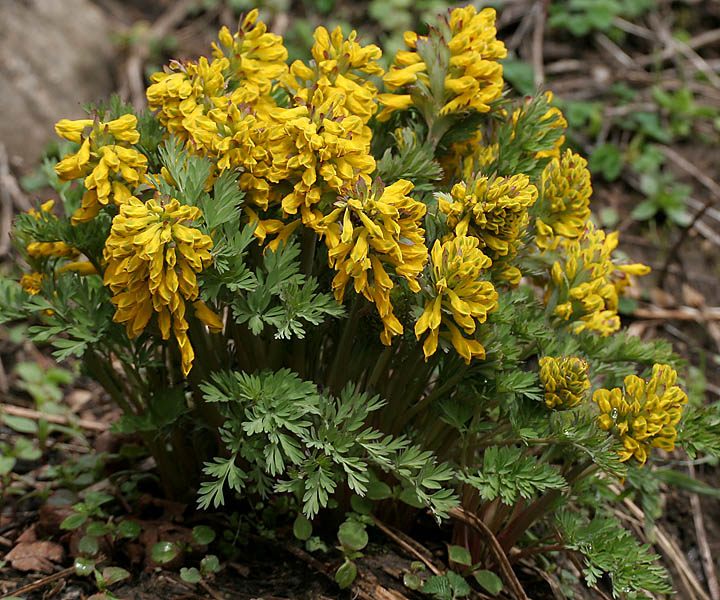
A perennial plant with a globose or flattened tuber. Stems are delicate, erect, up to 30 cm tall. Leaves are glaucous-green, bi- or triply ternate, usually two or three leaves. Flowers bright yellow up to 2 cm long, with large green bracts, gathered in a terminal racemose inflorescence up to 5 cm long. Blooms profusely in early May. Fruit is an inflated capsule. Seeds shiny, black. The plant can self-seed abundantly. In cultivation since 1874. Hardy in winter without cover.
Corydalis ambigua — Corydalis ambigua
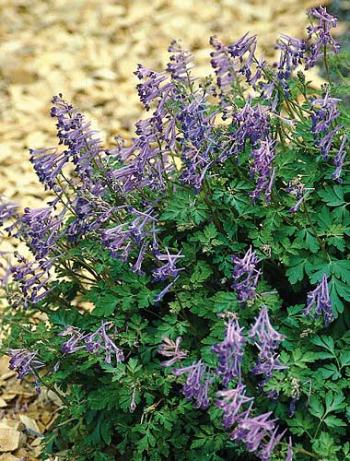
A small plant with bluish-lilac flowers and beautifully divided delicate leaves. When it spreads, it forms bright blue carpets.
A perennial plant with a tuberous root. The stem reaches no more than 20 cm in height. Leaves 2, occasionally 3(4). Leaves are bi-ternate, glaucous, at first greenish-brown when unfolding, and vary considerably in shape. Inflorescence is a loose few-flowered raceme up to 10-15 cm long. Blooms from late April to the end of May for about three weeks. Seeds ripen in late May. Self-seeding occurs. Vegetation ends in late May–June.
Location: requires a sheltered site, grows well under the crowns of trees and shrubs. Not demanding to soils, but prefers loose, organic-rich soils. Does not tolerate waterlogging.
Care: requires no special care. If necessary, fertilizer can be applied in spring while the plant is in active growth.
Propagation: exclusively by freshly collected seeds. Germination is lost after a month. Sowing sites should not dry out completely, otherwise the young plants will die.