
Herbs
Cortaderia
Cortaderia
Synonyms: pampas grass
Cortaderia (Cortaderia Stapf.) ) – a genus of perennial herbaceous plants in the grass family (Gramíneae). The genus name comes from the Spanish «cortar» — «to cut» because of the sharp-pointed leaves. The genus was first described in 1897 by the Australian botanist Otto Stapf in his «The Gardeners' Chronicle: a weekly illustrated journal of horticulture and allied subjects. ser. 3 22(570): 378, 396». In cultivation since the mid-19th century.
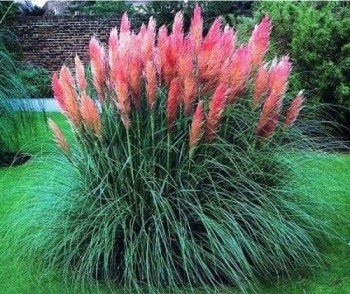
Its distribution includes South America, New Zealand and New Guinea. It occurs in steppe zones.
It is a dioecious perennial herbaceous plant with a fibrous root system, forming very large, dense clumps. It reaches 2-3 m in height. There are several stems; they are erect, sturdy and tall.
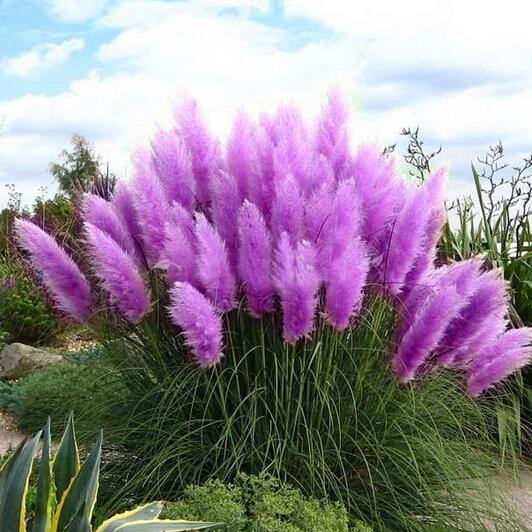
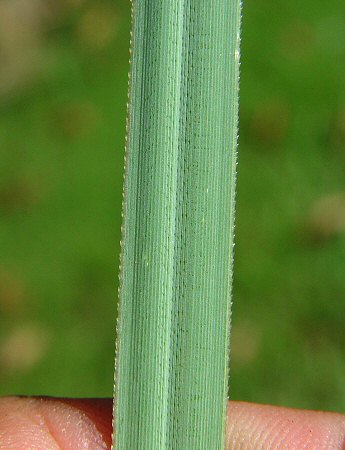
Leaves are rolled at the base into a large, dense rosette, linear, erect and arching towards the top, spreading, very long, can reach the length of the stem, sharp, rigid, glaucous, rough or sharply toothed along the margin and the midrib.
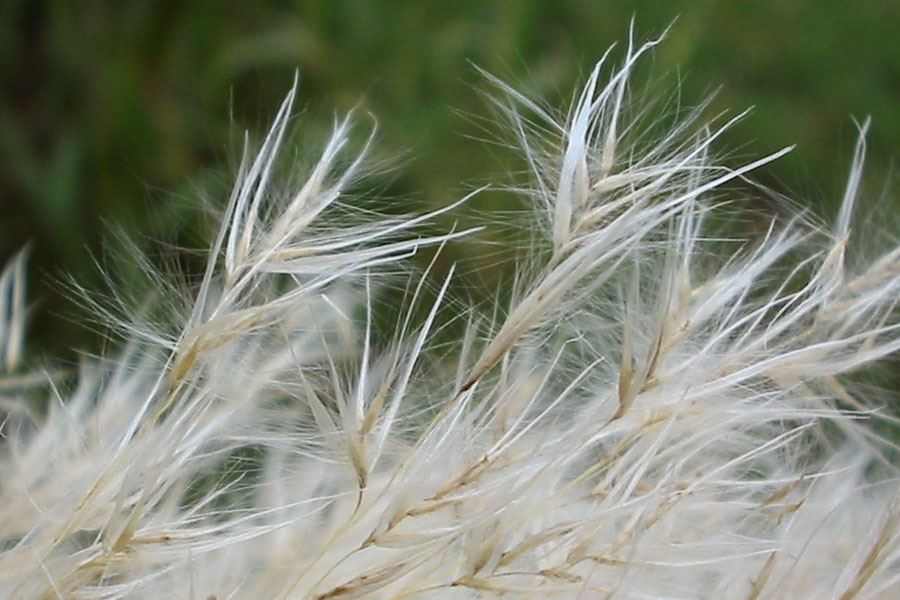
Spikelets are gathered into large, terminal, dense, plume-like, oblong or pyramidal compound panicle inflorescences up to 60 cm long, numerous, pistillate or staminate, many-flowered, ranging from silvery-white to pale-pink or golden-yellow. The rachis of the spikelets at the base of the flower bears more or less long hairs. Female plants are distinguished by larger, more decorative panicles, and by the fact that the lower floral scales are also densely covered with long, silky, shiny hairs.
Species: the genus includes 25 species. In ornamental horticulture used
Cortaderia selloana (Schult. & Schult.f.) Asch. & Graebn. — pampas grass, or dioecious Cortaderia, Cortaderia selloana
Hardiness: 5a (-23°C). Needs reliable winter protection.
Location: requires well-worked and relatively fertile loams or sandy loam soils. Drought-tolerant and heat-loving. Planted in partial shade; less decorative in bright sun. Moisture-loving.
Planting: planting is done in spring.
Care: requires practically no care.
Pruning: spent inflorescences and dry leaves are cut off in spring, as they retain their decorative appearance for a long time.
Propagation: propagated by seeds, which are sown in spring, and by division of the clump.
Pests and diseases: practically unaffected
Uses: can be planted in containers, which can be used to decorate patios. Looks spectacular on pond edges, on terraces, on lawns as an ornamental specimen, at woodland edges, in flower beds away from paths. Inflorescences are used fresh and dried for cutting. It is an important component of landscape design in parks and gardens. In cultivation only female plants are used.